








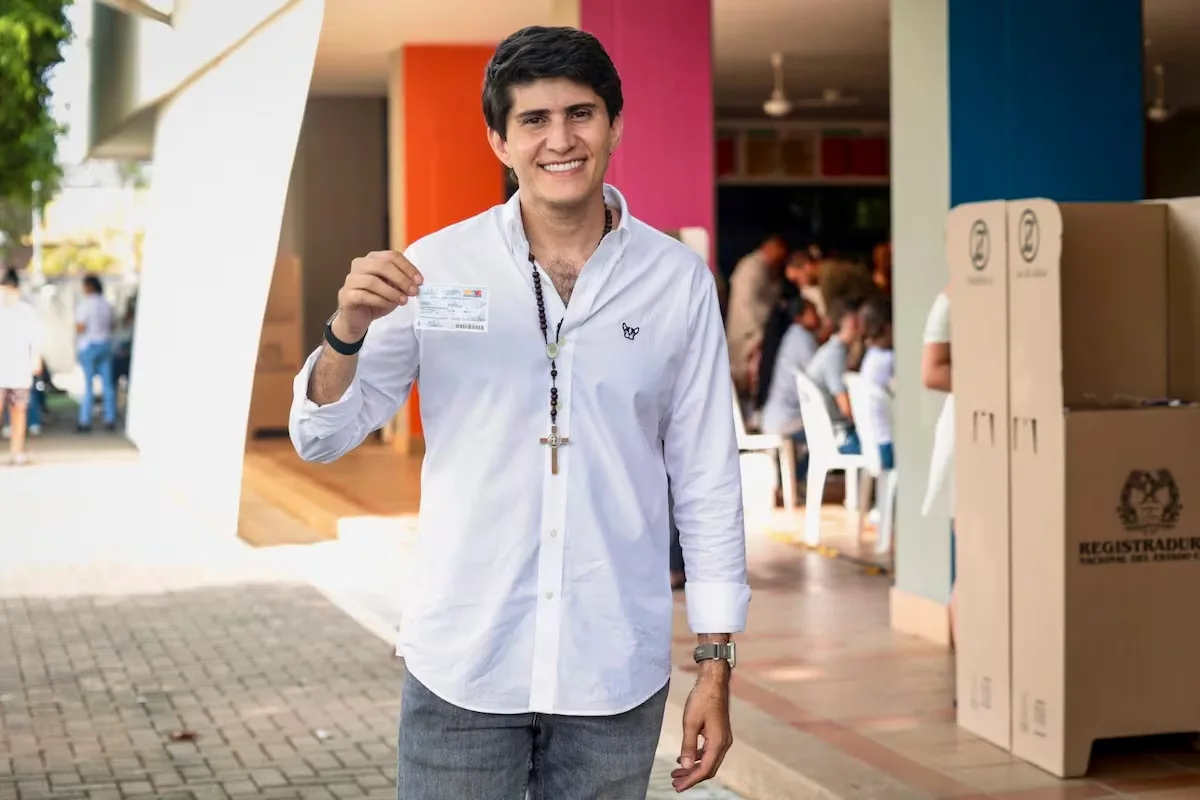
Conservative politician Wadith Manzur has been detained since March 12 due to the corruption scandal involving the National Unit for Disaster Risk Management (UNGRD). Just four days earlier, on March 8, he had swept the Senate elections: 135,000 votes, the third highest vote count in his party and the seventh in the country. His request to take office from prison put the upper chamber at a crossroads. “It is not easy,” acknowledged the new president of Congress, Honorio Henríquez, on Tuesday. The decision, ultimately, was to reject the request. Legislative authorities argued, in a resolution released this Wednesday, that the rules do not contemplate the possibility of taking the oath remotely. The Council of State, they noted, will have to determine if this implies the loss of office due to the expiration of the deadline to take possession of the position.
Manzur is 39 years old and is from Montería (Córdoba). He is the son of former senator Julio Manzur, who has submitted to the Special Jurisdiction for Peace (JEP) for alleged links with paramilitaries. He was elected to the House of Representatives in 2018 and renewed his position in 2022. In the last legislative period, he was one of the conservatives who distanced himself from the party leadership and supported the projects of Gustavo Petro’s government. The justice system accuses him of approving, as a member of the Public Credit Commission, the Executive’s indebtedness in exchange for million-dollar contracts financed by the UNGRD. His actions, according to investigations, were part of a larger scheme that involved buying congressmen with public funds to approve the government’s bills.
His lawyers submitted a request to the Supreme Court on March 27 for Manzur to take his oath from prison. The main concern, they explained, was that not doing so would imply the loss of his seat: the law establishes that parliamentarians have a maximum period of eight days after the installation of the new Congress (July 20) to take office. They argued that he has not yet been declared guilty, that he enjoys the presumption of innocence, and that denying him the possibility of swearing in remotely could translate into “the total annulment of the essential content of the political rights” of the leader and his 135,000 voters. They clarified on Monday that the intention was not for Manzur to legislate from prison, but to take office and then be suspended to ensure that, if released, he can exercise his position.
The Senate General Secretariat, to which the Supreme Court referred the request, prevented Manzur from assuming his seat with a procedural argument. It responded that there is no rule allowing an alternative mechanism to the in-person oath in Congress. The Constitution, it explained, states that the Legislature has a single seat. It also explained that a 2024 law enables the use of technological tools in sessions, but that it does so for specific legislative tasks, such as approving laws, and not for “the solemnity” of taking office.
The authorities avoided commenting on whether this decision implies the loss of Manzur’s office. The Senate Secretary General pointed out that the law contemplates a cause of “force majeure” as an exception to the rule of taking office within eight days, but that the Council of State is the competent authority to define whether being in prison falls into that category. However, he recalled that there is jurisprudence from the Constitutional Court and the Council of State establishing that being detained is a valid reason. He cited the case of former guerrilla Seuxis Pausias Hernández, alias Jesús Santrich, who took possession of his seat several months after the start of his term and exercised it until he took up arms again.
Beyond legalities, the possibility that Manzur takes office and eventually exercises his position has caused rejection among his colleagues. “Let him defend himself WITHOUT POLITICAL POWER. He is not welcome here,” wrote congresswoman Jennifer Pedraza of Dignity and Commitment on X on Tuesday. Something similar was said this Wednesday by senator María Lucía Villalba: “I support the Senate’s decision (…). Regaining citizens’ trust requires acting rigorously, respecting due process, and sending a clear message against corruption.”
A dozen congressmen from the last legislative period are implicated in the UNGRD case. Only three refrained from running for re-election in the March legislative elections. Six decided to run. Of them, four were elected: Manzur, Martha Peralta (Historic Pact), Juan Loreto Gómez (Conservative), and Karen Manrique (victims’ seat). The latter has also been unable to take office due to being detained. Both she and Manzur insist they are innocent and that they only processed projects in favor of their municipalities and not for themselves. “The only thing they question me for is having done a management for the municipality of Cotorra. A project that did not exist, not a penny was lost there (…) we are all under investigation, but they have targeted the biggest coward,” said the Córdoba politician.
The UNGRD scheme is the biggest corruption scandal of Gustavo Petro’s government. In addition to the congressmen already mentioned, former presidents of the Senate, Iván Name, and the House of Representatives, Andrés Calle, are also detained. In the Executive branch, Luis Fernando Velasco, former Minister of the Interior, is still deprived of liberty. Carlos Ramón González, former director of the Administrative Department of the Presidency and mastermind of the criminal plan according to the Prosecutor’s Office, is a fugitive in Nicaragua.
Read more The Watchtower sweeps the ashes of the fire and faces the looting