








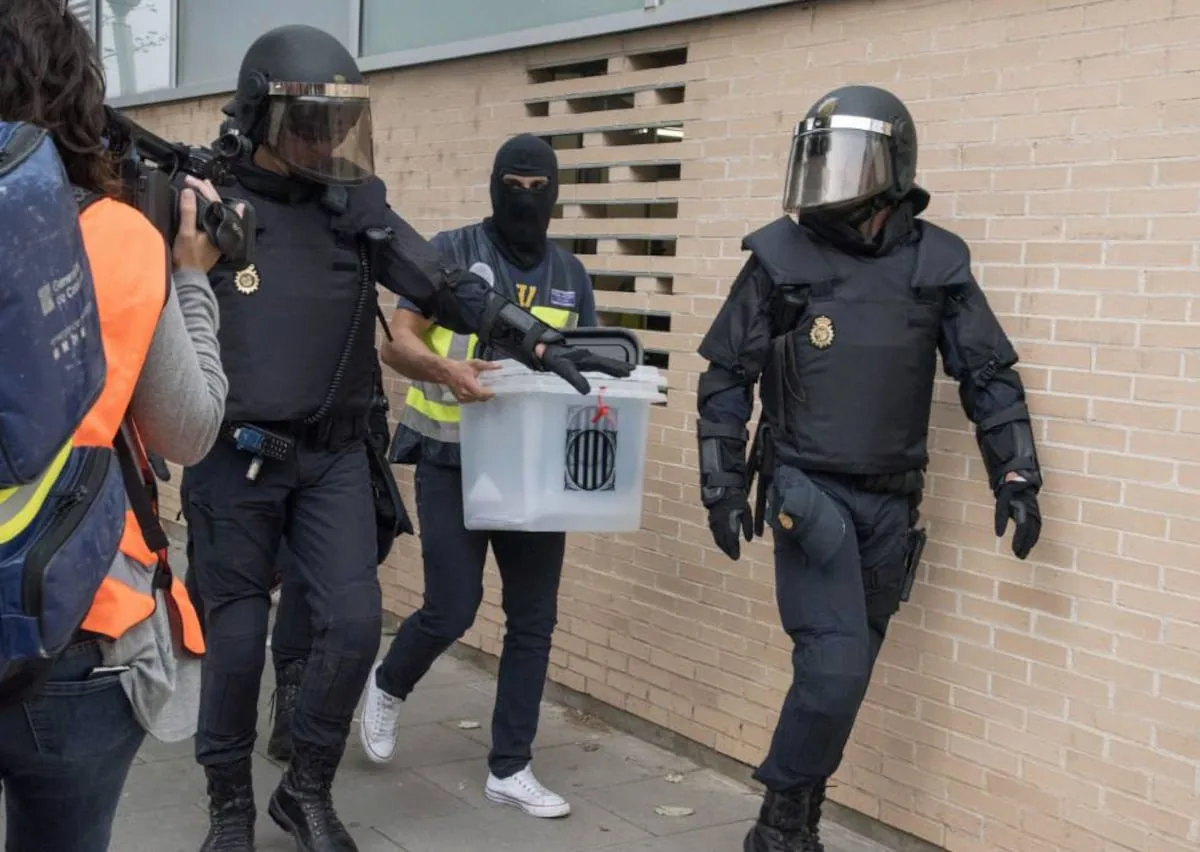
Almost seven years after the sentence that convicted nine leaders of the procés for sedition, the Supreme Court has authorized the Mossos d’Esquadra to destroy the material seized during the independence referendum of October 1, 2017, which served as evidence in the investigation and in the trial held two years later. In a resolution accessed by EL PAÍS, the court that judged the procés gives the green light to the Mossos to dispose of the ballot boxes, ballots, envelopes, records, and other objects and documents collected by the agents, but urges them to keep “one or two samples” of each piece of evidence and send it to the Supreme Court headquarters for safekeeping.
The decision of the high court comes following a letter sent to the Criminal Chamber by the Directorate General of Police of the Generalitat, in which it requested permission from the judges to destroy the material seized during the day of the referendum that gave rise to the judicial case that ended with prison sentences for the former vice president of the Generalitat of Catalonia, Oriol Junqueras; the former president of the Parliament Carme Forcadell, five other members of the Government, and the leaders of the ANC and Òmnium. The opening of that case is also the one that resulted from the departure from Spain of the former president Carles Puigdemont, whom the Supreme Court keeps prosecuted in absentia.
In the resolution of the Criminal Chamber, dated April 14, the judges establish that the destruction must take place in the presence of a lawyer from the Administration of Justice (the former judicial secretaries), who must draw up a report and, once completed, send it to the high court, along with the samples that have not been destroyed, “to be kept in the premises” of the Supreme Court. The Supreme Court order is signed by five of the seven magistrates who judged the procés who are currently active: Andrés Martínez Arrieta, Juan Ramón Berdugo, Manuel Marchena, Antonio del Moral, and Andrés Palomo.
Read more Teenager shot in Badajoz while playing at a school
The material seized by the Mossos on 1-O is currently stored in the warehouses of the different police regions, but the destruction must be centralized at the central headquarters of the Catalan police, in Sabadell. The Supreme Court urges sending everything there so that, once transferred, the lawyer of the Administration of Justice of the Civil and Criminal Chamber of the High Court of Justice of Catalonia (TSJC) is notified. For this, the Supreme Court has agreed to process a request for judicial cooperation to the regional court.
The actions of the Mossos during the election day were heavily criticized by the then government, led by Mariano Rajoy, and the highest official of the Catalan police, Josep Lluis Trapero, was even tried along with Superintendent Teresa Laplana, former director of the Corps Pere Soler, and former Secretary General of the Interior of the Generalitat César Puig, but all were acquitted.
Read more Worker at senior centers arrested in Valencia for stealing jewelry and money from elderly people