









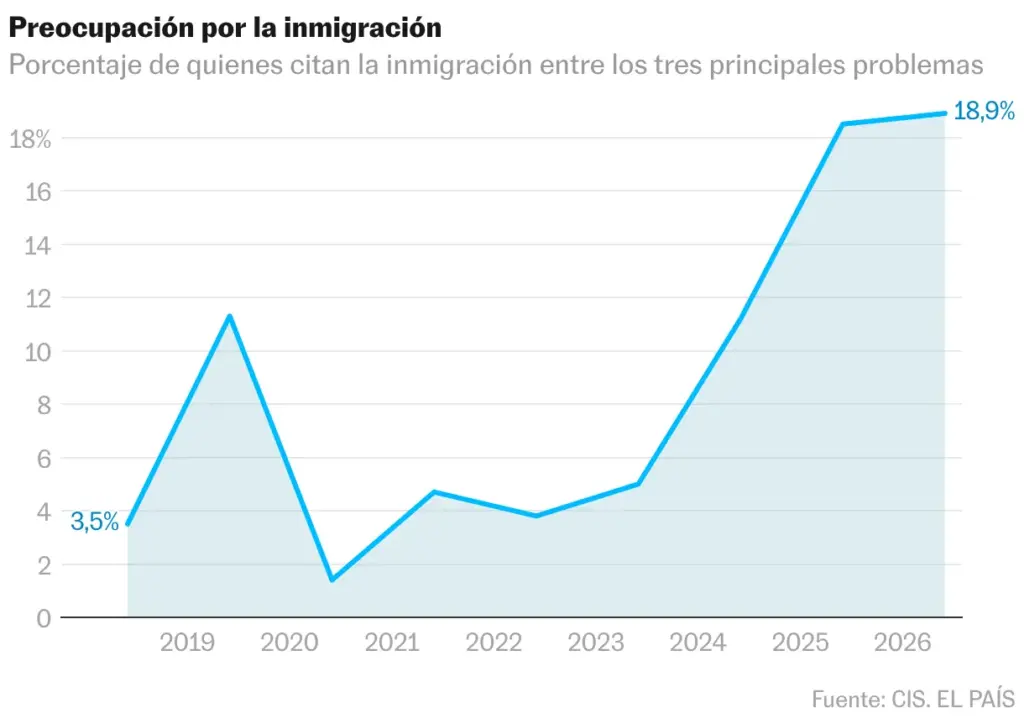
Assisting the 630 immigrants on the Aquarius, the drifting ship that Spain was going to receive, was a “humanitarian” issue, solemnly stated the Galician president, Alberto Núñez Feijóo, who even offered his land to host shipwreck survivors. It was June 2018. Almost no one knew what a “mena” was. The “national priority” was a marginal idea. The xenophobic far right had not yet burst into the institutions. Immigration was the twelfth problem in the country, cited among the three most serious by 3.5%.
Read more Zelenski dismisses the Prime Minister of Ukraine less than a year after her appointment
Today Feijóo, who already in 2025 referred to the Aquarius as “a ship full of illegal immigration,” presides over the PP, which has made its own both the rejection of the “menas,” accepting an acronym as derogatory as already known to refer to “unaccompanied foreign minors,” and the principle of “national priority” in social aid. It has done so alongside Vox, Spain’s third party and rising by hammering against immigration, an issue that has quintupled the percentage of those who place it on the podium of national problems, now three tenths away from being the second most serious.
And all this while a year passes since the racist riots in Torre Pacheco (Murcia), which led many to wonder if Spain is as far as is usually said from the level of social tension around immigration in the United Kingdom or France.
What has happened in these eight years? A xenophobic spiral has been unleashed, with the fundamental but not sole impetus of Vox, which permeates politics, is transmitted to public opinion, boils on social networks, and reaches the streets. “Everything is connected. Political speeches: the content on social networks and social reactivity,” says immigration expert Ruth Ferrero, professor of Political Science at the Complutense University.
A social worker in Cádiz, born in Larache (Morocco), 27 years old, who arrived in Spain at eight years old in the undercarriage of a truck, Mohamed El Harrak suffers the vicious circle firsthand. “An unbearable atmosphere is being created. The hate speech already reaches the neighbor, the baker… I have seen how even among boys and girls studying social integration the false idea of the immigrant with privileges takes hold,” he laments.
Drag and legitimization
The spiral has a political aspect that materializes in pacts between the PP and Vox, agreements by which “a traditional right in an identity crisis buys the frameworks of an unashamed far right,” in summary by Italian historian Steven Forti, author of Far Right 2.0 (Siglo XXI, 2021), who emphasizes that it is a European-scale phenomenon.
Since its emergence in Andalusia in December 2018, Vox drags the PP into increasingly high concessions up to its latest peak in this year’s pacts in Extremadura, Aragón, Castilla y León, and Andalusia, the toughest. If all share the “national priority,” the fixation against the “menas” — including the verification of their age, put under suspicion —, the suppression of aid to pro-immigration NGOs, the ban on the burka and niqab in public spaces, and the elimination of the Arabic Language and Moroccan Culture program, the one signed in Andalusia adds an “audit” of the “health cost derived from care for foreigners.”

The growing coincidence between the PP and Vox reaches their local governments, with measures such as the veto on Muslim prayer in public spaces in Jumilla (Murcia). It also affects a less binding but decisive domain in politics: language. If in 2024 Feijóo was already calling to vote for the PP in Catalonia to prevent “illegal immigration from occupying our homes,” his lieutenant Miguel Tellado demanded the deployment of the Army on the African coast. These are not isolated comments. They are part of the identification of immigration as a security problem that has settled in the PP, which also approaches Vox through “feminationalist” rhetoric, assigning Muslims the role of threat to women and homosexuals.
Normalization and growth
Accepting so many premises of Vox, has the PP managed to appease it? No. If in the 2023 general elections it achieved 12.4%, its current polling average is around 17%. Also, it is the only party that has risen in the last four regional elections. And there are reasons to think it advances not despite the PP buying its merchandise, but because of it. This is indicated by Does adaptation work?, a study on party strategies and vote transfers in twelve European countries published in 2022 by Cambridge that concluded that when centrist parties imitate the far right, the latter tend to benefit.
“When the far right pressures with radical ideas and the center-right accepts them, those ideas normalize more quickly. The reason is that moderate forces have a greater capacity to legitimize positions. If they assume extremist stances, not only those who already defended them reaffirm themselves, but a part of those who saw them as unacceptable stop seeing them that way. So the far right is the main beneficiary. This has happened in multiple European countries and is happening in Spain,” summarizes Portuguese political scientist Vicente Valentim, professor at the Instituto de Empresa, author of The normalization of the far right (Oxford, 2024).
The mentioned “normalization” of Vox’s ideas is already reflected in a better position than the PP when the right-wing dispute takes place in the field of immigration. A May survey by 40dB. detects that only 1.4% of Vox voters prefer the PP’s position on immigration; however, about 22% of those who supported Feijóo identify more with Santiago Abascal’s stance.
Result? Vox has no incentives to stop. And yes to double down. It is the next wave of the spiral.
The infinite bidding
No matter how much the PP concedes, Abascal finds ways to continue presenting himself as the firmest anti-immigration force before a public opinion accustomed to progressively hardened rhetoric. If the PP already links immigration and insecurity, Vox directly presents foreigners as murderers and rapists, spreading videos that associate them with machetes and guns, easily crossing the line of cruelty, insult — “moros” — and threats. If the PP has incorporated the expression “call effect,” Vox talks about “invasion.” If the PP opposes the Government’s mass regularization, Vox does so invoking the great replacement theory. If the PP falls short in its denunciation of dirty electoral play with the grandchildren law, Vox elevates it to a “coup d’état.” If the PP has accepted “national priority,” Vox already talks about “remigration.”
The escalation does not stop at Vox, pressured by even harder forces. While Sílvia Orriols (Aliança Catalana) ridicules Vox for not being as tough on Latin Americans as on Africans, Alvise Pérez (Se Acabó la Fiesta) argues that “national priority” is a “deception” that “changes nothing.” In turn, a constellation of classic far-right forces like Democracia Nacional and new youth agitation groups like Núcleo Nacional — already constituted as a party —, Revuelta, and Frontera have settled into xenophobia with appeals to a “white” us. Under that pressure, Vox has made an approach to the European white supremacist movement.
Read more France considers Rajoy’s article on the French team «racist» and «unacceptable»
The pattern already seen in France, Italy, Hungary, or Nordic countries repeats. With the debate on immigration and identity already skewed to the right, new entrepreneurs present themselves as even tougher (sometimes successfully, sometimes not). In Spain, these groups benefit from the fact that immigration has been politically “taboo” for decades, leaving a “wasteland of ideas” that the far right now exploits, explains Ruth Ferrero, immigration expert, who points to ways to break the vicious circle: a firm argumentative opposition from progressives and conservatives to xenophobic theses and “greater social spending” that reduces the “perception” of “competition” with immigrants for state aid.
Harsh views
The spiral unfolds its effects on public opinion. Although it is not at its peak — it exceeded 30% in 2024 —, the percentage of those who cite immigration as one of the three main problems tends to rise, as seen by comparing CIS data from each June since 2018.
But it is not just concern. In 2024, amid a political scandal over the distribution of unaccompanied foreign minors arriving in the Canary Islands, almost 75% of Spaniards associated immigration with negative concepts, according to 40dB. At the end of 2025, the year Spain recorded the largest drop in immigrant arrivals since 2019, Ipsos showed that this was the country among the thirty studied where the most (79%) thought the flow would rise in 2026. In the first half of the year, arrivals have dropped by 32%. But the discourse of the “call effect” and the “invasion” takes hold. However, not equally across society. Opinions are marked by party adherence, as shown by two May surveys from CIS and 40dB. There is polarization. The more right-wing the voter, the harsher the positions.
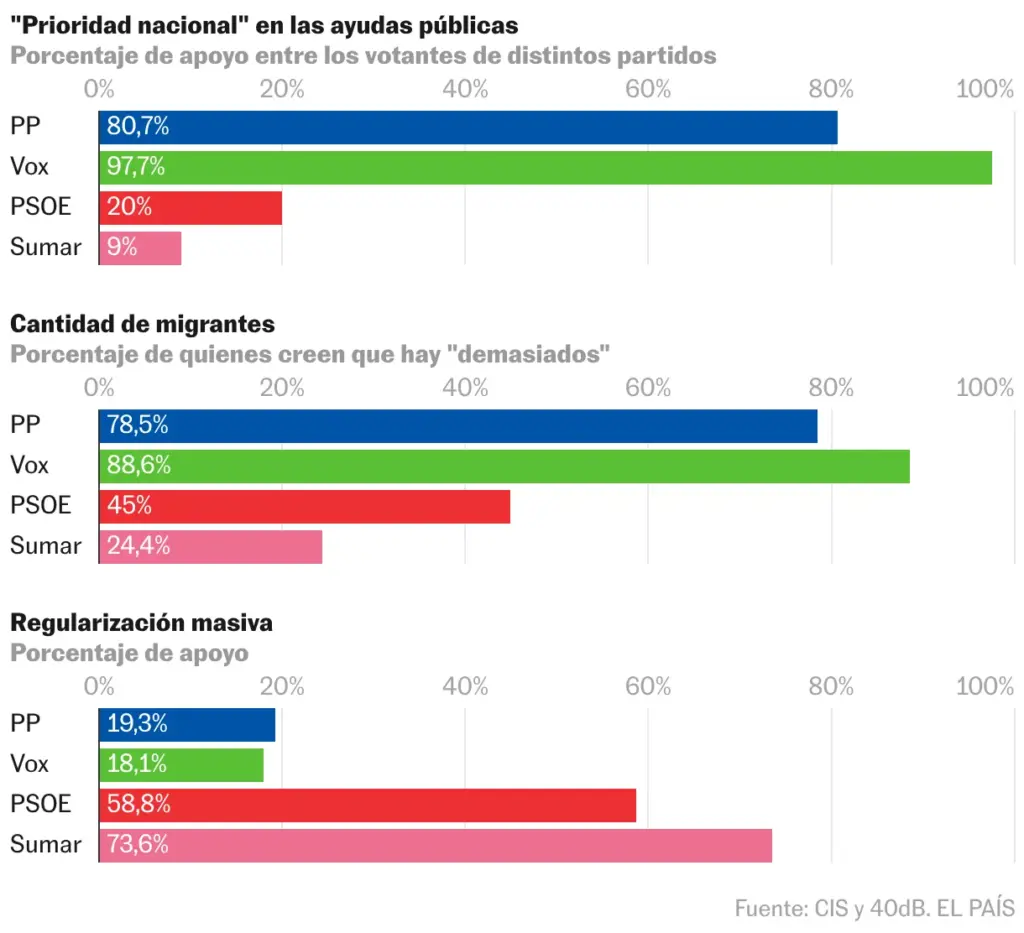
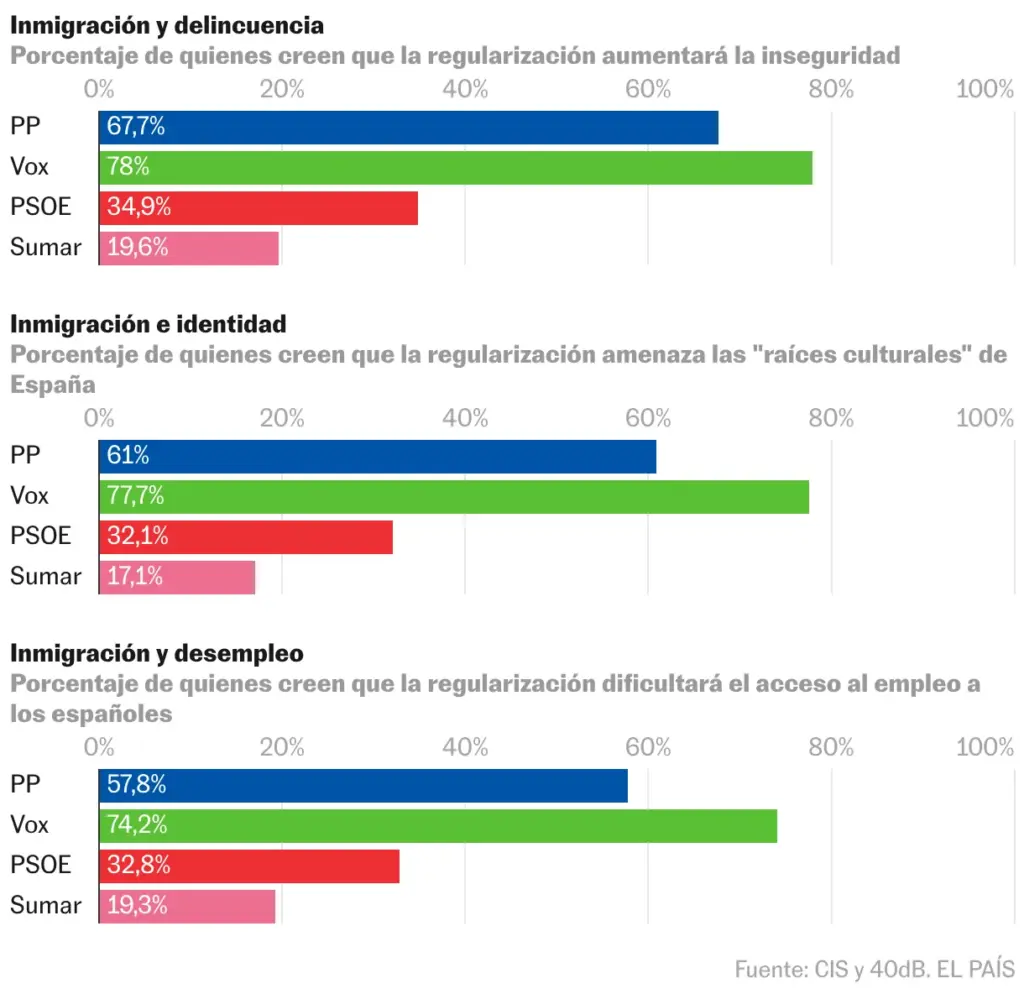
With such opinion data in the conservative electorate, deactivating the anti-immigration bidding seems complicated.
Digital brutality
With algorithms that reward extremist content, social networks stand out in brutality even with the already unleashed political rhetoric. What would be excessive even for Vox in conventional formats, passes on social networks. One example. On a walk down the street, Vox’s Agenda España spokesperson, Isabel Pérez, struck up a conversation with some teenagers. “The moors,” one boy told her, are the ones who “steal.” She told them: “Vote for Vox when you turn 18.” The party shared the video with the sequence on Instagram along with the message: “The kids have it clear.”
View this post on Instagram
In an environment where such virulent content validated by a whole governing party circulates with little control, hate is common currency. Since January 1, 2025, the Government’s Observatory of Racism and Xenophobia (Oberaxe) has detected more than a million hate messages. “I evangelize the Moor with a slap,” “all Latinos with machetes,” or “we are paying rapists” are just three examples collected in the last two monthly bulletins.
Another sign of the connection between political belligerence and hate discharge, the main recipients of the messages noted by Oberaxe coincide with the main target of the anti-immigration discourse: those originating from majority Muslim countries.
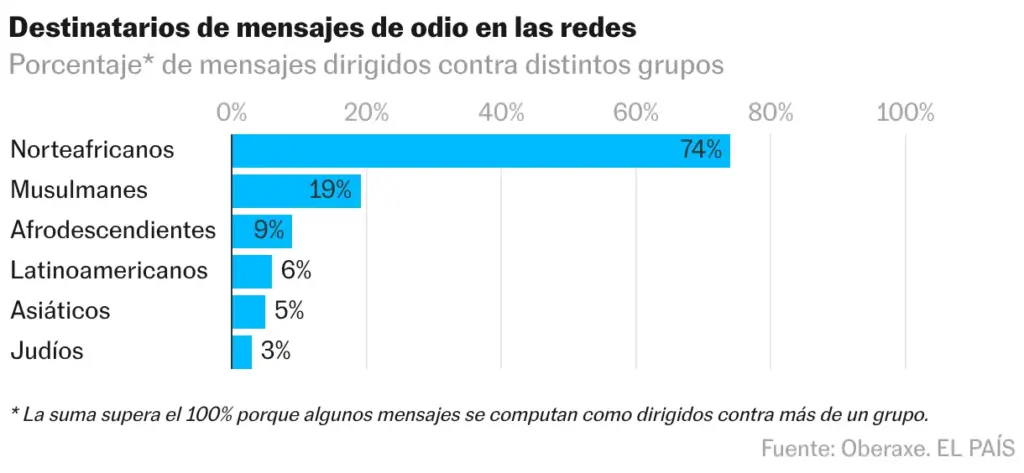
It is a constant flood, which does not fall on deaf ears. From the academic field, Vicente Valentim describes two effects, coauthor with Daniel Ziblatt — one of the authors of the popular essay How Democracies Die — of the article How dominant politicians erode norms (Cambridge, 2025): “First, networks facilitate the spread of extremist messages. As a result, many who might think certain ideas are unacceptable see from their mobile that many think that way. It is an effect similar to that of central forces when they legitimize radical theses. If by accepting the PP the ‘national priority’ already gains legitimacy, that many accounts amplify this message gives it even more.”
Mohamed El Harrak, spokesperson for the ExMenas association, also talks about its effects, turning the derogatory nickname around to raise awareness about the experience of those who arrive with nothing. “Opening Instagram affects self-esteem,” he says from Cádiz. “Many end up believing the discourse that labels them as delinquents, ashamed of their origins, their customs…”
Hate reaches the street
In this context of heated political debate and absence of red lines on social networks, “hate crimes and incidents” with xenophobic motives reached their maximum in 2025 in a series that begins in 2013. And the vast majority of those detected by police forces, 92%, occur in the physical world.
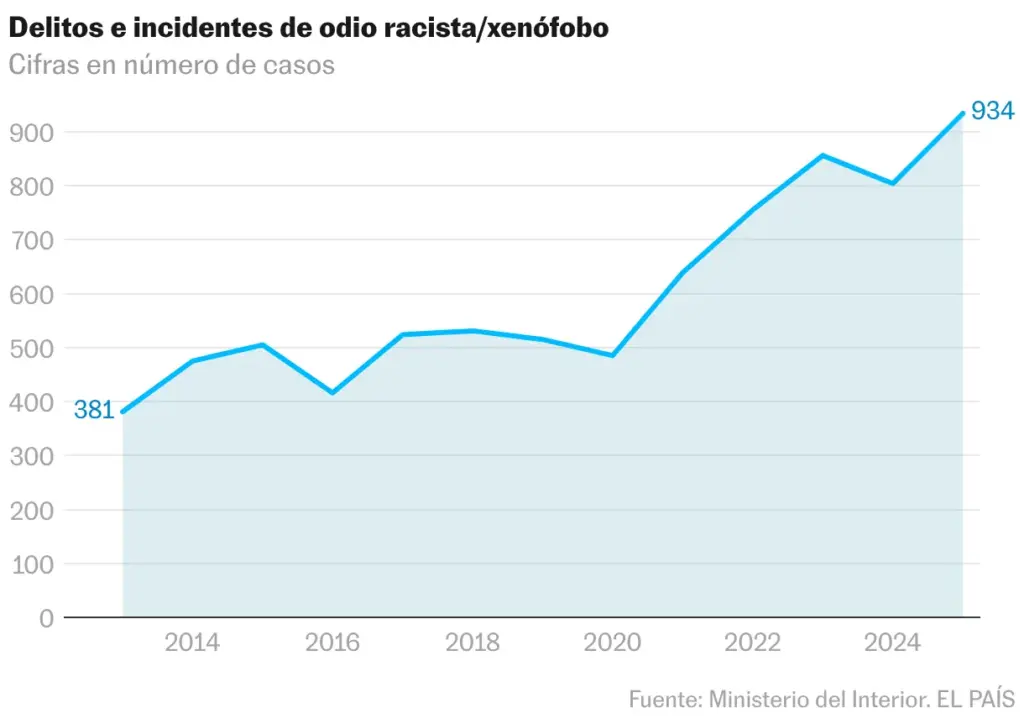
The director of Oberaxe, Tomás Fernández, a Civil Guard commander, has no doubts: digital hate cannot be isolated from what happens on the street, including racist riots. “By crossing the databases of online speeches with police records, it is seen that a significant increase in hate on social networks in week X correlates with a rise in incidents in week X plus one,” explains the coauthor of the article From online hate speech to offline hate crimes (Nature, 2024). Oberaxe’s report on the riots in Torre Pacheco also shows an unusually high production of hate messages before and during the outbreak.

Beyond the impact of social networks, Valentim emphasizes the one caused by the “normalization of the far right,” a phrase that gives its name to his book, in which he certifies, after analyzing thirty countries, a relationship between electoral support for the far right and the number of demonstrations of this ideology. “Normalization does not stay in conversations, it has effects on real behaviors, protests, or even violence,” he states.
In Almería, working on the street with immigration, activist Nadia Azougagh, a 41-year-old naturalized Moroccan, is worried. She recently saw some black kids being scolded for playing football on a public court. “You could hear things like ‘they are occupying our space.’ Before, the typical thing would have been a certain paternalism, like ‘look at the black kids playing.’ The atmosphere is changing,” she says. And she laments that she herself, every time there is news of a crime, has started reacting by looking at the suspect’s nationality. Why? Because if it is an immigrant, she becomes alert. It could be “the fuse for this to ignite,” she says. In her memory is the 2025 Torre Pacheco, but also the 2000 El Ejido. “This is a pressure cooker,” she states.