







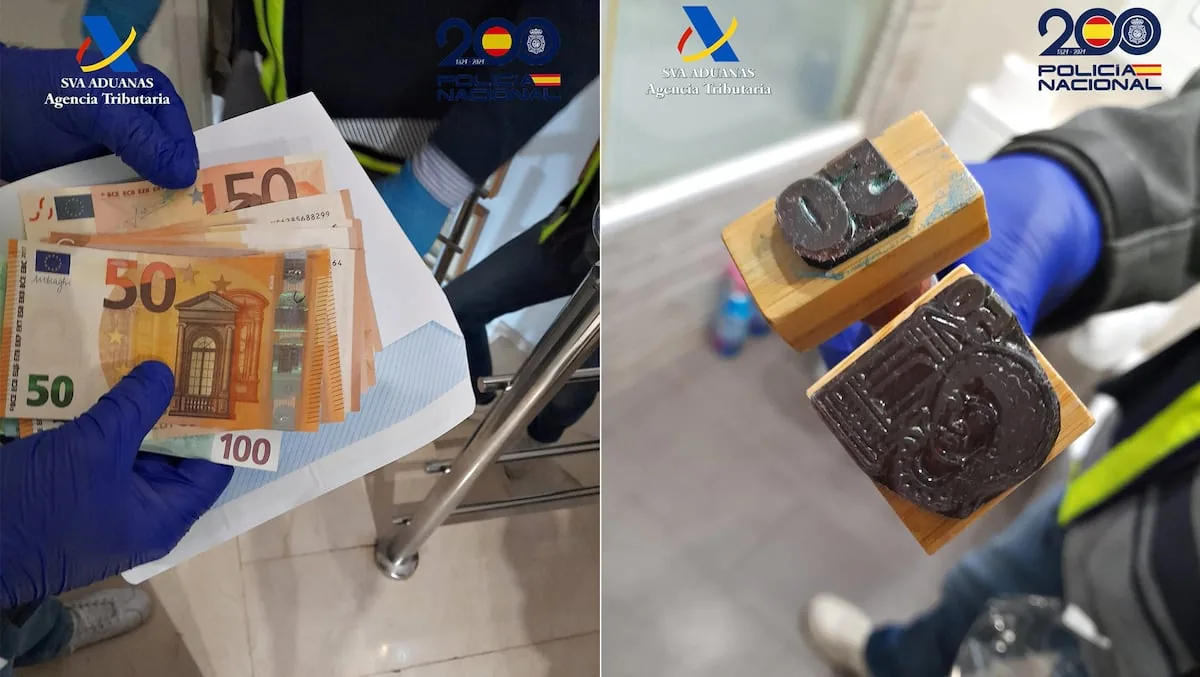
He was an intelligent, perfectionist young man with higher education, and he decided to start counterfeiting 20, 50, and 100 euro bills at his home in Málaga. He opened a page on the Dark Web, a hidden part of the Internet that does not appear in common search engines, and began to have success. In just two years, it is estimated that he sent more than 500 orders by mail to customers in 20 countries who rated his services with excellent reviews. The young man, under 25 years old, was arrested by the Police last March 3 in the capital of the Costa del Sol, according to this police force’s report on Wednesday. At his home, they seized 30,000 euros in counterfeit bills and cryptocurrencies worth close to 150,000 euros.
The young man, with no criminal record, led a relatively orderly life. He did not show off or make unnecessary expenses, something investigators had seen in other similar cases. He lived the normal life of a boy his age, despite the service he offered from his home. “His clients knew they were buying counterfeits (…) He was well regarded, had good customer ratings,” police sources indicate. “Better quality, higher price,” these sources add, without specifying his rates. “The 50 euro bill can cost 20 euros, but if it is better, the price goes up,” they estimate. The arrested man demanded payment in cryptocurrencies, specifically Monero, one of the most used virtual currencies that offers great privacy in payments, making it difficult to trace. He also used different names to send the orders.
The arrest of this young man in Málaga highlights the change happening in currency counterfeiting. It has gone from counterfeiters working with offset printing presses, which use metal plates and rubber rollers to transfer ink to paper, to others “more artisanal,” who buy or order everything needed from Chinese companies, from paper with security threads to rubber stamps to imitate the watermark. The level of “perfectionism” that the arrested counterfeiter in Málaga imposed on himself was such that he ordered “two metal pieces” to perforate the security window that 20 and 50 euro bills have and then place a type of aluminum foil that simulated this feature.
Read more The Supreme Court changes United States election rules with a decision that limits minority rights
The Bank of Spain Brigade of the National Police began investigating this case last October. Shortly after, the Austrian Police alerted them that they had detected one of the young counterfeiter’s clients in Málaga. In the investigation, besides the Austrian Police, the Tax Agency and Europol (the European police office) have participated. The police coordination agency will now be responsible for contacting the police of the countries to which the counterfeit bills were sent, such as Germany, France, or Serbia, to locate the buyers, who may face charges for distributing counterfeit currency. One of the shipments did not leave the border. It was ordered by a young man who was arrested earlier this year in Madrid and who stated that he had bought the counterfeit bills on the detainee’s website.
The arrested man in Málaga worked from home. There he had an endless list of materials such as ink cartridges, holographic paper for 20 and 50 euro bills, two manual presses, print cuttings of bills, two guillotines, three rolls of metallic holographic foil (thin, resistant metal sheets used in crafts), two embossed stamps with the watermark, or a bottle of OVI ink, a substance that changes color depending on the viewing angle and is used in many of the main modern bills.
Read more Begoña Gómez will denounce Vito Quiles for an assault in a restaurant in Madrid