









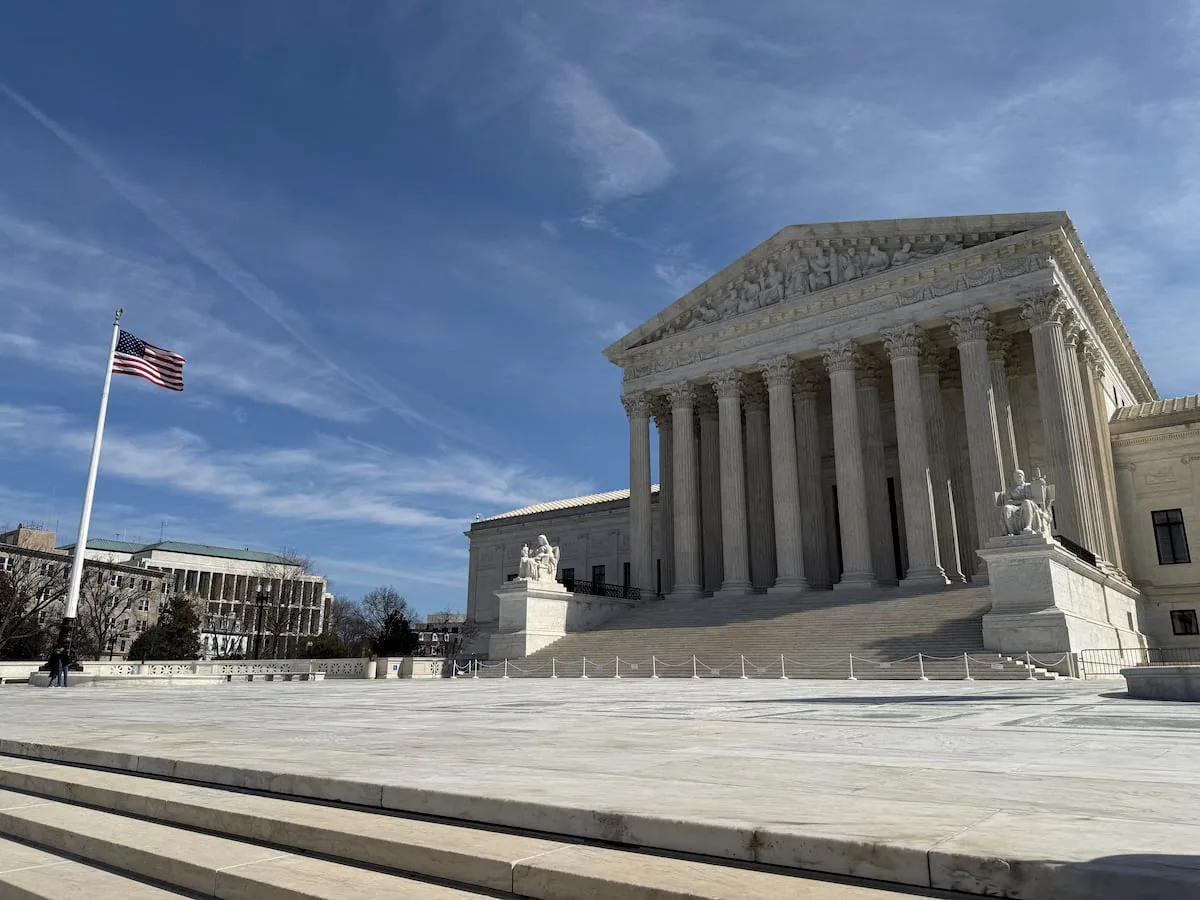
The United States Supreme Court disabled on Wednesday a key part of the Voting Rights Act of 1965, one of the great achievements of the civil rights era. In a (6-3) vote in which the conservative bloc asserted its supermajority, the court ruled in favor of the plaintiffs against the State of Louisiana for having created a second majority-black district to comply with section two of the law.
Read more Begoña Gómez will denounce Vito Quiles for an assault in a Madrid restaurant
It opens the door for Republicans to rush to redesign electoral districts controlled by their rivals, especially in the southern part of the country. These are what are known here as “minority-majority” districts, as they are constituencies in which a minority group, for example, African Americans, represents more than 50% of the population.
The ruling, of enormous long-term significance, since it changes the electoral rules that have prevailed in the United States for the past six decades, threatens to also have consequences in the upcoming November elections, in which Donald Trump’s party is fighting for the majority in one or both Chambers, and the President of the United States, the effectiveness of the second part of his term and who knows if also to be subjected to his third impeachment (political trial).
The Supreme Court majority, whose opinion was written by one of the most right-wing justices, Samuel Alito, considerably weakens section two of the law, which prevents the design of electoral districts (that very American but undemocratic practice known as gerrymandering) from discriminating against the voting power of blacks, Hispanics, Native Americans, and Asians, who have traditionally voted Democrat. Until this Wednesday, it was constitutional to privilege from institutions the right of those minorities to see themselves reflected in the politicians who represent them.
The Voting Rights Act also requires taking into account the demographic composition of constituencies so as not to privilege the white majority by merging or dividing districts. For Alito, a misapplication of that Section Two has distorted the spirit of the law, as it conflicts, he argues, with the Fourteenth Amendment, which guarantees equality before the law, and the Fifteenth Amendment, which prohibits racial discrimination when voting. “Section Two was designed to strengthen the Constitution, not to conflict with it,” writes Alito.
The justice insists in his opinion that the intention is for the ruling to be limited only to the Louisiana case, but nothing prevents Republicans in other places, such as Florida, for example, from using that precedent. This is how liberal judge Elena Kagan argued when she read her dissenting opinion aloud, an uncommon gesture that serves to express a justice’s strong disagreement with a Supreme Court ruling.
Reconciliation
The law, promoted by Senator John Lewis, represented a great advance in the reconciliation of a country with a painful slave-owning past in which racial discrimination persisted in large parts of its territory for decades after the end of the Civil War. The law, which has been targeted by conservatives for decades, also prohibited discriminatory electoral practices, such as requiring literacy tests to vote or the application of poll taxes.
For 60 years it has greatly contributed to increasing minority representation in state and federal offices. It also had immediate consequences: according to Ari Berman in his book (titled after a famous Martin Luther King speech) Give Us The Ballot. The Modern Struggle for Voting Rights in America (Picador, 2015), “it caused the number of registered black voters in Southern States to rise from 31% to 73%, and African American representatives to grow nationwide from 500 to 10,500.”
This Supreme Court is the same one that a couple of years ago dealt a fatal blow to affirmative racial discrimination in universities with a ruling that annulled the selection systems of Harvard and North Carolina. In practice, it meant the end of decades in which black and Latino students were mainly favored with the idea that educational centers should give them more opportunities in the interest of a more diverse society and centers of power.