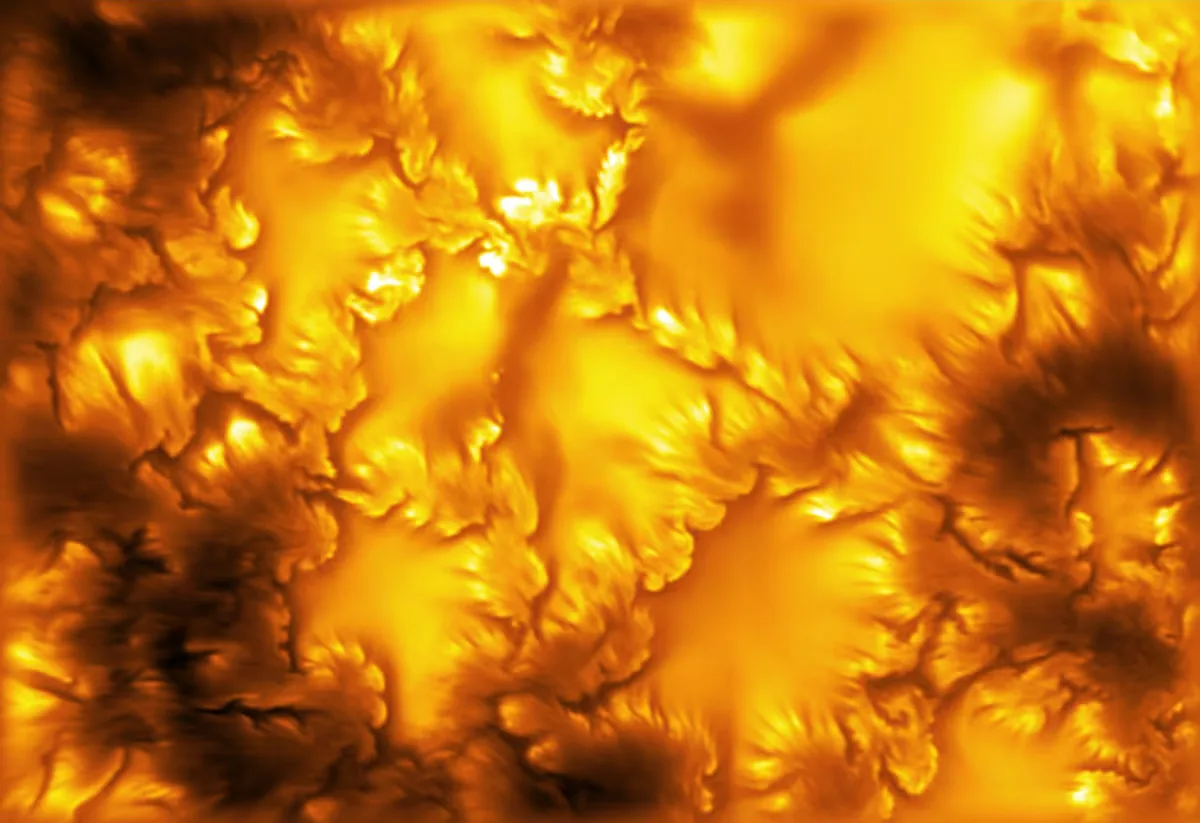
The visible surface of the Sun, known as the photosphere, is an extremely dynamic environment where plasma churns, influenced by thermal currents and powerful magnetic fields. Although it was known that this thin layer of its atmosphere housed complex structures, detailed observation had until now been a huge technical challenge.
Read more French justice convicts the ‘streamers’ who participated in the live death of an ‘influencer’
This week, an international team of researchers has managed to capture the highest spatial resolution images obtained to date of the photosphere thanks to the Daniel K. Inouye Solar Telescope, located on the Haleakala volcano on the island of Maui (Hawaii, USA).
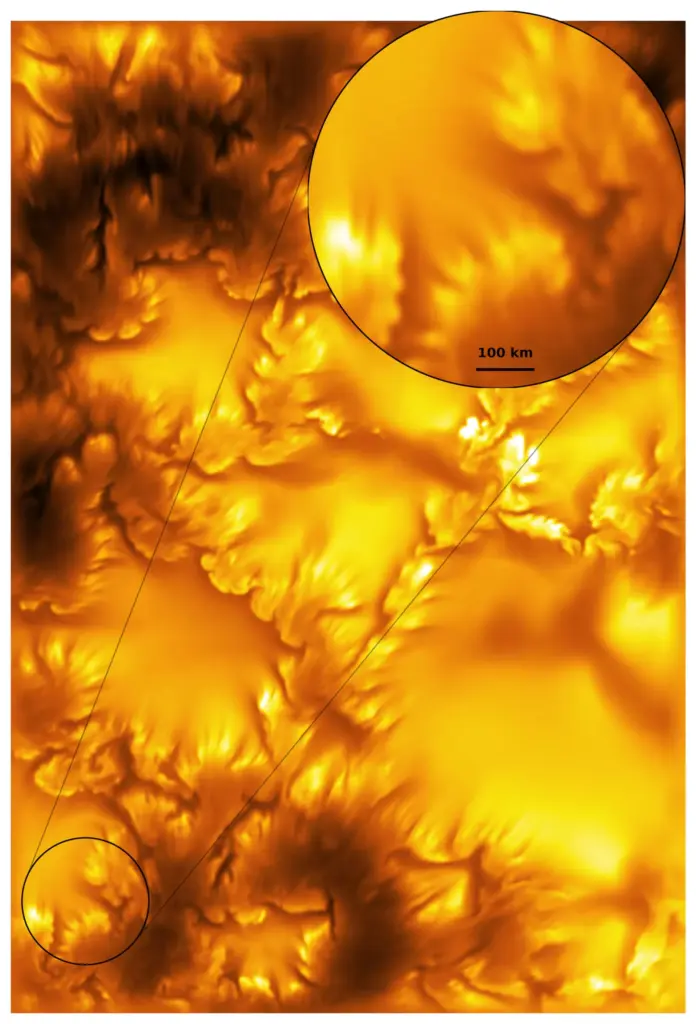
The study, published this Wednesday in the journal Nature, reveals a solar architecture much more intricate than previous models suggested. By analyzing a magnetically active region near a sunspot, the time sequences obtained by the instrument showed a surface dominated by band-shaped structures and small-scale vortices.
First confirmation on the solar surface
These formations have been identified by the authors as Kelvin–Helmholtz instabilities, a classic fluid dynamics phenomenon that occurs when two adjacent fluid layers move at different speeds, generating characteristic waves and vortices. Although this process had been theorized and identified in upper layers of the solar atmosphere such as the corona, the new work provides the first conclusive confirmation of its direct existence on the star’s surface.
Read more LIV Golf announces agreement with an investor to survive in 2027 with fewer tournaments and prizes
“The images reveal with unprecedented detail how solar matter mixes on tiny spatial scales,” explains David Kuridze, researcher at the National Solar Observatory (NSO) in the United States and lead author of the work. “Identifying these instabilities in the photosphere helps us understand how plasma flow and magnetic field lines interact on a small scale, a fundamental mechanism to explain energy dissipation in the Sun.”
Magnetic field dynamics and energy transfer
The widespread presence of these instabilities suggests that plasma mixing in the photosphere is much more active than traditional theoretical models predicted. This process plays a key role in magnetic reconnection and in the transfer of mass and energy to the upper layers of the solar atmosphere, determining factors for understanding the mechanisms that trigger solar eruptions and space weather.
The Inouye Solar Telescope, funded by the US National Science Foundation (NSF), has a four-meter primary mirror that allows it to resolve details on the Sun as small as a dozen kilometers. The finding demonstrates the potential of this infrastructure to unravel the fundamental magnetic processes that govern the functioning of stars.
Read more The gap in regional funding widens: Murcia receives 977 euros less per inhabitant than Cantabria