









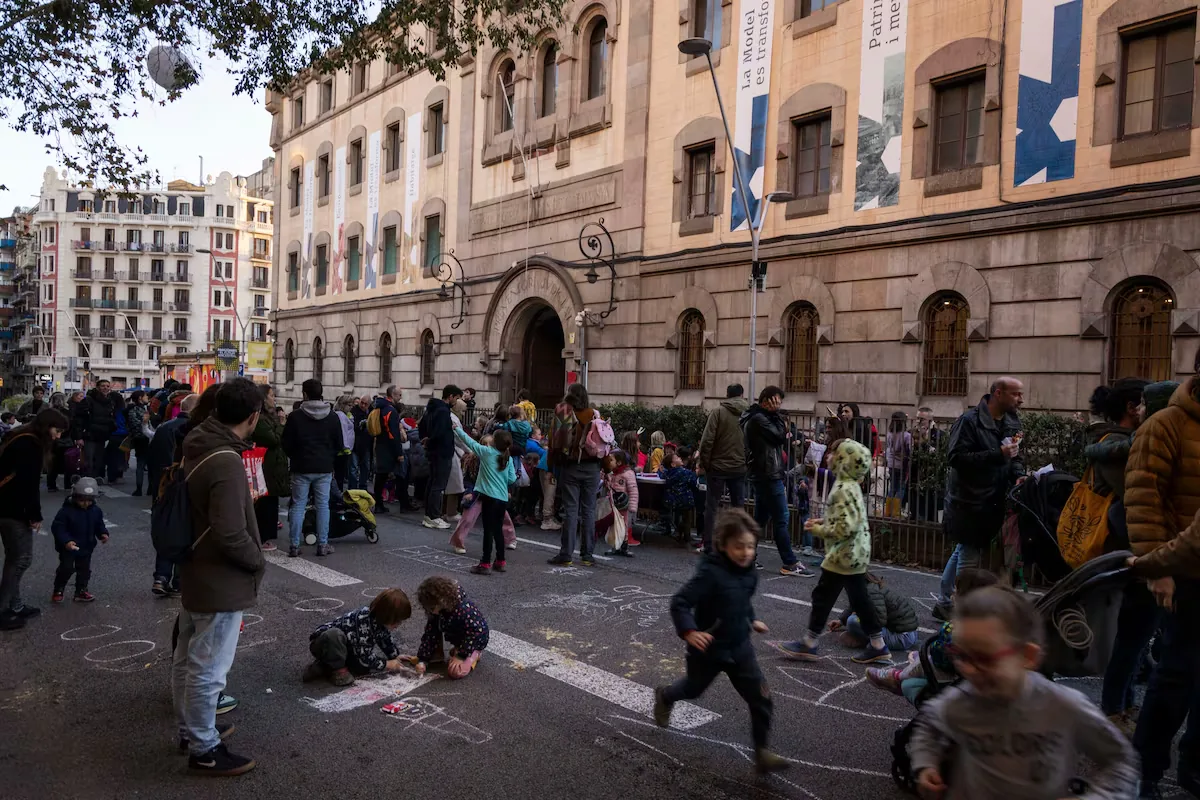
Air quality has been improving in Barcelona for three years, although it remains far from the recommendations of the World Health Organization (WHO). We have known this since the beginning of this year, with the 2025 Public Health Agency report. This Sunday, the municipal Agency published a statement that focuses on the city’s schools and points out that “the sharp reduction in the concentration of nitrogen dioxide (NO2) in the city’s air,” mainly caused by traffic, has also impacted educational centers: “Between 2018 and 2025, exposure to NO2 outside schools has decreased by 40%.”
Read more Arrested the alleged perpetrator of the forest fire in Castellví de la Marca (Barcelona)
The agency highlights the interest in knowing the air quality in these environments because the city’s minors are a population especially sensitive to the harmful effects of pollution and spend many hours at school. In fact, it was in Barcelona where the School Revolt was born, the movement of schools against pollution in their surroundings.
In the city, in recent years, the near disappearance of the most polluting vehicles (the oldest diesels) and the fleet renewal forced by the Low Emission Zone have been decisive for improving air quality. But experts look to the WHO recommendations and call for a drastic reduction in urban traffic.
The 2025 health report shows that all schools are within the current limits set by European legislation (40 micrograms of NO2 per cubic meter), but only 26% of primary schools would meet the level planned for 2030 (20 micrograms) and none meet the level recommended by the WHO (10 micrograms).
As always, indicators vary by neighborhood and the exposure level varies according to the districts, depending on the traffic level they endure. The two districts where exposure to pollution in school environments is highest are the most central: Ciutat Vella and Eixample, where the station next to the traffic detects the worst levels. And the lowest are Les Corts and Sarrià-Sant Gervasi.
Despite the improvements, the Public Health Agency reminds that it is estimated that 2025 air pollution levels are responsible, each year, for 7% of deaths in the city, 30% of childhood asthma cases, and 10% of new lung cancer cases. All percentages have been reduced by half in the case of deaths since 2018. “This health impact would be further reduced if Barcelona complied with the legal limits for 2030,” the statement warns, which argues that mortality associated with pollution would fall by 27%, new childhood asthma cases by 17%, and new lung cancer cases by 29%.
The agency applauds the improvements but warns that air quality still entails “a considerable disease burden” and calls for continued pollution reduction (also particle indicators) to meet the regulations planned for 2030. The cited report specifies recommendations such as reducing motorized mobility, promoting public transport, active travel, proximity, and teleworking. And “continuing to improve urban design with measures that limit private vehicle use, especially in the most polluted areas.” “Overall traffic reduction is the measure with the greatest positive impact on health, both due to improved air quality and associated benefits, such as noise reduction, fewer traffic injuries, and increased healthier urban spaces,” it adds.