









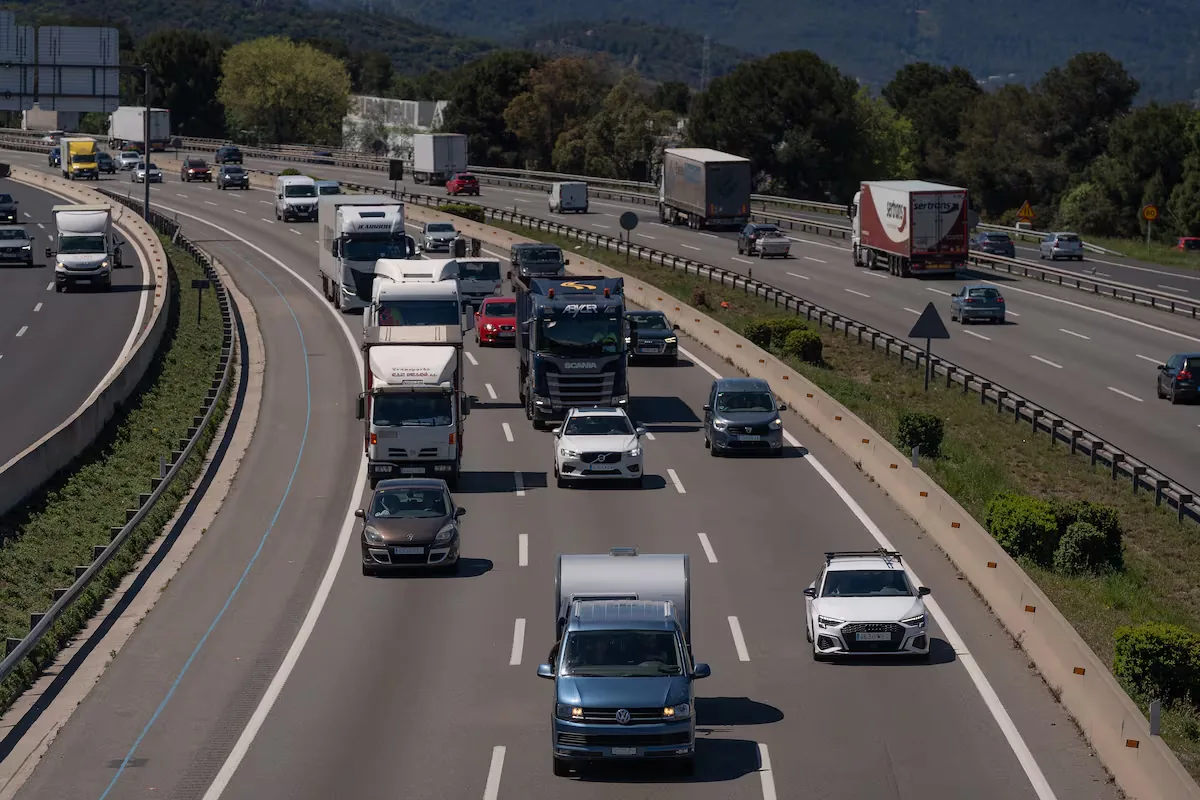
Catalonia is preparing for the total solar eclipse this Wednesday, August 12, with a special mobility device that will have about 700 personnel, 180 of them specifically assigned to traffic. However, Trànsit expects mainly local mobility. The director of the Servei Català de Trànsit (SCT), Ramon Lamiel, explained this Tuesday that, according to the data collected so far, “no long-distance trips are expected,” because around 60% of the vehicles identified in the observation areas come from the same region. The astronomical phenomenon, which will not be repeated in the territory until 2180, has focused attention on the movements on the roads towards Ponent, the Camp de Tarragona, and Terres de l’Ebre, from where the event can be best observed, and truck traffic towards this area from Martorell is prohibited between 17:00 and 00:00.
The concern is concentrated in the hours immediately before and after the eclipse, when thousands of vehicles may coincide at the main access points. Mossos d’Esquadra will deploy about 700 personnel within the operation, with 180 agents dedicated specifically to mobility. Surveillance will focus especially on the AP-7 and the A-2, as well as the accesses to the municipalities that have organized activities and enabled parking spaces. The device will be coordinated with local police and the Agents Rurals, the latter also monitoring the risk of fires.
Prevention measures
About 20 authorized points have been planned throughout the territory to follow the phenomenon. Authorities insist on using only the designated parking lots and avoiding parking on road shoulders or spaces that could hinder traffic or access for emergency services. Trànsit also asks to check the vehicle’s condition before starting the trip. “You have to plan and keep informed about the traffic status continuously,” Lamiel has recommended.
The device also contemplates a strategy to distribute traffic among the main routes. For trips from Martorell to Lleida, Trànsit recommends using the AP-2, while the AP-7 will be one of the main routes for those heading to the Camp de Tarragona and Terres de l’Ebre. Additionally, restrictions will be established for trucks heading south from the Martorell area between 17:00 and 22:00 hours.
Authorities will also maintain aerial surveillance to monitor traffic and detect possible incidents. The goal is to prevent the concentration of vehicles at certain points from affecting both mobility and access for emergency services, especially during return times.
Read more A Chinese company invents a laser device that kills mosquitoes in mid-flight
Priority to public transport
The main recommendation to reduce pressure on the roads is to avoid using the car whenever possible. “If you can see the eclipse from your home, accessing the observation points by public transport or walking is perfect,” Lamiel said, who also asked to take advantage of the reinforcements planned in the transport system of some municipalities.
📢INFO!
🚆🌘 @Renfe schedules a special reinforcement train of the R16 to facilitate the return after the eclipse on the night of August 12
🕘 Departure from Tortosa: 21:56
🕛 Arrival at Barcelona Estació de França: 00:51🔗https://t.co/rc9NDteGsm pic.twitter.com/2vRG2CUyW1
— Rodalies Catalunya (@rodalies) August 11, 2026
Renfe has scheduled a special train on the R16 Rodalies line to facilitate the return to Barcelona after the eclipse. The train will depart from Tortosa at 21:56 and arrive at Estació de França at 00:51. The service will stop, among other towns, in L’Ampolla, L’Ametlla de Mar, Cambrils, Tarragona, Sant Vicenç de Calders, and Vilanova i la Geltrú before heading to Barcelona.
The operation mainly warns about the moment of departure from the observation points, when thousands of people may leave the designated areas simultaneously.
Read more The day King Charles III almost died in an avalanche