









Antonio Martínez is a security guard in an office building in downtown Madrid. For many years now, he does not travel during the high tourist season months (July and August). “I can’t stand the overcrowding and I can’t afford the prices they ask for now,” he says. With a salary that does not reach 1,500 euros a month, divorced and with three emancipated daughters, Antonio’s strategy for traveling is to do so in the months when no one else does, as long as he books several months in advance to get a rate he can afford. “Instead of a two or three week trip in summer, I take several getaways of four or five days throughout the year.” This year he has already visited Istanbul or Prague.
Read more Wittenoom: Spaniards in the Australian ‘Chernobyl’
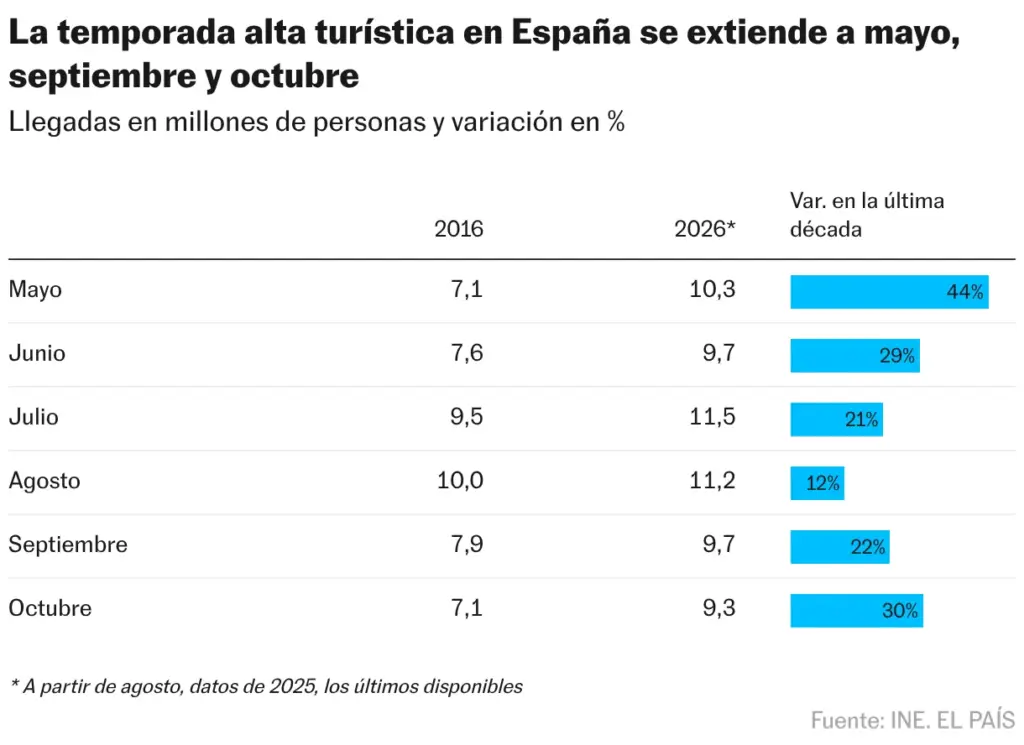
Tourism in Spain is slowly starting to spread beyond the busiest months. One in three foreigners who visit Spain do so in June, July, or August. The sector has historically been one of the largest industries in the Spanish economy thanks to an image in which summer plays a central role. But that trend has begun to reverse. If in 2022 those three months concentrated 35.5% of the tourists for the whole year, the percentage has gradually decreased since then: to 33.6% in 2023, 33.1% in 2024, and 32.8% in 2025.
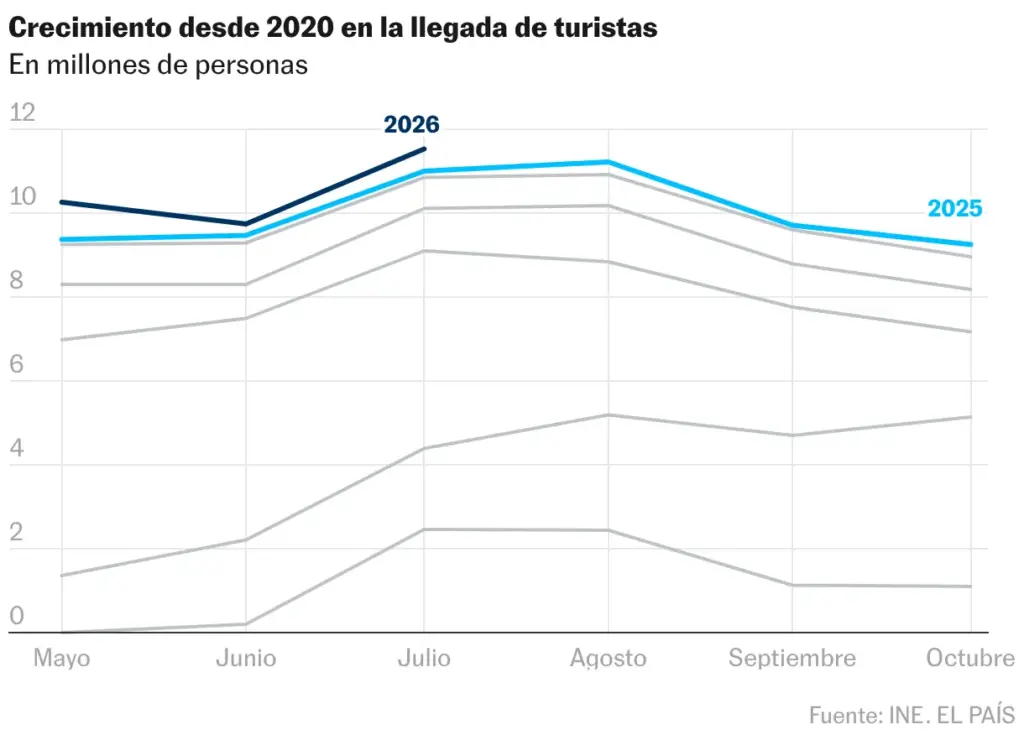
The first data for 2026 continue to support this trend. This summer, in fact, started with an unusual event: June recorded fewer arrivals than May, a month in which the figure of 10 million visitors was exceeded for the first time. Hotel overnight stays grew by 2.5% in May (900,000 more), driven by foreign tourism, and fell by 1% in June (330,000 less). In July, they grew a timid 0.3% (155,000 more) due to the opposite effect.
Sales data from the travel agency Destinia confirm that the transfer of tourists outside the high season is happening, especially since the pandemic ended. If in 2023 the month of May concentrated 16.6% of the bookings made in the six central months of the year (from May to October), three years later that percentage has risen to 18.4%. Something similar happens in the case of September, which can be considered the ultimate winner month of de-seasonalization. It increasingly surpasses June by a wide margin in traveler volume, while approaching (although still with a large gap) July and August. And in October, with a smaller base that helps raise the percentage, Destinia points out that bookings have gone from representing 2.6% to 4.7%, almost double.
The main reason accelerating the rebound of travelers in months like May or September must be sought, according to almost all sources consulted, in the high prices for traveling in the high season. Hotel rates have exceeded an average of 156 euros per room this summer, according to the latest INE data, to which must be added heavily increased plane tickets due to the Iran war and the kerosene crisis. “Spain is totally unmanageable in terms of prices. If you try to go somewhere on the coast of Cádiz or Málaga, prices are impossible for the high season months and that is causing a change in travel decisions,” points out Carlos Garrido, president of the Tourism Board. “If you can’t travel in summer, you’ll have to do it in other months. De-seasonalization is already a fact and it is positive because it allows travelers to reduce expenses, lower pressure on destinations, and plan new alternatives for agencies,” completes the head of the organization that integrates about a hundred companies.
Salvador Marín, director of the Research Service of the General Council of Economists, agrees with Garrido and points out that the Spanish tourism model is experiencing a gradual redistribution of trips throughout the year. “Traveling in spring or autumn allows reducing accommodation and transportation costs and maintaining the budget allocated to vacations.” Despite this, he emphasizes that this change in traveler flows from high to low season is still an ongoing transition. “The summer season will not disappear: July and August maintain their weight, but spring and autumn are gaining presence in travel decisions.”
Another cause accelerating the redistribution of tourist flows is the overcrowding of some major beach and urban destinations. “There are already places with an average occupancy of 85% in the last four years and that can already be considered a technical full. They can’t grow more and it is desirable that they don’t. Zero growth in a destination like Marbella is a very good year,” stresses Ramón Estalella, secretary general of the Spanish Confederation of Hotels and Tourist Accommodations (Cehat). The executive points to a new behavior pattern among travelers, especially nationals, to justify that extension of the high season beyond June, July, and August. “People travel more and more, and at the same time month-long trips are disappearing, unless you have your own home. The sum of both factors causes what was previously concentrated in a family trip in summer to now be spread over several trips throughout the year.”
The downside of that mass tourism, which goes hand in hand with the rise of the tourist apartment business, translates into an unprecedented rise in rental prices, which has expelled residents and businesses from cities due to the inability to afford rents, or into the collapse of infrastructure and public services in some municipalities. Neighborhood anger has been visible on multiple occasions in the most visited destinations. The Balearic Islands are this summer one of the most active protest hotspots. A demonstration in Palma gathered 25,000 people at the end of July. “Citizen discontent is evident. At some point they will have to listen to us after three consecutive years of massive mobilizations,” says Jaume Pujol, spokesperson for the platform Menys turisme, més vida (less tourism, more life), which called that mobilization.
False de-seasonalization
But Pujol is very critical of the de-seasonalization policy of tourist flows promoted, like other administrations, by the Balearic Government. “It is a false de-seasonalization. The only thing it serves is for those who were already getting rich to continue doing so by increasing the volume of arrivals not only in the summer months. Therefore, more than a solution it is a measure that worsens the problems, which now extend to six months and in two years could do so throughout the year,” he states.
Climate change and rising temperatures, especially noticeable in the central summer months, are the latest reasons behind the transfer of travelers to the mid and low season. This is supported by one of the latest studies from the Joint Research Centre of the European Commission. This analysis center points out that a 3°C increase in average temperature would shift tourist demand in July and August, which could be reduced by about 10%, while increasing between October and May.
A recent study conducted by the Spanish firm Mabrian Technologies, specialized in tourism intelligence, points out that the continuous heat waves in the Mediterranean are changing travelers’ perception of some destinations like Spain. These episodes of high temperatures “generate strong short-term reactions and a limited impact on long-term perception,” says Carlos Cendra, partner and marketing director of the company. The study surveys the opinion of travelers who have visited five destinations (Spain, France, Italy, Greece, and Portugal) in the last four summers (2023 to 2026) and emphasizes that the most sensitive source market to this temperature increase is the French, whose citizens “show significantly greater sensitivity to the weather conditions of the Mediterranean destinations studied.”
In the case of Spain as a receiver, Cendra emphasizes that high temperatures generate short-term volatility in climate perception, but that this indicator recovers fairly quickly as soon as conditions return to normal. “This demonstrates the destination’s ability to absorb episodes of extreme heat without suffering lasting reputational damage,” considers the expert.
Estalella, however, denies that the temperature increase leads to lower growth in arrivals and overnight stays in the high season. “When the occupancy data of the peninsular beaches during this summer’s heat waves are known, it will be seen that it had no impact. There are very loyal people to the destinations, even when it is very hot,” says the head of the hotel employers’ association.
Aware that the combination of high prices, overcrowding, and high temperatures forces them to make urgent changes, both hotels and tourist accommodations have stepped up to adapt to the new demand. A spokesperson for Paradores specifies that one of the lines of action to promote de-seasonalization has been the extension of opening calendars when demand allows it. “This year the Parador de Costa da Morte will open one month longer while establishments like Ibiza, Aiguablava, or Jávea maintain year-round opening.”
The Mallorca Hotel Business Federation (FEHM) emphasizes improving the offer as a stimulus to attract tourists outside the high season. “The Mallorca hotel sector has invested 4 billion euros in the last fifteen years in repositioning and modernizing the plant,” they highlight. “The results are very clear: before the pandemic barely 5% of the plant remained open all year and today we are around 20%. The goal of that strategy is not to keep growing in July and August, but to keep strengthening the previous and subsequent months,” adds a spokesperson for that employers’ association. The focus to achieve this is on traditional markets like Germany, “which better distribute their demand throughout the year,” but also on some long-haul ones “like the United States, Canada, or the Middle East.”
Alongside the search for new tourists, some chains or platforms have opted for secondary cities or growth in rural areas to break away from the summer monoculture. This is the case of Barceló, which closed last August an unprecedented corporate operation in its 95-year history: the acquisition of 80% of the capital of Rusticae. This platform of charming rural establishments brings together 200 hotels in Spain, Portugal, and Morocco, which jointly bill around 50 million euros.
Raúl González, CEO of Barceló’s hotel division in Europe, the Middle East, and Africa, emphasizes that this operation is the first phase of Barceló’s foray into rural tourism. “We are in contact with other sector players to see if we can buy more companies or integrate others to get a stronger team, improve day-to-day operations, and have more operations. Although initially we do not plan to acquire accommodations, if the opportunity arises, we will,” he says.
Airbnb’s rural turn
Airbnb, the giant of tourist apartments, with more than seven million listings worldwide, has also started a shift from cities to the emptied Spain in a three-year plan called ‘Rural Commitment,’ in which it will invest 40 million euros for projects promoting new tourist destinations, support for local commerce, and revitalization projects in emptied Spain towns. “The role of hosts is especially relevant here, as they function as authentic local tourist offices and encourage consumption in local shops and services. In addition, family stays, due to their duration and number of guests, boost rural demand, strengthen the economy, and promote sustainable development in these communities,” says Jaime Rodriguez de Santiago, general director of Airbnb in Spain and Portugal.
That strategy change, however, is due to the forced tightening that its business in Spain has suffered as a result of numerous restrictions imposed on tourist rentals in the major cities where it operates, such as Madrid or Barcelona. Only in the Catalan capital is it expected that by 2028 the nearly 10,000 tourist apartments currently operating will lose their licenses. The shift towards less crowded destinations in Barceló or Airbnb is just another sign that Spanish tourism needs to broaden its horizons. Because what the beaches offer in July and August has become too limited.
Read more Where and how Russia tries to weaken Ukraine’s allies