









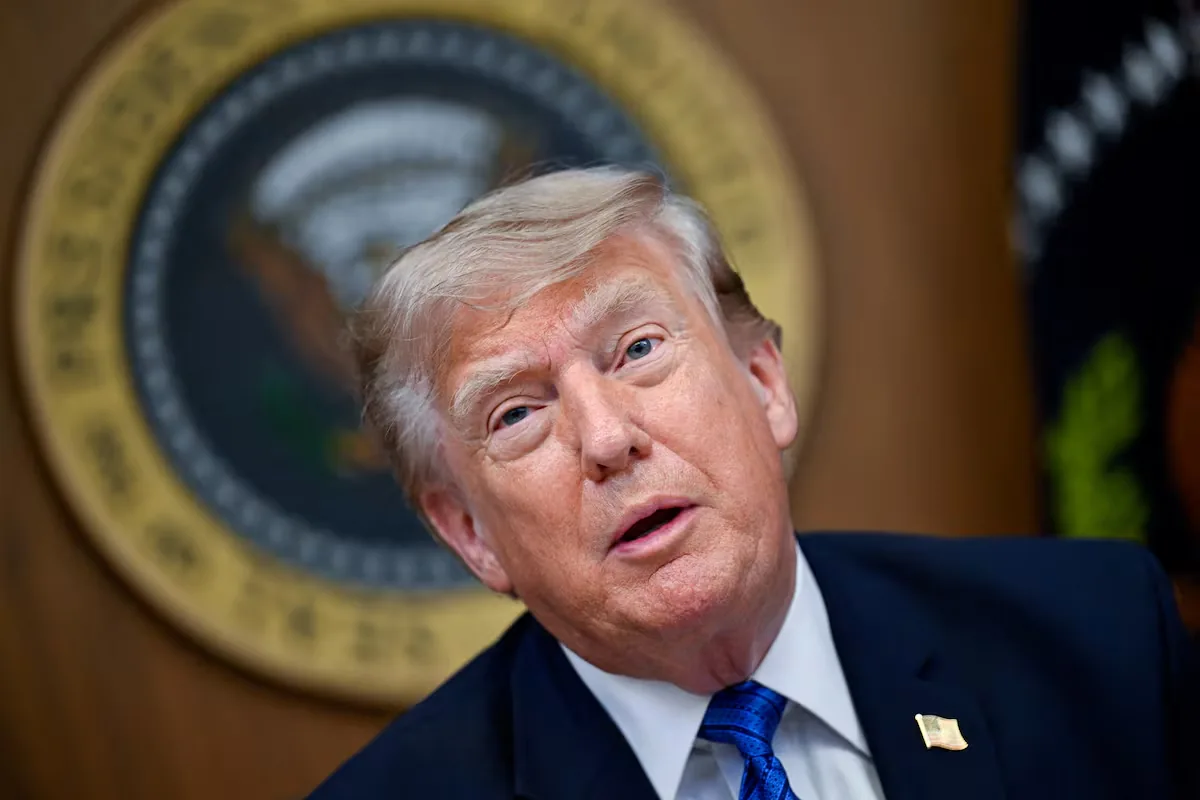
Once again, the political future of the United States is tied to the Latino vote. It used to happen every four years, during the presidential elections, when parties remembered that Latinos represent 15% of the national electorate and began courting these communities with messages tailored to their tastes and cultural preferences. Joe Biden did not understand this, but Donald Trump did. Now it is happening again in crucial midterm elections both for the survival of the MAGA project and for the salvation or the rapid deterioration of American democracy.
Read more El Tigre put on the presidential sash and began to roar
Trump’s message in 2024 was, essentially, the same as in his previous campaigns: tough on crime, border closures and mass deportations, traditional values and policies against cultural and gender diversity (antiwokeness), but above all, controlling inflation and a strong economy. With this last promise, he defeated Kamala Harris.
In 2016, when he became president promising a “big and beautiful” wall to stop the supposed rapists and criminals crossing the southern border, Trump was not yet well known in Latino communities. But after Biden’s open border policy, post-COVID inflation, and an intense campaign criminalizing migration, that message finally gained traction. Latinos rewarded him. In 2024, Trump increased his share by 12 points compared to 2020 by capturing 48% of the Latino vote nationwide, propelled by working-class Latino men and border communities in Texas.
A year and a half after his return to the White House, that support has eroded considerably.
The trigger was the criminalization of Latin American migrants. Many members of the Latino working class, who naively believed the president would only deport criminals, have witnessed and been victims of brutal ICE raids, a true manhunt that does not distinguish between offenders and honest people. These raids have not only destroyed families and communities; they have also directly impacted employment in agriculture, the food industry, and construction. A survey by the Equis Research Center, published in March, showed that 62% believed Trump was trying to deport as many people as possible. The poll also found that 65% consider his immigration policy “goes too far.”
The other factor is the economy. Latinos make up one of the most dynamic and thriving groups in the country. But when a Latino loses their job as a day laborer, goes to the supermarket, or fills up the gas tank, they realize Trump is not on their side. It is not surprising that even among those who voted for him in 2024, 66% still support him. That represents a drop of almost 27 points since January 2025, according to the Pew Research Center. What is truly surprising is that the Democrats have not capitalized on that discontent.
Latinos know that historically they have been used by both parties as an electoral wildcard. Then they are ignored until the next campaign. It is logical that many feel disaffected from politics today. They are millions of voters who do not find attractive options in either party. In fact, 71% say they have not seen political advertising in Spanish in the past year. That lack of investment and communication worsens the disconnection and suggests that neither party is doing the necessary work to win over this orphaned electorate.
Partly, this explains why those abandoning Trump have not jumped the fence to the Democrats in the expected proportions. Republican pollster and strategist Mike Madrid talks about a “misalignment” that makes Latinos increasingly less loyal to party franchises. It is easy to understand why: they find themselves politically adrift, orphaned of proposals at a time of enormous uncertainty.
Can Republicans and Democrats change that sentiment three months before the elections on November 3?
The answer is not clear. Latinos can tip the balance in the Senate race in at least six states: Texas, Arizona, New Mexico, Nevada, Georgia, and North Carolina. They will also be decisive in dozens of districts to define control of the House of Representatives, such as the 4th district of Washington State.
It is a rural and agricultural district, traditionally conservative. There is Yakima County, where Latinos represent more than 50% of the population. Many are local farm laborers. Trump won it comfortably in 2024, but his immigration policies have had a devastating effect. Farmers are increasingly struggling to find labor due to the fear caused by ICE raids.
Still, Trump has already endorsed Yakima commissioner Amanda McKinney, who has declared herself a member of the MAGA movement. Her opponent will be Democrat John Duresky, an Air Force veteran who lost his job at the Harford nuclear reserve due to cuts in the DOGE program, promoted by Trump and executed by Elon Musk.
Both candidates see an opportunity in Yakima. But while McKinney bets on the nationalist and anti-immigrant MAGA vision, Duresky must have understood that the battered Latino community could take him to Congress. “We need to find a way to communicate with these rural areas and compete as if we really cared,” he told NPR. Perhaps unknowingly, he was describing the need to align expectations and proposals: the problem pointed out by Mike Madrid.
Although the Democrats currently hold a considerable lead in the Senate race in several key states, nothing guarantees they will prevail in Michigan and Wisconsin, also essential to control the legislative power and restore checks against Trump.
Latinos are also decisive there and yet do not clearly favor the Democrats either. What this indicates is that, while most Latinos are no longer with Trump, they are not with his opponents either.
However, not all Latinos have turned their backs on the president nor are they uniformly discontent with the MAGA agenda. In South Texas, they continue to support Republicans on border security and remain doubtful about the economy. Florida remains a Republican stronghold where Cuban Americans remain solidly aligned with Trump and his candidates. Causing a shift there seems highly unlikely.
Since breaking with Trump brings scorn and amounts to political suicide, it is hard to imagine Republicans using these midterm elections to distance themselves from him, even if that means assuming long-term costs, such as losing the 2028 presidential race. Moreover, Trump seems increasingly indifferent to anything not related to his enrichment or personal glory.
So Democrats have an open window among Latinos in many other places. A UnidosUS survey found that one in five Latino voters remains undecided heading into November.
What would need to be done to consolidate the Democratic shift and political re-engagement among their bases observed in New Jersey, Virginia, New York, and more recently, in the Michigan primaries?
Despite the progressive wing’s victories with Zohran Mamdani in New York and Abdul El-Sayed in Michigan, many Democrats still prefer a pragmatic agenda focused on immediate needs.
The majority of Latino voters do too. And if the alpha of that agenda is rejecting immigration policy, the omega should be seeking solutions and remedies for the economic crisis. Latinos continue to complain that they feel excluded from policies that directly affect them.
So if I were a Democratic strategist, I would do three things.
First, I would not talk about ICE raids only as a human rights issue, but also for their economic consequences. In Yakima, a predominantly conservative county, Duresky cannot win on moral outrage alone. He needs to remind voters that if the harvest rots due to lack of laborers, everyone’s life will be worse.
Second, I would shield pragmatic and moderate-toned candidates in districts where the Latino vote decides — as Rubén Gallego in Arizona and James Talarico in Texas have done — and let the progressive wave of Mamdani and El-Sayed fight their own battles in big cities. Democrats cannot afford to deepen an internal ideological war that further separates Yakima from Detroit or South Texas.
Third, I would immediately invest in political advertising in Spanish with concrete policies that connect with Latino voters. That 71% of Latinos who have not seen a single ad represents a huge segment of the electorate that remains completely unattended.
Although it is unlikely anyone will adopt it, I would say Republicans also have a way out to recover some of the ground lost because of Trump: reduce the profile of the raids. It is an operational adjustment that would avoid a suicidal break with the former president. But for that, Tom Homan, the border czar, and Markwayne Mullin, Secretary of Homeland Security, would have to believe there is political life after November or after Trump. The first is likely. The second, at least for them, seems impossible.
Read more Electoral uncertainty takes over Girona, the capital still controlled by the independence movement