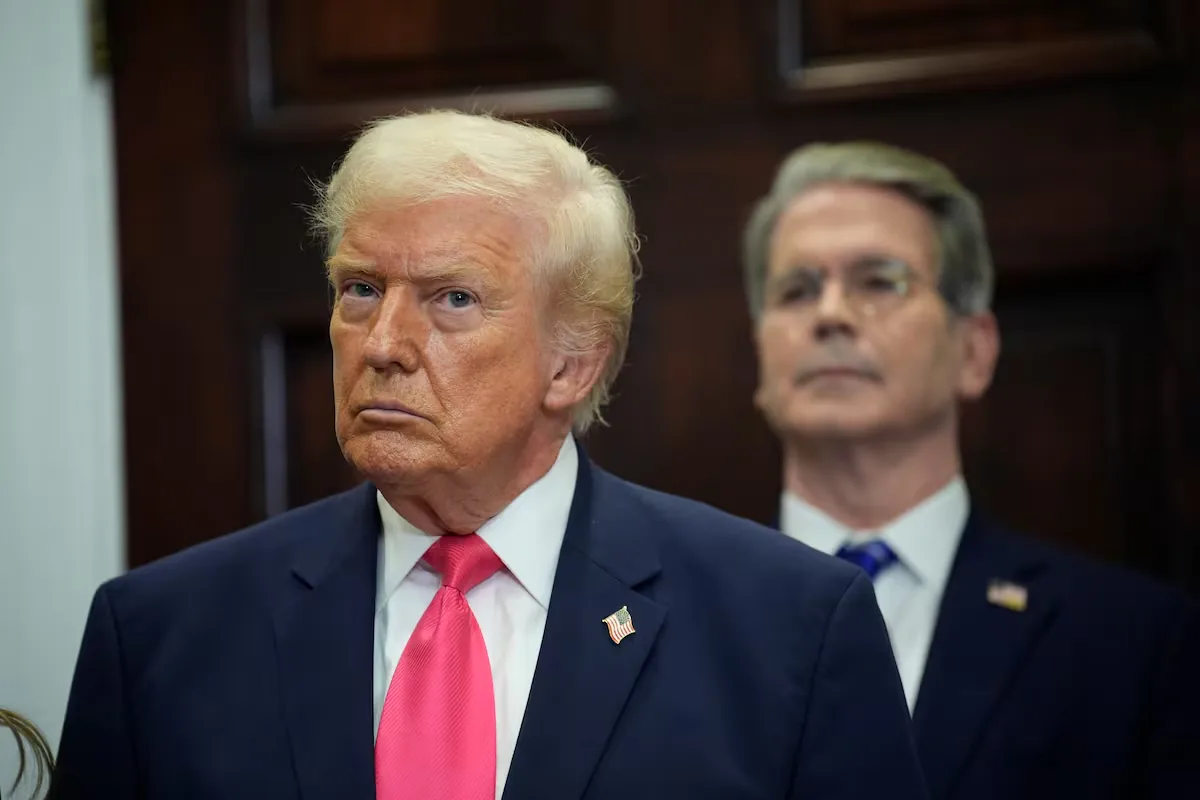
The promise made last Wednesday by the President of the United States, Donald Trump, to give $5,000 to all “American adults” if the Republicans win the elections next November left behind a trail of moral, legal, political, or procedural doubts. And among all of them, the most urgent: will he be able to fulfill it, or is it just another distraction maneuver to add to the list of similar perks announced and never delivered?
Read more Who is in charge of Al Qaeda? Why there is no other Osama Bin Laden
Besides criticism for its appearance as an operation to buy votes, the desperate populist-electoral gamble launched to avoid a collapse at the polls also raised economic alarms. It was interpreted by analysts as a bad idea in an inflationary environment, where Treasury debt has exceeded 40 trillion euros for the first time and whose financing costs are close to the highest levels since before the Lehman Brothers bankruptcy in 2008.
It is not yet clear what Trump means by “adults,” because he did not specify it in the speech in which he made the announcement, during a Republican convention convened in Dallas to his own glory. The promise could add up to $1.3 trillion (around 1.1 trillion euros) to the U.S. debt if it covers the 270 million possible candidates, according to the latest census. The Republican did specify that this money is to be spent in the United States and not in “Canada, China, or Germany.”
Stimuli like the one Trump proposes are usually reserved to alleviate certain emergencies, such as an economic crisis or a pandemic, by stimulating demand; the measures to mitigate COVID added up to $1.9 trillion. Also, they are not usually used when inflation is high (as is the case: in August, according to data from this Friday, it marked again 3.4%, as in July) due to the price of oil, skyrocketing because of the Iran war.
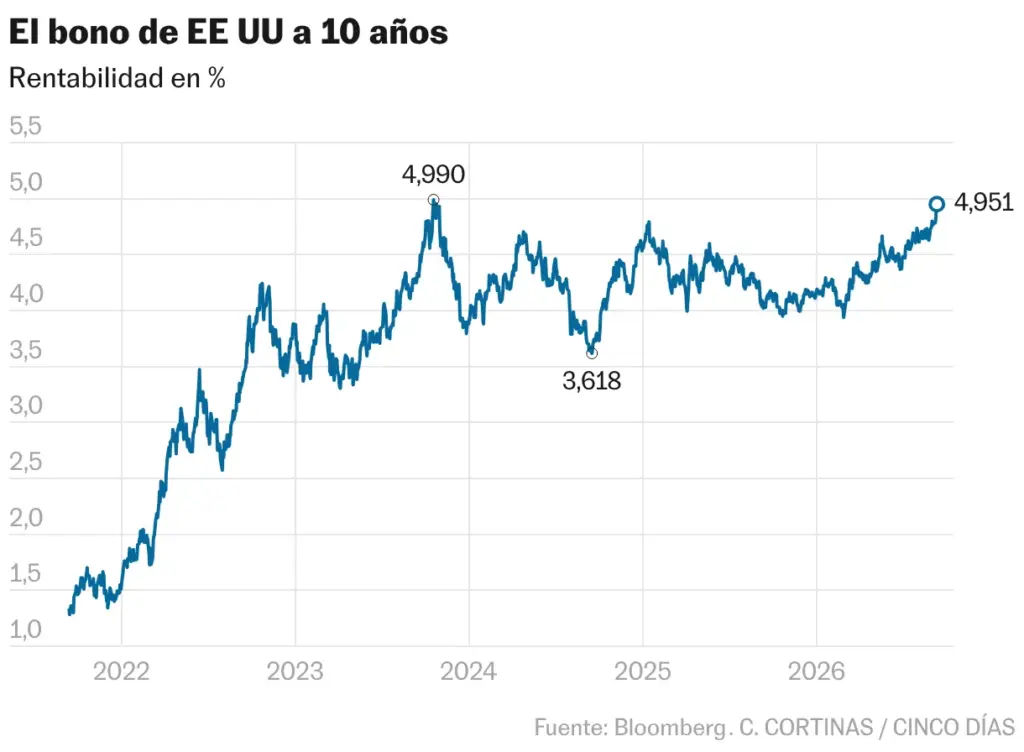
It is, in fact, inflation that causes the Federal Reserve to raise interest rates next week. And that cocktail of high inflation with budget imbalance is shaking the foundations of American debt. The yield on the 10-year Treasury bond, a global benchmark, is trading this week at the 5% threshold, just thousandths away from marking its highest level in 19 years. That is, investors are demanding more and more interest from the Treasury to buy its debt, facing a budget deficit (difference between income and expenses) expected to close the year at 5.8% of GDP, $1.9 trillion. In the extreme case, Trump’s measure could double it.
Between Trump’s loquacity and the volume of the promise, the market does not quite believe the proposal. But that does not mean it is harmless. Padhraic Garvey, an analyst at ING, wrote this week that “although it is unlikely” that the “Trump dividend,” as the president has dubbed his electoral gift check, this measure “is not exactly what the long end of the curve wants to hear in the current situation.” “If the disbursement were covered with new debt, it would also increase the Treasury’s financing needs […]. The immediate relief for households could become a bigger bill for the state and for those who need to finance themselves,” indicate the analysts at XTB.
The maneuver also seems designed to complicate the life of Treasury Secretary Scott Bessent. It would not be the first decision by the President of the United States to do so. On Wednesday, in the same speech in which he promised his electoral gift, Trump boasted on the stage of the Republican convention that he made the decision to declare war on Iran ignoring the recommendations of the Treasury chief, whose voice he mockingly imitated.
Bessent, a deep expert in financial markets, has played a key role in limiting the impact on Wall Street of his boss’s whims. And his latest target seems to be precisely the rise in interest rates on 10-year debt. In early August, he agreed with Japan to intervene to raise the value of the yen, taking care that Tokyo did not sell its gigantic portfolio of American debt, of which it is the largest foreign holder with $1.1 trillion.
At the end of the month, Bessent surprised the market by doubling the pace at which the Treasury buys long-term debt. The move meant amending a routine strategy approved two weeks ago, and coincided with records in 30-year debt, which was interpreted as a way to intervene in the market. Investors did not buy the bluff because, in a way, it is blowing hot and cold (buying long-term debt by issuing more short-term) and, moreover, its scope is limited (each operation is $4 billion). Still, this week, in light of new debt highs, the Treasury raised the stakes again with a $6 billion purchase. It also did not work.
Powerful bond investors, large institutions that move slowly but inexorably, are concerned about the imbalance of U.S. accounts. “In our opinion, deficit reduction is the only lasting anchor for long-end yields,” Pimco, the world’s largest debt manager, said in August. “In the United States, the deficit has become largely insensitive to underlying economic needs, rising strongly even in a strong economy.”
No analyst expects investors to flee American debt. But they do expect them to think twice before buying it. Or to redistribute their portfolio. This is precisely what the world’s largest sovereign fund, which manages Norway’s oil dividends and whose assets total two trillion, has proposed. The managing entity has proposed a readjustment to reduce the weight of debt in its portfolio. Most of it is U.S. debt.
Concern about long-term debt is not gratuitous, since besides being capable of shaking Wall Street, these assets are the benchmark for the mortgage market. According to the Freddie Mac index, since the war began, the average rate on 30-year home loans has risen from 5.98% to 6.76%. A few weeks before the elections, the average American has more expensive mortgages, diesel at six dollars a gallon for the first time in history, and inflation over 3%. The cost of living was already one of the keys to Joe Biden’s defeat two years ago, and it is taking a toll on Trump because of a war in Iran as unnecessary as unpopular. But his latest whim to climb in the polls, beyond being unbelievable, only reinforces market fears about the little regard for sound accounts of a former magnate whose companies did not always pay their debts. Maybe he should have started by listening to Bessent in February.
A promise with legal doubts
Three days after the President of the United States dropped the bomb of the “Trump dividend,” it is still unclear whether that promise is legal. Or if to implement it he will need Congress’s agreement, a point he himself denied on Thursday. Federal law prohibits spending to influence the vote, but the midterm bonus could be saved because the payment would be made once the polls are closed. There is a Supreme Court precedent that allowed something similar in Kentucky and other cases of similar promises, like the one the Georgia Democrats launched in 2020: $2,000 in coronavirus aid if the party retained the state Senate.
There are also previous examples of unfulfilled promises by Trump. Like when he said he would distribute a $2,000 check from tariff gains and another $5,000 to celebrate the reduction of the civil servant mass undertaken (and left halfway) at the beginning of his second presidency by Elon Musk’s Government Efficiency Department. Its potential recipients are still waiting for them.
Read more The derailment of a train in French Normandy causes 44 injuries