





Ukraine must always be in the spotlight if it wants to survive. This is the diplomatic strategy of its president, Volodymyr Zelensky, when a conflict breaks out in the world that could weaken his country in the fight against the Russian invasion: Ukraine must be present and proactive, even if it is in another war and thousands of kilometers from Kyiv.
Read more Feijóo warns that foreigners who «abuse women or steal» will be regularized
The war against Iran has harmed Ukraine in several ways. A document published this April by the Hague Research Institute for Eastern Europe (THRI) summarizes it in these points: it receives less attention from its allies, the high price of fuels has boosted the Russian state’s revenues, and the war in the Middle East puts at risk the supply of American anti-aircraft ammunition for Ukraine.
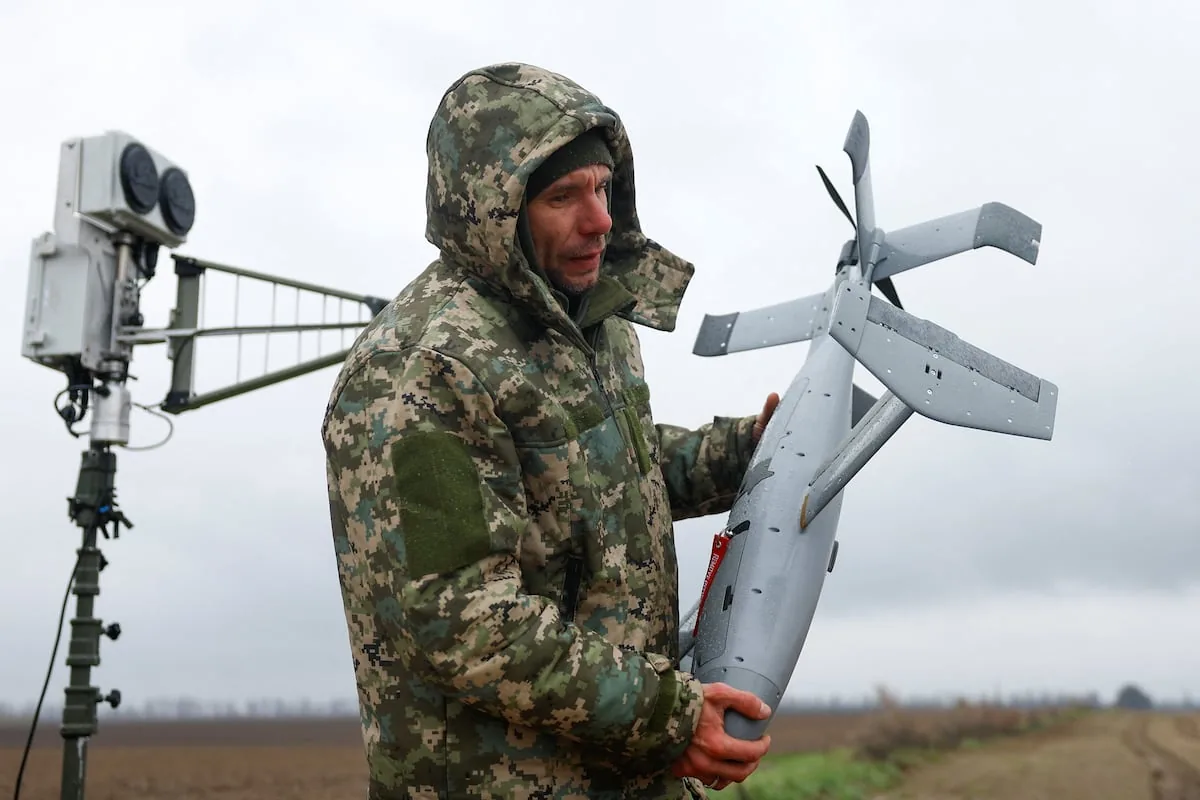
But Zelensky has made a virtue of necessity and has achieved, at the same time, a victory that few expected: turning his country into a new global actor. At least 200 Ukrainian military personnel have been stationed since March in the Middle East, according to figures advanced by the president himself. This personnel is responsible for training and fine-tuning the anti-drone systems that, according to Ukrainian state media, have already been put into operation in Saudi Arabia, the United Arab Emirates, and Qatar. The three countries have supposedly shot down long-range Iranian bomb drones thanks to the Ukrainian interceptor devices and also to their electronic warfare equipment.
The United States started the war against Iran on February 28. Zelensky initially welcomed the military operation as a way to neutralize one of Russia’s main allies. As the days passed and it became increasingly clear that the Iranian regime would not fall, the Ukrainian leader adapted the narrative: his concern was now that the conflict would drag on too long and to the detriment of his country’s interests. If so, Ukraine had to assume a role on the Arab stage taking advantage of its military background.
Zelensky first offered Ukrainian experience in anti-drone defenses on March 6. “We don’t need your help in the Middle East, we know more about drones than anyone,” was Donald Trump’s response.
The Ukrainian leader ignored the new disrespect shown by the American president and went straight to talk with the Arab monarchies. In the last week of March, he traveled to Qatar, Saudi Arabia, the United Arab Emirates, and Jordan, returning to Kyiv with several bilateral security treaties. The agreements consist, according to Zelensky’s summary on April 13, of an exchange of anti-drone weaponry and defense training for “energy security,” that is, for oil. The Ukrainian government assures that Kuwait, Jordan, Oman, and Bahrain are interested in supporting similar agreements.
Deaf ears from Israel and the US
The paradox is that the moves Ukraine is making also benefit the interests of the United States and Israel, two countries that so far have prioritized their relationship with Russia.
Zelensky confirmed that he would have liked to visit Israel during his late March trip to the Middle East, but Israeli authorities rejected it. Israel does not apply sanctions to Russia nor has it provided known military aid to Ukraine. In fact, it has no objection to buying from the so-called ghost fleet, the merchant ships transporting Russian raw materials sanctioned by the West. The latest case, reported on April 14 by the Ukrainian state media Suspilne, is that of a cargo ship that docked on April 12 at the port of Haifa with tons of wheat from occupied Ukrainian territories.
Zelensky has been warning Israel and the United States for weeks that Russia, according to its secret services, is providing intelligence information to Iran. Moscow has supposedly given information about targets on Israeli soil and details about American bases in the region, according to Kyiv’s alert. But these warnings have fallen on deaf ears. Zelensky admitted on April 9 in the British newspaper The Guardian that “the United States ignores the warnings because they trust Vladimir Putin.”
Igor Reiterovich, political scientist and professor at the Taras Shevchenko National University of Kyiv, emphasizes that “both the United States and Israel act this way because they do not want to further irritate Moscow.” “So far, the United States has significantly underestimated Ukraine. It is a very personal matter, largely linked to the US president and his attitude towards Zelensky,” he adds.
Another important factor, this academic indicates, is that Ukraine has not had significant presence in the Middle East for decades. Russian work abroad still has a big lead over Ukraine: while Ukrainian drones shot down Iranian Shahed drones over the Arabian Peninsula this March, the state company of the United Arab Emirates DP World sold its stake in the main port of the Ukrainian province of Odesa and created a new port operator in the Russian Far East.
One thing Zelensky has is that he does not give up. The Ukrainian leader made a new trip this April, to Turkey and then to Syria. He has been one of the few international leaders who have traveled to Damascus to support President Ahmed Al Shara. The reason is none other than to offer defense assets for Ukraine to try to make Russia lose its influence in Syria. The Russian army maintains air bases in Syria despite the overthrow in 2024 of its ally, dictator Bashar al-Assad.
Libya is another Mediterranean country where Ukraine has set foot in its new status as a global military actor. On its coasts, it has launch bases for maritime drones against Russian merchant ships and is allegedly providing drones and military training to Russia-opposing groups in North Africa.
From the Black Sea to Hormuz
The current phase of the Ukrainian diplomatic campaign is to convince the United States that its experience can also serve to control the Strait of Hormuz. The blockade by Iran of this maritime route in the Persian Gulf has sent crude oil prices soaring. Zelensky insists that his drones and weapons broke the blockade imposed by the Russian fleet in the Black Sea; they can do the same in Hormuz. “No one has achieved anything similar to what we have in the Black Sea. There is much theoretical debate about the Strait of Hormuz but Ukraine can help from experience,” Zelensky said on April 13.
Both the Ukrainian Ministry of Foreign Affairs and the UK’s have pointed out in recent days that Ukraine is being invited to Western government meetings on the crisis in Hormuz. “Ukraine continues on its remarkable path from being a recipient of aid to being a provider of security,” noted the Washington-based geopolitical study center Atlantic Council on April 9. Reiterovich believes Ukraine was already a global actor, especially because of its operations in Africa against Russian mercenary groups: “Ukraine’s role was less visible and prominent, the war against Iran has highlighted it.”
Read more Barcelona launches a new International Peace Prize endowed with 300,000 euros