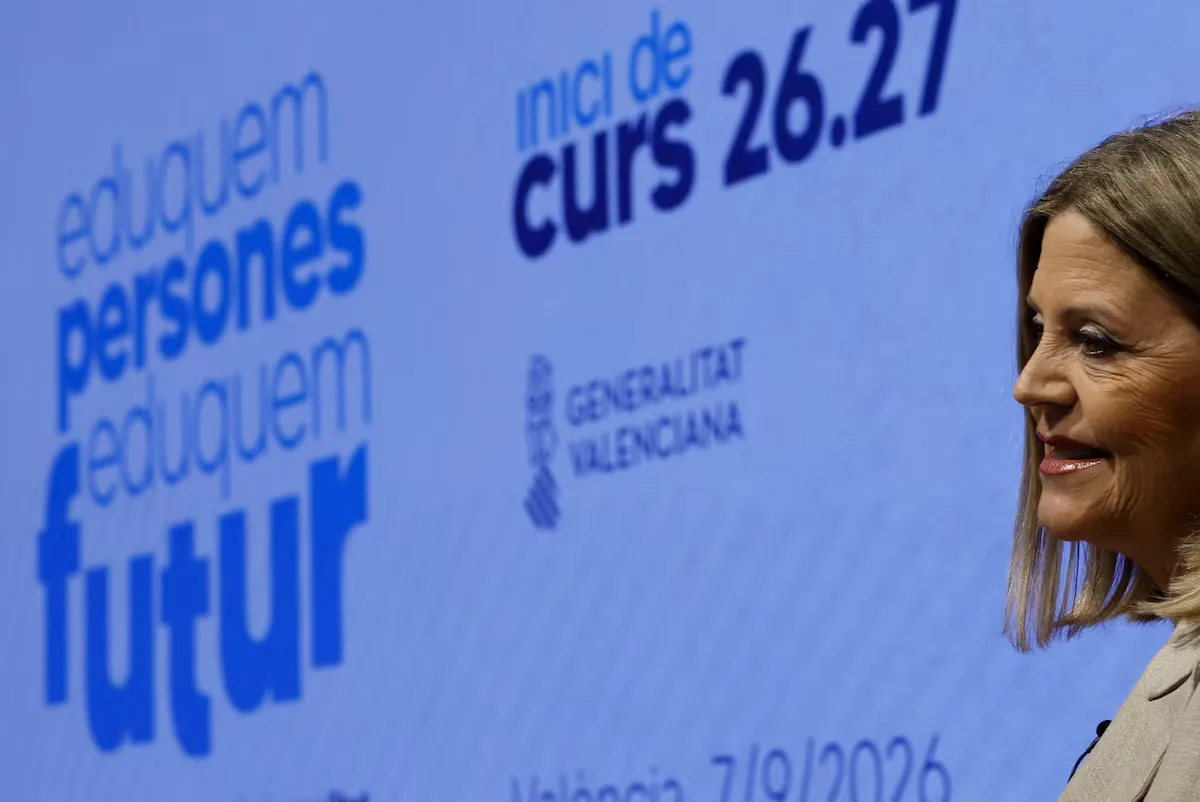






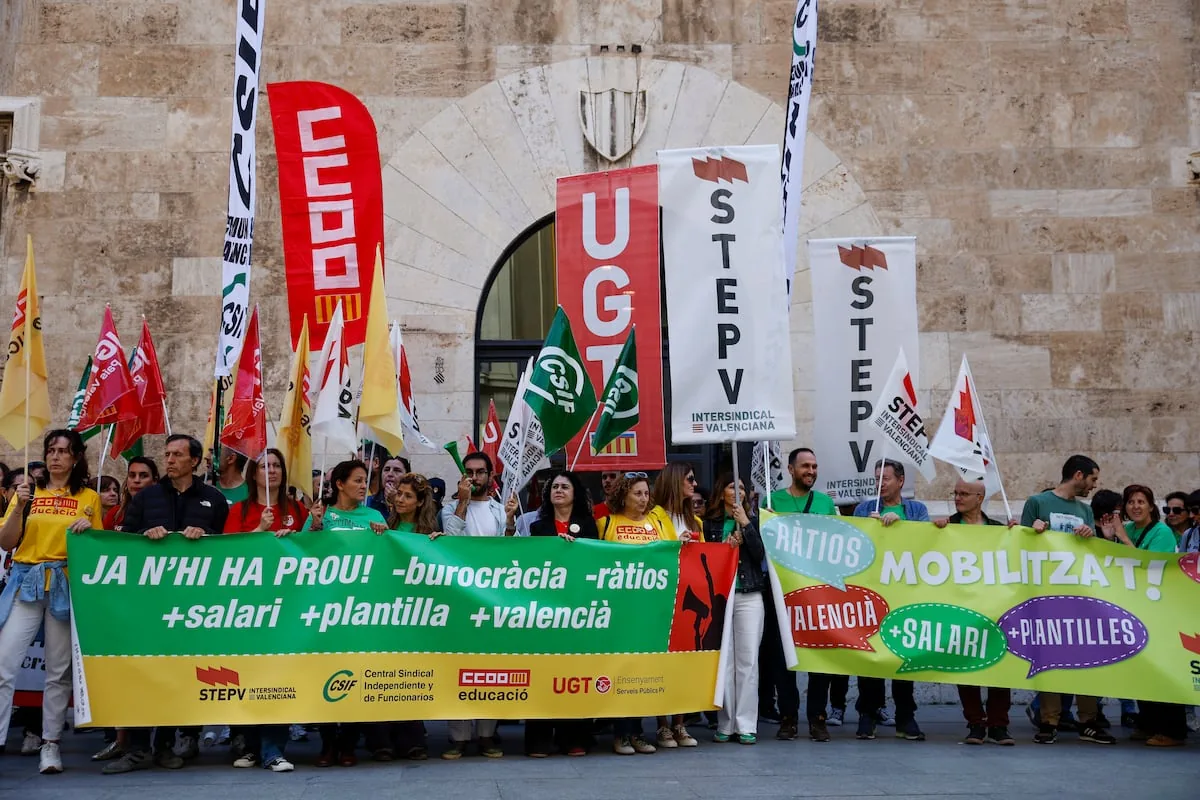
There are only four days left until the start of the indefinite strike in non-university public education in the Valencian Community, and positions remain far apart. At a rally this Wednesday morning in front of the Palau de la Generalitat, the unions calling the strike from Monday, May 11 — STEPV, CC OO, UGT, and CSIF — again asked the Valencian president Juanfran Pérez Llorca to mediate with his Education and Finance departments to facilitate an agreement that should improve teachers’ pay, reduce student ratios, improve school infrastructure, or reduce bureaucracy. The president responded that he does not have to mediate between departments but announced that the Education minister, Carmen Ortí, will bring a new proposal to the scheduled sectoral table tomorrow.
The strike coincides with the end of the school year, and the Generalitat Valenciana has proposed 100% minimum services for 2nd-year Baccalaureate teachers — there are 24,000 students enrolled in this course in public centers in the Valencian Community — “with the purpose of guaranteeing the EBAU” or university entrance exam. But the unions considered the proposal “abusive.” The next day, Education lowered its minimum service demands to guarantee student evaluations, which the unions also rejected because, they understand, it invalidates their right to strike.
Minister Carmen Ortí has put forward different arguments as the strike call approached to reduce some of the union demands: lack of room for maneuver without the approval of new Generalitat Budgets or salary increases that would represent between 350 and 500 million euros for the regional coffers. She even urged the unions to negotiate next autumn.
Yesterday, at an event in Castellón, Ortí expressed her willingness to dialogue but qualified that they do not have “much room for maneuver.” A day later, President Pérez Llorca announced that there will be a new offer to the unions at the already convened sectoral table this Thursday. “I always say that we have to negotiate, and of course the Consell will do so. The teachers’ right to strike must be respected, but the students’ evaluation must also be guaranteed,” he emphasized.
The teachers’ unions are waiting for tomorrow’s meeting. It is a “new opportunity” for negotiation, explained Marc Candela, spokesperson for the STEPV union this Wednesday at the doors of the Generalitat. “The minister said she has quantified the measures we ask for, let her present them. Because if there is no will, the strike goes ahead,” he stressed.
Candela denied that the May 11 strike is political and recalled that the Botànic Government “was also called for several strikes,” but “then there were no staff cuts, no diversion of funds to private schools, nor attacks on Valencian. Now public education is being dismantled, and we take to the streets because we are fed up,” he denounced.
Xelo Valls, representative of the Federació d’Ensenyament de CC OO, insisted that mediation by President Pérez Llorca has been requested because “from Education they give us to understand that there is no authorization from Finance [headed by former Education minister José Antonio Rovira] to continue with our demands, but we have not received a response to that request for a meeting with the president.”
“We want him to mediate and put order within his Government so that there are no technical problems to that real negotiation to update salaries, expand staff, and dignify facilities. For now, the strike remains; today we have mediation to discuss minimum services, and tomorrow a sectoral table is convened to talk about bureaucracy, but more topics could be added to the debate,” added Valls.
Read more This is the Andes virus, the only hantavirus strain transmitted from person to person
Kilian Cuerda, from UGT, stated that if the president of the Generalitat “wanted, the strike could be unlocked in one day; he has the capacity to work honestly and address demands such as infrastructure, ratios, staff, bureaucracy, Valencian language, and salaries, which have been frozen since 2007 and mean that each year we lose between 4,000 and 6,000 euros.”
Cuerda emphasized that “to negotiate, one must talk honestly, but the members of the Consell appear without proposals, without a framework document, without reading our requests; it is an absolute lack of respect, they do not do that prior work, or they say there is no money, that we will see in autumn… Also, they propose abusive and illegal minimum services.”
From CSIF, its regional president, José Seco, explained that their organization “was the first to propose an economic amount to start talking” and quantified it as a salary increase of 300 euros “since teachers in the Valencian Community are among the worst paid in all of Spain.”
“Therefore, we have already shown our cards and told them ‘we want 300, let’s start negotiating. We also want days so that teachers can accompany their children when they are sick and certain conditions such as inclusion so that centers can properly attend to students who need it.”
The conflict in Valencian education has led the political groups of Les Corts Valencianes to speak out. The opposition has demanded that Pérez Llorca “take the reins” of the negotiation to avoid the indefinite teachers’ strike and has accused the Education minister of “lying” about the amount that the teachers’ unions’ demands represent [she estimated it at 2.4 billion euros].
The PP has called the teachers’ demand for salary improvement “legitimate,” but has asked that the students’ interests be taken into account, and Vox has acknowledged that teachers have lost purchasing power but has accused the unions of “manipulating the situation with a strictly sectarian and political view.”
Read more Six beers (and one non-alcoholic) with a gold medal from 0.89 euros