









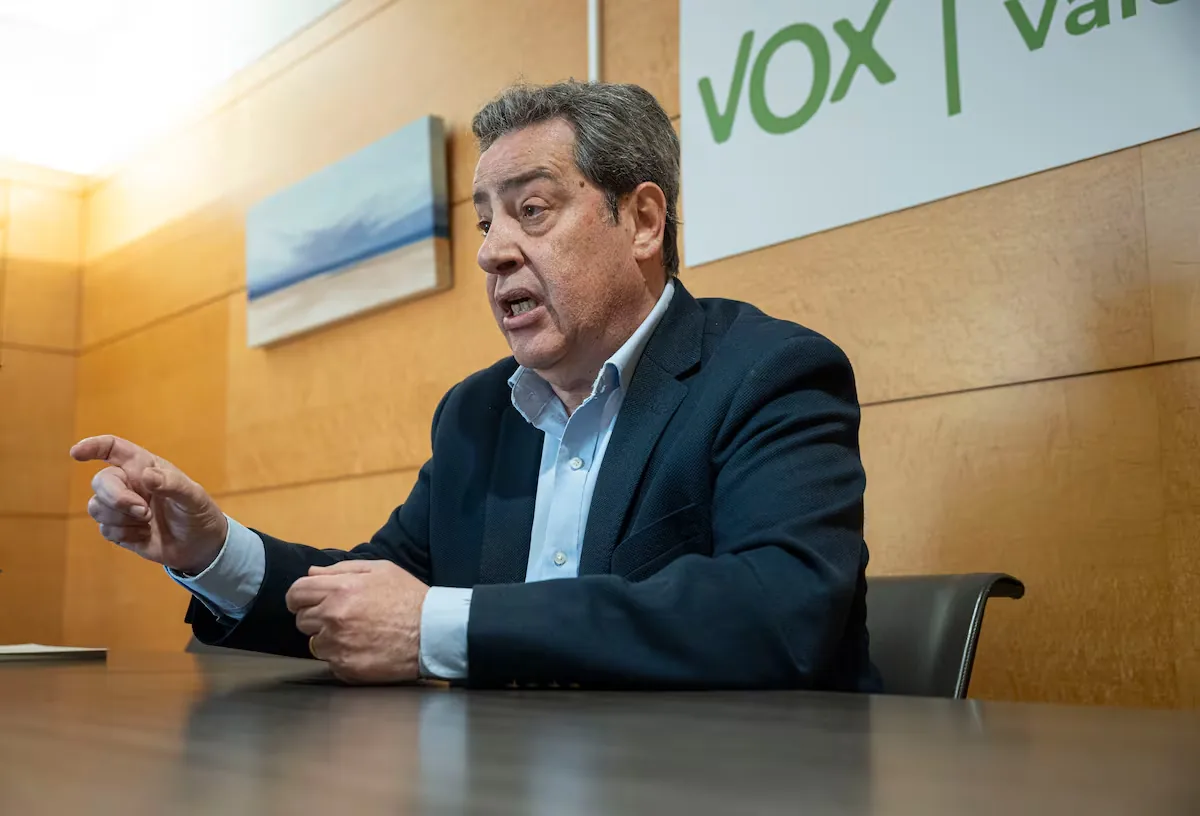
Faced with the insistence of journalists, finally the síndic (spokesperson) of Vox in Les Corts Valencianes, José María Llanos, came to acknowledge this Tuesday that the purpose of calling a press conference was none other than to send a warning to navigators: if the PP and the Consell do not include their “national priority” in the Generalitat’s budgets, they will not support the accounts.
Read more The Government injects 260 million into the state housing company to build 1,629 affordable homes
The warning responds to the fact that the Finance Minister, José Antonio Rovira, has been assuring for two days that there is no “national priority” in the “numbers.” Neither in the draft Budget Law nor in the complementary draft Law on fiscal measures, formerly known as the accompanying law, presented. The votes of the far right are necessary for the PP to pass the accounts in Les Corts.
Llanos has insisted that the national priority is demanded in social aid, access to housing, and the use of national products in school and social canteens. “Call it whatever you want, that is a national priority,” he maintained, while warning that if this principle does not “definitively appear,” his party will not support them. Although it is not literally cited in the budgets presented last Friday by the Consell, it is “agreed” with the PP for their approval, as well as the rest of the measures he has announced.
Llanos has insisted that the agreement with the ‘populars’ is based on three pillars for Vox to “sit down to negotiate”: a “drastic” reduction of the tax burden, “rigorous” measures in housing matters, and the so-called national priority. “Those were the three pillars that, once accepted, we put on paper to carry out the negotiations and today we can specify something more,” he advanced. The spokesperson reiterated the good willingness of the President of the Generalitat, Juanfran Pérez Llorca, to negotiate and did not want to raise the tone, but his appearance reveals some nervousness in the face of the Consell’s public statements.
Llanos indicated that a “minimum period” of rooting, registration, or connection with the territory will be required, that aid will be linked to the contribution history, permanence, and contribution to the public system, and that those in an irregular situation will be excluded from it. In housing, he announced that a “prolonged, real, and effective” rooting based on registration will be required and that higher and more restrictive minimums will be implemented.
The síndic pointed out that now, once the accounts have already been presented, negotiations will continue also through amendments, with “future” bills and with the law on fiscal measures, administrative and financial management, and organization. He also acknowledged that there are items “in some ministries that we do not like,” especially in the First Vice Presidency and Ministry of Housing, Employment, Youth, and Equality, and warned that for Vox to finally support the accounts, they will have to be “redirected or eliminated.”
Llanos again targeted the Acadèmia Valenciana de la Llengua, the official normative body of the Generalitat, as the ultra group’s target and announced a new 25% cut, for the second consecutive year, in its budget, with a new 25% cut, the same percentage as the previous one. However, the accounts presented by the Consell last week included a 5.1% increase in the Acadèmia’s budget, up to 3.14 million euros, above the 2.98 million of 2025.
Vox does not recognize the Acadèmia and supports theses contrary to the postulates of philology and the university community according to which Valencian was spoken before the conquest of the territories that were under Muslim rule in the 13th century by the Christian king Jaume I with an army made up of Catalans and Aragonese.
Regarding housing, the Vox síndic has boasted of a 35% increase in its budget item in the regional budgets “thanks to Vox” and the streamlining of procedures to reduce costs and bureaucratic obstacles.