

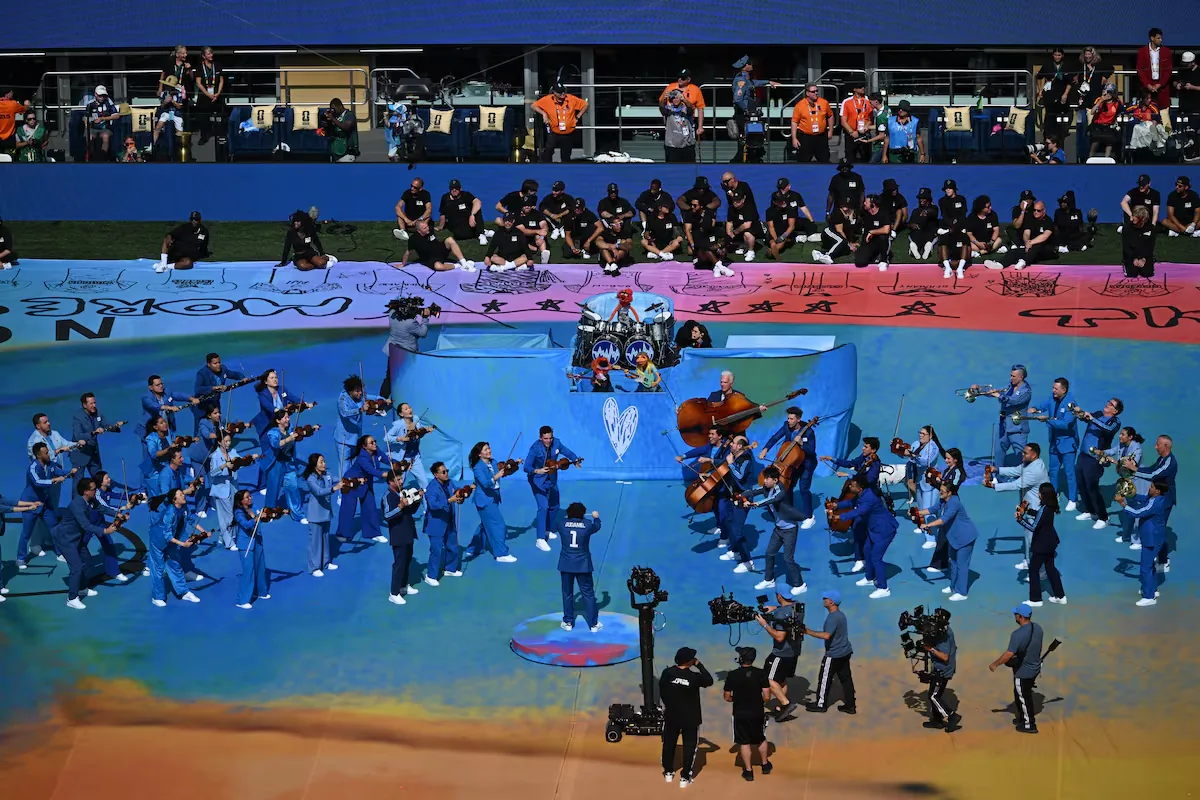
Our region was a protagonist in the World Cup not only through the players who competed in the tournament, but also through music, sending the world a message of unity, harmony, and hope. Under the direction of Venezuelan maestro Gustavo Dudamel, members of the New York Philharmonic and the Simón Bolívar Symphony Orchestra of Venezuela performed together in a historic presentation.
Read more A court rules that bail rights cannot be denied to migrants detained in the US
The alliance that UNDP has maintained for more than two decades with Gustavo Dudamel and the National System of Youth and Children’s Orchestras and Choirs of Venezuela (El Sistema) recently gave us the opportunity to host members of the Simón Bolívar Symphony Orchestra. An extraordinary group of young people between 18 and 28 years old who traveled from a Venezuela beginning a profound process of healing and recovery after the devastating earthquakes, to the city of New York to collaborate with one of the most important orchestras in the world and bring the transformative power of music to every corner of the planet, under the direction of the Venezuelan maestro—a historic event that should fill us with deep pride as a region.
Music does not erase suffering nor replace urgency. But it can do something deeply human: unite people, keep hope alive, and remind the world that, even amid tragedy, collaboration and creativity remain a force capable of eliminating borders, producing harmony, and creating beauty. This will be demonstrated by breaking the paradigm of classical music as something elitist and exclusive, integrating it with pop, rock, and afrofusion from a lineup of artists including Colombian and Caribbean Shakira, Madonna, Justin Bieber, BTS, Burna Boy, and the PS 22 Chorus (with participation from Coldplay).
That symbolic moment also reflects a broader phenomenon. Increasingly, the culture of our region occupies international stages. From music and film to gastronomy and tourism, the region today reaches millions of people through its cultural expressions that reflect our essence. This invites a deeper question. Can the growing cultural visibility of our region become a driver of development, inclusion, and social cohesion?
Latin America and the Caribbean possess a strategic asset that has long been underestimated: its cultural wealth. With 8% of the world’s population, it concentrates nearly 10% of World Heritage sites, six of the seventeen megadiverse countries, and more than 300 indigenous languages. That diversity today awakens growing international interest and offers a unique opportunity to drive development.
The evidence is increasingly visible. Latin American and Caribbean artists lead music charts, audiovisual productions from the region receive top international awards, and millions of people discover the region through its culture. In 2026, searches to learn Spanish increased significantly after the Super Bowl halftime show starring artist Bad Bunny. That same year, for the first time, a Spanish-language album won the Grammy for Album of the Year. The world is listening to Latin America and the Caribbean like never before.
But visibility does not automatically translate into development.
Today the region employs about 6.9% of its workforce in creative activities, above the global average. However, it remains behind in trademark, patent, and industrial design registrations. In other words, it creates a lot of value but captures less than it could. At the same time, many creators face informality, limited access to financing, and little protection of their intellectual property.
Investing in culture means much more than supporting an economic sector. It means investing in people, creating community, and building identity. Every music school, library, cultural center, or artistic space expands capacities, strengthens communities, and opens opportunities for children and youth to fully develop their potential. Creativity also builds citizenship, strengthens trust, and creates bonds where divisions often exist.
That is why transforming international visibility into development requires building ecosystems that allow that talent to flourish. Policies are needed to strengthen creative industries, promote innovation, expand access to financing, protect cultural heritage, and connect global recognition with local opportunities.
This has been the driving force behind the alliance between Gustavo Dudamel, El Sistema, and UNDP, an alliance we built after the catastrophic earthquakes that struck Venezuela to create a global campaign mobilizing resources and partnerships for a resilient, dignified, and people-centered recovery, which everyone can join. This campaign will include a concert for Venezuela on August 23 in Los Angeles, California, which will allocate 100% of ticket sales to the crowdfunding platform, to which everyone can contribute.
When the New York Philharmonic and the Simón Bolívar Symphony Orchestra shared the stage in the World Cup final, the brief minutes of the tribute that connected all our hearts with our Venezuelan sisters and brothers were very powerful. But its effect can transcend time and space, transforming our collective imagination as a region—especially that of our youth—expanding the horizon of what is possible.
That is culture. An inseparable part of our history. In the hardest hours, it allows us to collectively process pain and, at the same time, dream together about our future. Just as Latin America and the Caribbean shone doubly in the World Cup final, besides inspiring the world, may we recognize ourselves as a society and make culture a driver of development and collective construction of our future.