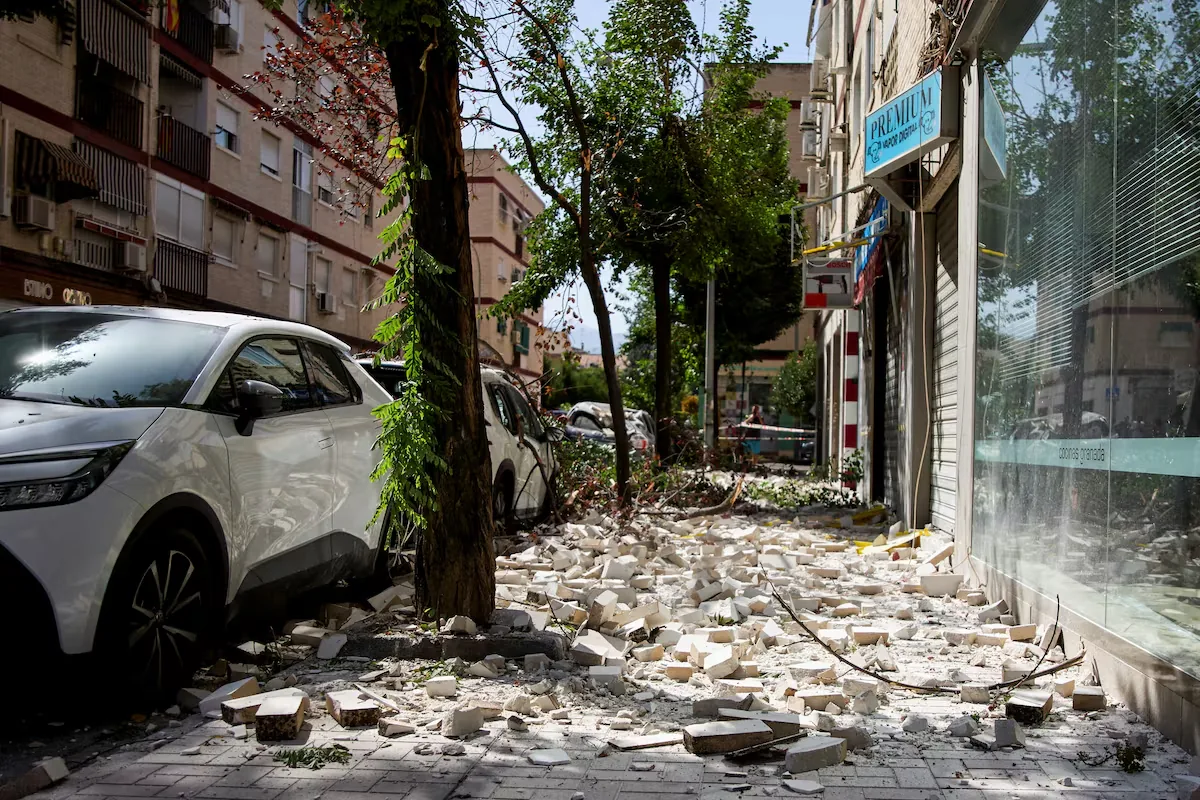
Granada trembled again this morning. Three days after the earthquake that woke the inhabitants of the province during the early hours of Saturday, a new 4.8 magnitude earthquake shook the metropolitan area this Tuesday. The epicenter was located in Gójar, near , the same place where the earthquake occurred on August 15. The movement, recorded at 10:37, according to the National Geographic Institute (IGN), was followed by several aftershocks, including one of magnitude 4 and another of 4.2.
Read more The cream under 9 euros that rescues cracked heels and is already a summer essential
According to the IGN, the answer to the question of why that area is shaking so much lies beneath the feet of the people of Granada. The province is located in the Betic mountain range, a geologically active region where numerous fault systems converge. The Granada basin is, in fact, one of the areas with the highest seismic activity on the Iberian Peninsula, as the public agency recalls.
Juan Vicente Cantavella, director of the National Seismic Network, explains that the two almost twin earthquakes are “closely related,” although he warns that it is not possible to predict whether there will be another tremor of greater magnitude. “They are part of the same seismic series,” explains the seismologist and researcher.
Aftershocks, he clarifies, are common in these scenarios. “Earthquakes rarely come alone. It is not the norm,” the expert points out. However, the behavior of each sequence is different and cannot be precisely anticipated. Most often, there is a main one from which others of lesser magnitude derive. On this occasion, it has been different. “You can no longer talk about a main one, because there are really two,” Cantavella notes, since both almost twin earthquakes are categorized with the same magnitude: 4.8.
Earthquakes respond to a release of energy, he explains, because the earth’s crust accumulates stresses until a moment comes when the material cannot withstand them and a rupture occurs. “When it breaks, that generates new stresses in the area. Those new stresses are what cause the aftershocks,” the expert emphasizes.
Read more Russia warns the United Kingdom that it will «pay a price» for supplying drones to Ukraine
The faults that cause them
According to the expert, the analyses carried out so far point to the fault in two localities located in the metropolitan area of the Granada capital. Although it is still not possible to say so with certainty. “The closest and best known is the Belicena-Alhendín fault, but there may be one that is not known so far. There are also other nearby structures, such as the Santa Fe fault,” Cantavella maintains.
The IGN considers the Granada-Málaga area as the most seismically active in Spain and documents significant earthquakes in the years 1431, 1531, and 1884. “The area can produce earthquakes larger than those that have just occurred,” Cantavella emphasizes. “In 1431, an earthquake occurred in the same area that caused much damage and affected the Alhambra of Granada. The geology is the same now as it was 2,000 years ago,” comments the director of the National Seismic Network. The literature from those years records that, that time when the town of Atarfe trembled, “it was so great and so many times that there was no memory of people who had seen anything similar.”
For the expert, what happened thousands of years ago is “totally relevant.” “It can perfectly happen again right now,” the seismologist points out. The difference, he argues, is that “we are better prepared.” Since the seventies, seismic-resistant construction regulations have required compliance in Spain in areas with the highest seismic hazard. In addition, “people are also much more aware that these kinds of things can happen,” he notes.
The recommendation in an extreme case is “to crouch down, cover your head, and hold on.” If you are inside the house, he points out, you should protect yourself under a table or a sturdy element and avoid rushing outside. If you are on the street, the appropriate thing is to move away from facades.
Read more A joint police operation between Spain and France dismantles an illicit migrant transfer network