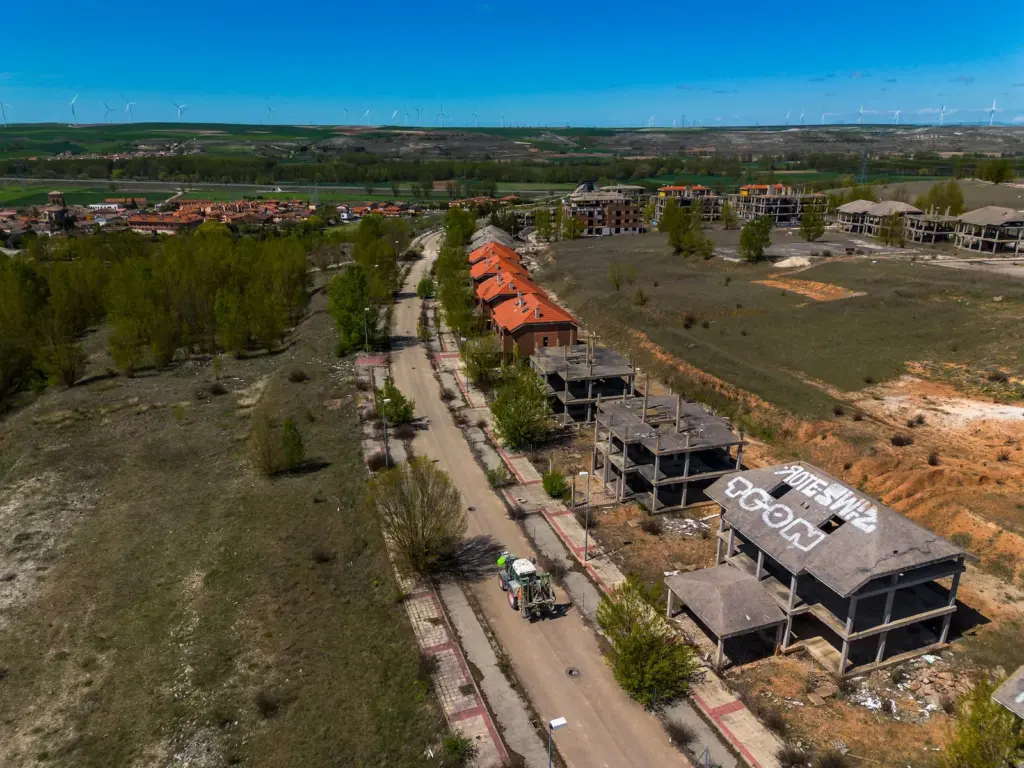









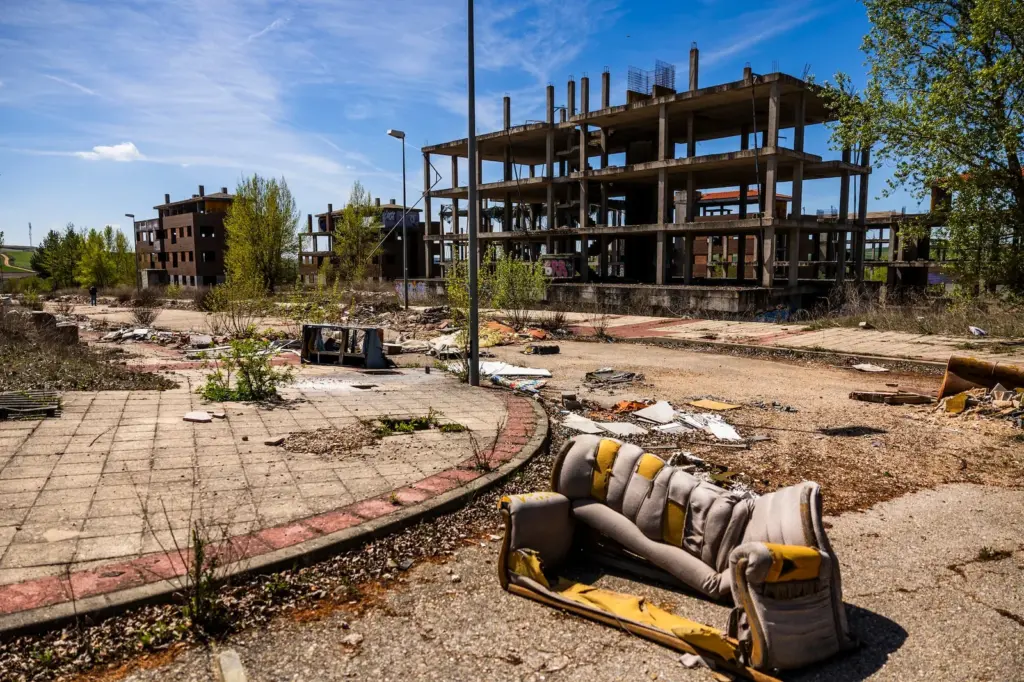
On the night of July 15, 2008, the housing developer Martinsa-Fadesa, dragged down by the crisis and the bursting of the real estate bubble, declared insolvency and filed for bankruptcy, unable to meet its payments. It owed 5.2 billion euros: the largest bankruptcy in Spain’s history up to that point. The next day, as soon as he heard the news, a plumber working as a freelancer, subcontracted by Martinsa-Fadesa, convinced that he would not see a euro for his work, dismantled the radiators he had installed in some houses of a development that the real estate company was building in Buniel, a town of 600 inhabitants near Burgos. He would receive nothing, but at least he saved the materials. The carpenter who had installed the window and door frames thought the same, as did the bricklayer who had re-roofed some of the houses. Much of this development was about to be finished, but that day its fate turned and it began to regress towards chaos: after the subcontracted professionals came the looters, who took the copper from the pipes, the kitchen tiles, or the manhole covers. In the final stage of degradation, some have been coming for years to leave an old sofa, piles of rubble from construction, a broken refrigerator, or car and tractor tires that no one wants anymore.
Read more Candela Peña: “I am the worst attack against myself”
The development, of approximately 1,000 homes, many of which were close to becoming elegant semi-detached chalets, has turned into a collection of houses showing their skeletons and a dump. And a bigger problem for the town and a constant headache for its mayor, Jesús Díez, from Ciudadanos. The half-finished houses languish next to the highway to Valladolid and deteriorate day by day in their race towards ruin. Meanwhile, renting an apartment in Burgos is generally difficult, as in the rest of Spain; and expensive: a 100-square-meter apartment costs 1,000 euros on average, according to the Idealista portal. The same goes for buying: it is almost impossible to find anything for less than 300,000 euros.
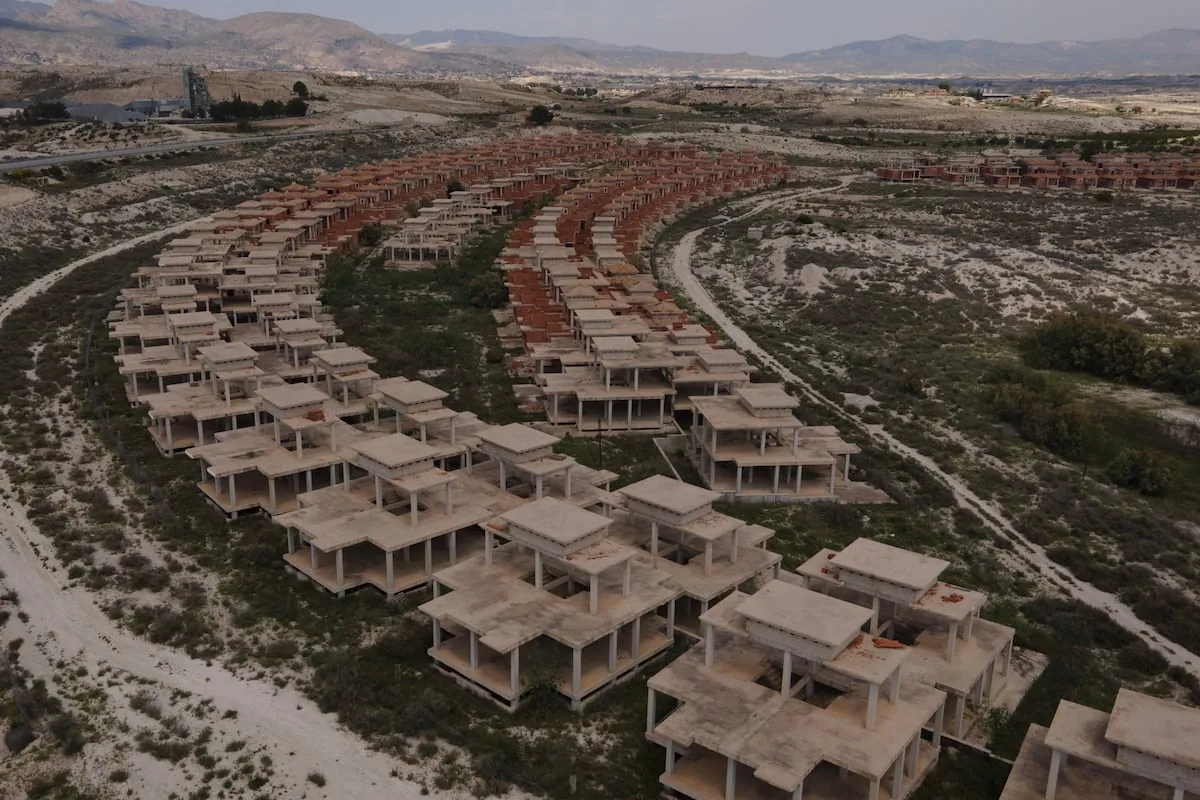
What happens in this town in Burgos is not a unique case. According to a study by the Ministry of Housing published in 2025, there are more than 100,000 homes spread across ghost developments the size of Buniel in Spain. One example: in the municipality of Fortuna, Murcia, beyond the industrial park, a complex pompously named Fortuna Hill Nature & Residential Golf Resort began construction in 2005, which was to house nearly 3,000 homes. In 2009, the real estate company carrying it out went bankrupt. Today it is an empty city made up of rows of ghostly semi-detached houses in the middle of a desert plain: the inhabitants seem to have fled after a nuclear catastrophe or a viral epidemic. Forgetting the Hill Resort, the area is once again known by its traditional name, Las Lamparillas.
Another example: on the top of a hill in the municipality of Pego, Alicante, nearly 1,000 empty homes stand out, also heirs to the bankruptcy of Martinsa-Fadesa. They surround what was once a model home that, like the rest of the development, has been meticulously stripped. From here there is a beautiful view of the valley and even the sea can be seen.
The Ministry of Housing study is called Residential Sectors in Spain and is, among other things, a detailed x-ray of the land pending construction in the country. One section mentions development areas with 1,000 or more homes, “in urbanized areas and in an advanced stage of construction,” but whose houses have not been finished. That is: ghost developments with half-built houses like those in Buniel, Pego, or Fortuna, which in the vast majority of cases have been frozen since the day the 2008-2009 real estate crisis halted them. The report also points out another decisive fact: there is urbanized land, that is, with streetlights and roads—although without buildings erected—for approximately 390,000 homes spread across Spain. These figures are especially bitter when placed next to another: the Bank of Spain estimates that nearly 700,000 homes are missing to meet the galloping demand that causes prices to soar.
All these ghost developments look similar from afar. Up close, each is different and carries its mountain of absurdities. Some have deteriorated so much that it is better to tear them down and build anew.
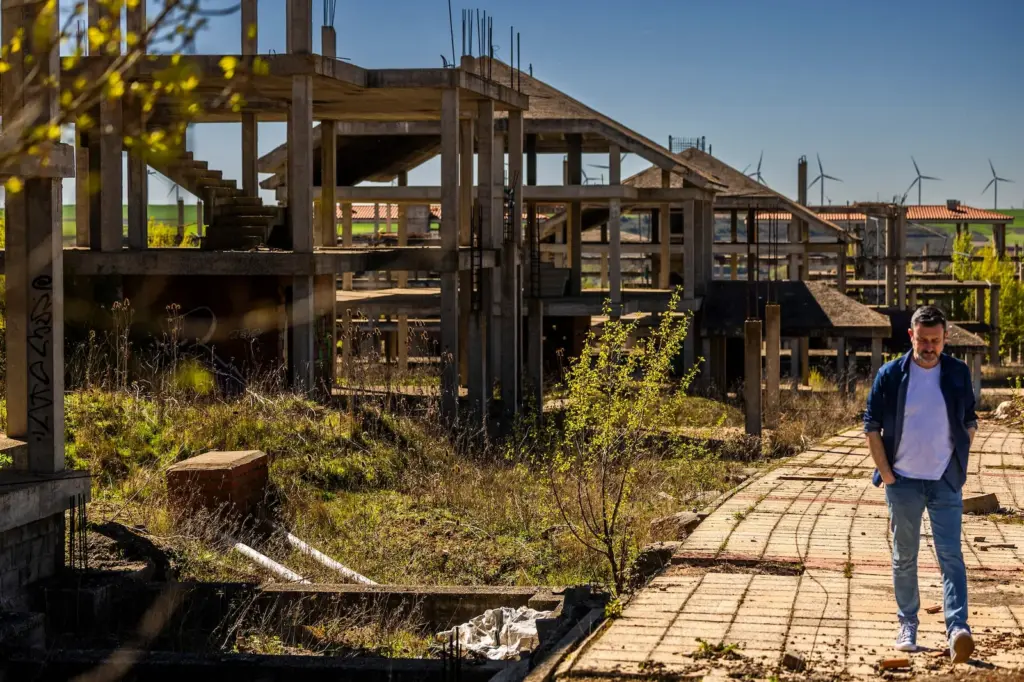
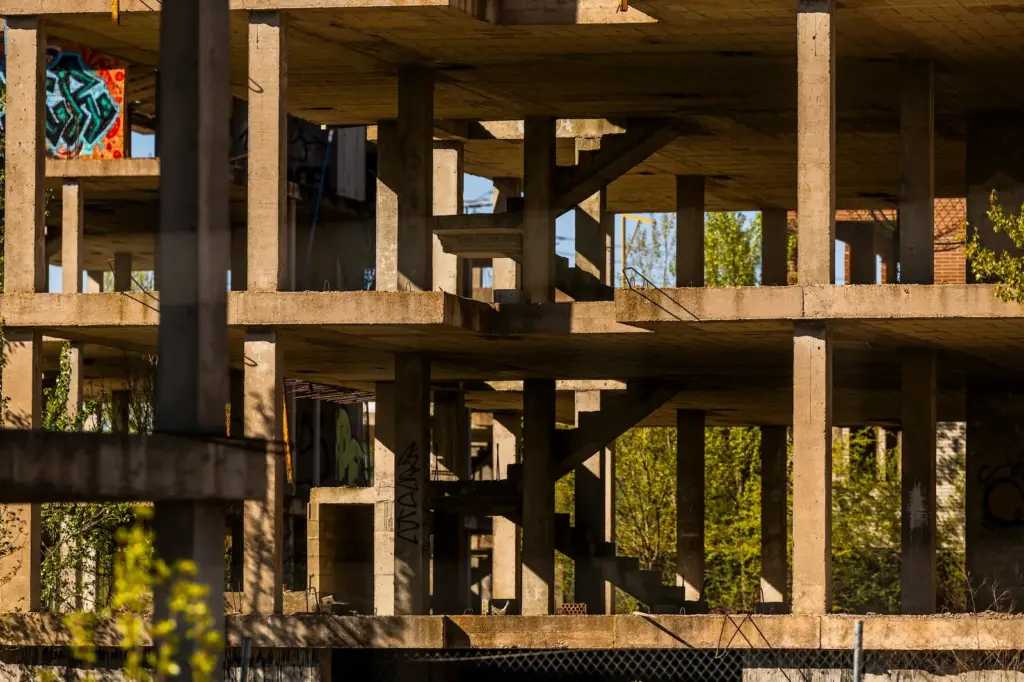
This is not yet the case for Buniel. Mayor Jesús Díez agrees, with some resignation, to show it. If you go by car, you have to turn off at the last roundabout of the town, following the sign “camino agrícola” (farm road). In reality, it is not a farm road. In fact, the road that starts from the roundabout ends in a collection of paved streets, wide, with sidewalks and streetlights. The weeds and wild bushes have taken over every corner, and it is true that you have to be careful because all the manhole covers are missing—someone stole them to melt and sell—and tires can get stuck in the holes. Some cyclists have already fallen, and the mayor fears that a tragedy could happen any day. Some have thrown garbage bags into the manhole holes, not knowing—or knowing—that there are pipelines that, in theory, should work. There are masonry nets hanging from some roofs, as if construction had stopped yesterday and not more than 12 years ago. There are interior stairs of houses without facades that go up two floors only to end in nothing: a whole symbol of construction and the entire development.
Díez has shown it many times (he has been mayor for seven years). “There was a time when there was a guard, who was more at the bar than here, of course. But not anymore. And another year we put up a fence around the whole area: it lasted a day, because farmers used many of these roads to go to their fields in tractors; so anyone can enter here,” Díez explains. With the same resignation he has had all morning, he predicts that to get all these dead homes and buildings to be reborn and become the city of almost 3,000 inhabitants planned, a miracle is needed: “That the owners of this come to an agreement.”
Read more Eviction in the Golden Mile of Northeast Madrid
The “owners of this” are the former creditors of Martinsa-Fadesa. In fact, the ownership of all this contemporary ruin is divided, in varying percentages, among many: there are, among others, real estate companies created to take over the plots and buildings inherited by banks during the crisis, such as Divarian Propiedad SA, which owns 40.30% of the Buniel pie, or Land Company 2020, which manages 6.47%; there are also firms specialized in buying and selling financial credits, such as Blackstorm Elite, which owns 1.11%. And even a law firm, Fortuño Gil, with 14.7%. Also on the list of owners is Sareb, known as the bad bank, the state entity created in 2012 to absorb and liquidate toxic real estate and financial assets held by banks and savings banks rescued during the financial crisis, that is, apartments and buildings that no one wanted from bankrupt banks. Sareb owns 17.77% of the ghost development of Buniel. And the City Council, as the ultimate owner of the roads and streets, also holds 8.82%.
Reaching an agreement among such a jumble of owners is a herculean task. And more so for a small City Council like Buniel’s, the most interested, deep down, in getting this moving. “Many people come here in ties representing these owners and say they have no money, that there is no feasibility study, that they lack funds, this and that. What they don’t have is willingness. And we can’t even do a feasibility study: that costs at least a million euros and we don’t have that. I have 11 employees in the City Council,” protests the mayor. “And luckily we didn’t end up taking over the development, as they asked us, because if that were the case, we would be forced to provide water and electricity to the invisible man. So the only thing we can do today is denounce the matter and show it, again and again,” he adds, while pointing with his finger at a broken three-piece sofa that someone left in the middle of the abandoned street of the development, next to the hole of a manhole without a cover: “It’s already a matter of health: of the environment.”
Economist and real estate expert Ignacio Ezquiaga says that with the housing shortage in the country, it is a real waste that all these ghost cities deteriorate year after year in such an obvious and gratuitous way. “There was a first step during the 2008 crisis, when the State came to the rescue of banks and financial entities to avoid collapse; now another important step must be taken: to put all that urbanized land to work: there is land for 390,000 houses on urbanized but empty land and almost 100,000 half-built houses. It is a huge pool of land in dead hands. For cases like Buniel, and many others, forced expropriation should be carried out to reverse the situation.”
There are developments that flirted with emptiness, such as Seseña (Toledo) or Mar Tirreno, in Pulpí, Almería. The difference is that the works—at least part of them—were finished five minutes before the crisis broke out. And that allowed the first settlers to arrive. In the case of the ghost development of La Fortuna, in Murcia, in the middle of the Las Lamparillas plain, the works were halted, unfortunately, shortly before the bubble burst due to the suspension of payments by the real estate company Promociones Eurohouse, which was burdened with debts of more than 200 million euros. The nearly 3,000 half-built homes, mostly semi-detached chalets, now facing a hostile landscape of bushes and bare mounds, were intended for middle or lower-middle-class English people who could not afford a house even on the second or third line of the beach (La Fortuna is 70 kilometers from the coast). The price was to be approximately between 150,000 and 200,000 euros. Right now, the owners of the development, according to an Urban Planning technician from the La Fortuna City Council, are “the members of the compensation board,” that is, the heirs of the real estate company’s debtors, without providing further details. He adds that the condition of the chalets is good and that the viability of the development is “possible.” Magdalena Rico, a lawyer from Murcia who has defended those affected by a similar case in another failed development, Trampolín Hills, not far from La Fortuna, says that even today the 3,000 ghost chalets of La Fortuna, finished, would have a market at around 175,000 euros.
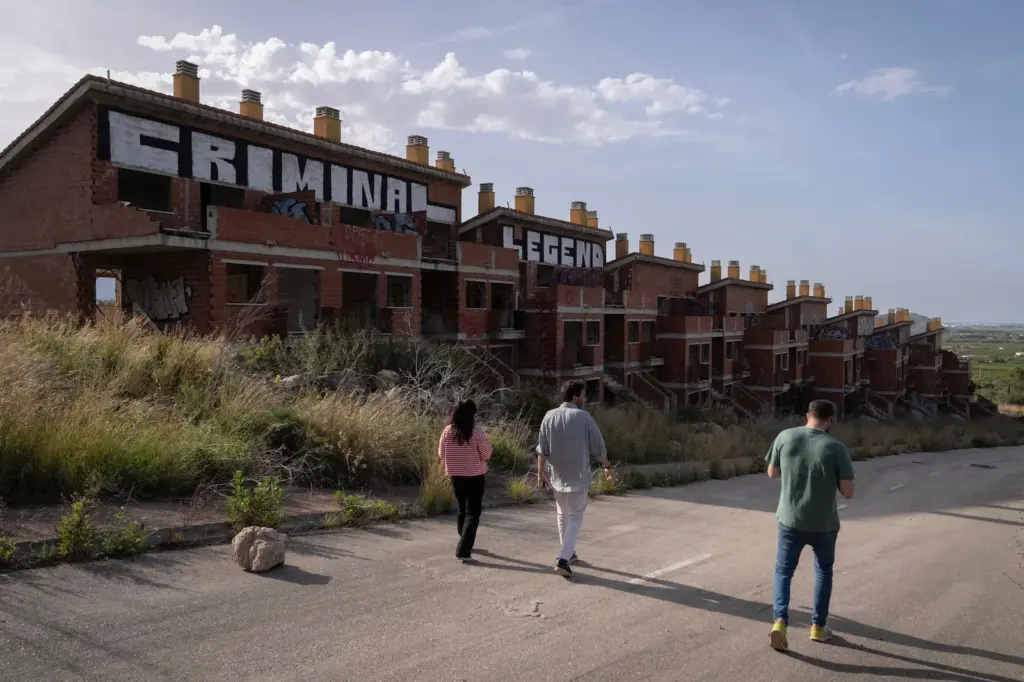
180 kilometers from La Fortuna, going up the coast, on a mountain near the Alicante municipality of Pego, with 10,000 inhabitants, is the dead development of Penya Roja. These are 1,000 homes sister to those of Buniel or La Fortuna. Here the manhole covers are also missing, part of the streetlights, everything that can be sold on a black market. There are spectacular graffiti, worthy of an exhibition. The Urban Planning councilor, Laura Castellà, describes and points out the homes with the same feeling of helplessness as the mayor of Buniel. Also in this case, the bankruptcy and the turn towards ruin came that night of July 15, 2008, because this set of houses also belonged to the gigantic Martinsa-Fadesa, which scattered similar sleeping brick monsters across the country’s geography. The hill that hosts the development, also called Penya Roja, is beautiful. The weather, this April afternoon, a blessing from heaven. “They tore the mountain down to make this,” protests Castellà.
However, in the case of Pego, a solution seems in sight: a local builder, the VAPF group, specialized in luxury tourist housing, bought the half-built houses and the rights to rehabilitate the development in 2020 after paying 14 million euros to the landowners (former landowners who received a home in exchange, investors, heirs of Martinsa-Fadesa’s debts, the City Council… the same mess as Buniel). But, according to Castellà, the VAPF group, which presented a rehabilitation project a month ago, is already in charge, at least, of the surveillance and maintenance of the development. “Environmentalists disagree. They want everything torn down. But the mountain will never be what it was. You can’t go back. If I had to approve this from scratch, I wouldn’t approve it, of course. I would leave the mountain virgin, untouched,” she explains. And, getting indignant at times against an invisible enemy, she asks: “But now, what do I do with this?” —and points to the rows of ruined homes, a roundabout you have to guess, a very old red seesaw eaten by weeds on which surely no child has ever played— “Can someone tell me what I do with this?”