









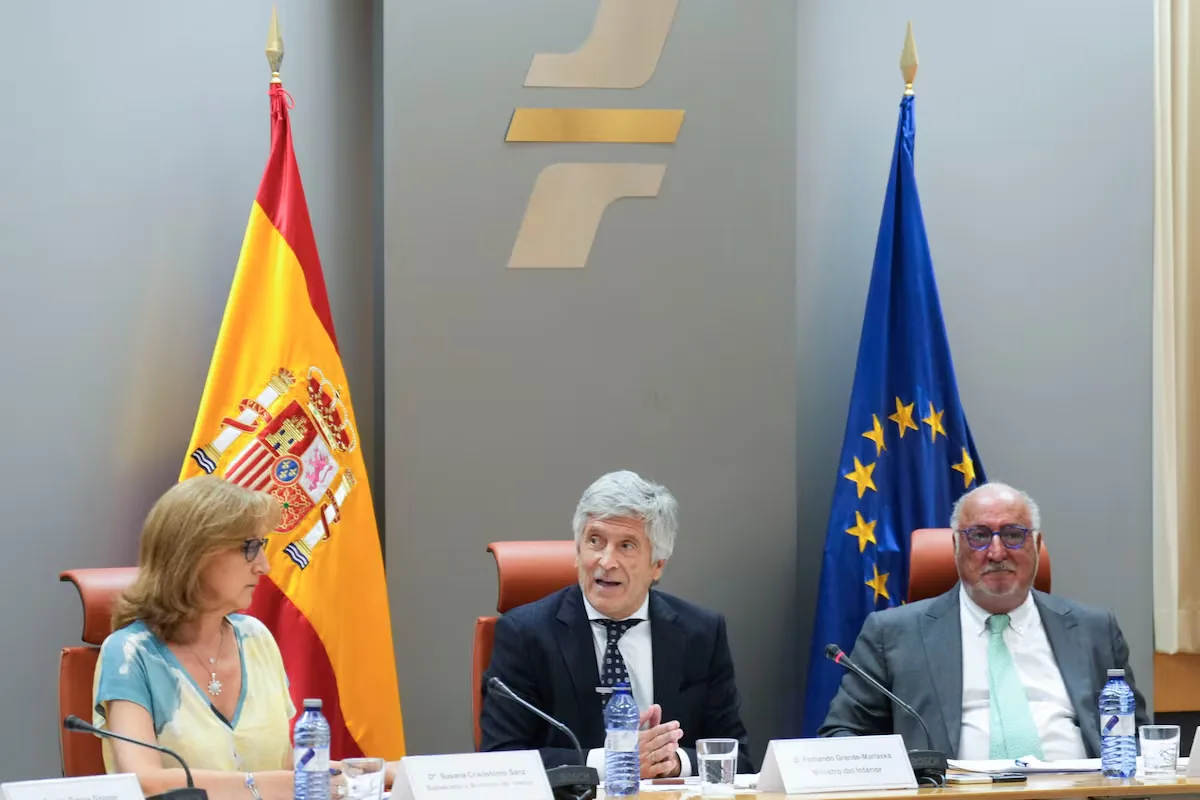
Bad figures for road accident rates during the summer months on the roads. The Summer Operation report, presented this Monday by the Minister of the Interior, Fernando Grande-Marlaska, shows an increase in the number of deaths from 230 in the summer of 2025 to 240 in the current one, between July 1 and August 31. The Interior Minister described these figures as “a bad summer,” in which 218 fatal accidents were recorded and 926 people had to be hospitalized.
Read more A man accepts 26 years in prison after killing his pregnant partner in Manresa
During the two months of the Summer Operation, there was a 1.5% increase in mobility compared to the same period last year. In total, 102 million trips were made. According to the data presented by the minister, 110 people died on the roads in July (five fewer than in 2025) and 130 in August (15 more than the previous year). This means that on average, four people lost their lives each summer day. From January 1 until midnight yesterday, 777 people have died on the roads.
During the summer, there was a reduction in deaths among so-called vulnerable users (pedestrians, cyclists, and motorcyclists), with 92 fatalities, 12 fewer than in 2025. Twenty-six pedestrians died (three more than last year) and 12 cyclists (three more). Those who broke the upward trend recorded since 2014 were motorcyclists: 54 died, which is 18 fewer than in 2025. The reduction was concentrated in Galicia, Andalusia, Madrid, and Catalonia. Half of the motorcyclists who died lost their lives during the weekend, on a conventional road, and due to leaving the road, according to data from the Directorate General of Traffic (DGT).
“Of the 26 pedestrians who died, 17 died at night during twilight and 13 of them were not wearing reflective clothing,” the minister explained. Grande-Marlaska highlighted that 25 people who died during the Summer Operation were not wearing seat belts.
The day with the highest number of deaths was Thursday, August 13 — the start of the Feast of the Virgin of August, during which many patron saint festivals are celebrated — with 10 deaths, while in July there were two days without fatalities. The highest number of deaths occurred on conventional roads — a single lane in each direction — with 175 deaths, 73% of the total. The remaining 65 occurred on highways and motorways.
The most serious fatal accident of this summer — and of the year — occurred on Sunday, July 5, when the winery businessman Iván Sanz Cid, his wife, Irene Garijo, and their three children, aged 9, 14, and 17, were returning from Cantabria to Valladolid when their car, a Ford Bronco, left the road. Only the youngest daughter survived the accident. She was airlifted to the hospital in Burgos, where she underwent surgery. The accident occurred at 16:20 on the Meseta motorway (A-67), at kilometer 83, heading towards Palencia, when the vehicle left the road and rolled over several times. The Government sub-delegation pointed to possible “driver drowsiness” as the first hypothesis of the accident.
Another of the most serious fatal accidents this summer occurred on Thursday, August 17, when four young people aged between 18 and 21 died and another was seriously injured in a traffic accident recorded this Monday on the N-122, between the towns of Bulbuente and Maleján in Zaragoza, after a crash involving two cars and a truck. The frontal collision between a car and a truck. The four deceased were all occupants of the same car, the one that collided with the truck, according to sources from the Provincial Council of Zaragoza. The seriously injured person was airlifted to a hospital. There were no injuries in the other car.
The Minister of the Interior highlighted that forest fires and the eclipse on August 12 also influenced road mobility. During the fires, 2,640 kilometers of roads were closed, affecting 227 routes. The greatest impact occurred on July 27 with 850 kilometers closed. These operations involved 1,600 agents.
The eclipse resulted in more than 2.3 million trips, both long-distance and access to observation areas. The moment of greatest intensity, after the phenomenon ended, occurred between 9:00 p.m. and midnight, when traffic increased by 25.7%.
The Directorate General of Traffic has the phone number 018 to assist victims of road accidents. It offers information, guidance, and support to victims and their families. It is free, accessible, has national coverage, and is available in more than 50 languages. It operates from 8:00 a.m. to 9:00 p.m. every day of the week. It can also be contacted via WhatsApp at 645 713 823, by email at victimastrafico@dgt.es, or on the DGT website.
The Socialist Group will again present the proposal to reduce the blood alcohol limit
The Minister of the Interior, Fernando Grande-Marlaska, has announced that the Socialist Group in the Congress of Deputies will “in the coming days” again present the proposal to reduce the blood alcohol limit while driving, as EL PAÍS already reported. The Interior Minister explained that there has been no change to the text that was rejected a few months ago and hopes that this time it will be approved by the other groups that previously rejected it.
Grande-Marlaska called for “reflection from all political parties” and appealed to “scientific evidence” on the importance of not consuming alcohol when a person is going to drive. He mentioned a study from the University of Valencia that shows that consuming 0.5 grams of alcohol per liter of blood or more triples the risk of having a traffic accident. A study by the Directorate General of Traffic (DGT) shows that 5.2% of drivers have consumed alcohol.
“It is time to correct this situation and place ourselves at the forefront. I hope this time it is approved and through the urgent procedure because our only goal is to reduce deaths caused by alcohol consumption,” Grande-Marlaska stated.