







EL PAÍS offers the América Futura section openly for its daily and global informative contribution on sustainable development. If you want to support our journalism, subscribe here.
Read more Read to Grow: CAF’s Commitment to Culture and the Word
I remember that since I was a child I have cared a lot about trying to do things to “save the planet.” Back then I thought that putting the trash in its place, inside a plastic bag, would be enough to achieve my goal. In the end, I was like most people: as soon as the trash disappears from our sight, we stop worrying about what happens to it. We don’t think about the landfills, many clandestine and poorly regulated, where all kinds of human rights are broken. Since we don’t see it, it doesn’t exist.
Over time I found that I could do even more things. The trash could not only go in its place, but it could be separated into different types like cardboard, aluminum, glass, and plastic to be ‘recycled’: a magical word that promised to change everything. It was the solution to the waste problem. With this, I had control over sending those wastes to where they were really useful. In my imagination, while it disappeared from my eyes, all this reached a clean company; not like in the landfills where the trash arrives mixed between organic and inorganic. I thought that what I had thrown away somehow had the power to come back to me in that product that now said “contains 5% recycled plastic.”
But as I got closer to environmental problems, I realized there was a big difference between the words reduce and recycle; and also a big difference between recyclable products like cardboard, glass, and metal compared to plastic. The waste problem goes beyond what my little self thought. The waste problem, especially plastics, originates much higher up: in the production and design of products. That is where we can really change how their flow works.
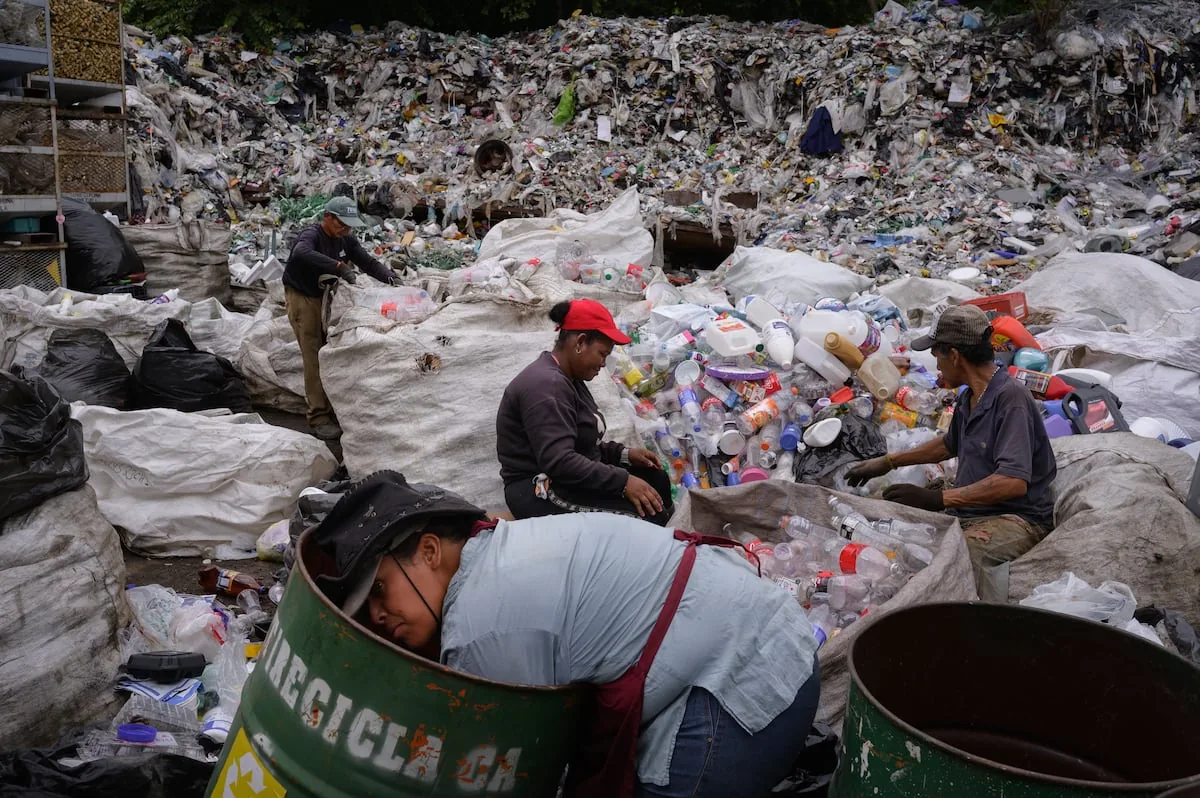
Over time, the plastic problem has been growing. In the 1980s in Latin America, approximately 7 kg of plastic per person per year was consumed. This amount has increased to an average of more than 30 kg per person per year, with countries like Mexico and Chile reaching up to 50 kg. Of all this plastic, 4% is recycled in the region, although in some countries this number may be higher. Perhaps, after reading these data, one might think that all that is needed is to improve separation and collection to increase the amount of plastic recycled, but this is not really the solution.
Recycling is often sold as infinite. That each recycled bottle will become another new one and so on. But this does not happen. The plastics known as “more recyclable” are polyethylene terephthalate (PET) and high-density polyethylene (HDPE). It is known that PET can be recycled between one and three times, and HDPE between three and ten. This means that after going through the recycling process, these products end up degrading into lower quality plastics that eventually can no longer be recycled or end up being transformed into “renewable” fuels sold as more ecological alternatives to fossil fuels.
Read more Do not think about public education
This is one of the facts I find most interesting, since recycling will not actually end up solving the plastic pollution problem; at most it could delay it until that PET bottle ends degraded into a plastic bag or clothing with “recycled polyester” that will no longer be recyclable. At the end of its useful life, it will end up discarded or incinerated. The other alternative is that it ends up “disappearing” into the air by being burned in the “ecological” gasoline of a ship, releasing dioxins and heavy metals into the environment somewhere in the sea where we probably won’t realize the impact it is generating.
Plastic recycling also generates a second controversy, which is the feeling of being the solution for produced plastics. This gives companies that make them a license to continue packaging their products in packaging, bottles, and bags of this material, instead of seeking other alternatives to migrate to, such as cardboard, paper, glass, or even refillable or returnable containers that, although they may be plastic, are used multiple times before ending their useful life.
As a doctor, the plastic crisis we currently live in worries me not only from an environmental perspective but also from a public health perspective. They are a product that contains multiple substances that are released throughout the life cycle, increasing the risk of different endocrine diseases, inflammatory diseases, and various cancers; this without mentioning microplastics, about which we are increasingly learning how they affect our health and the environment.
I think what we need is a comprehensive initiative that considers both national and international actions, including ambitious proposals put forward in the global plastics treaty. Initiatives involve reducing plastic production and changes in national public policies that encourage migrating to other materials, as well as zero waste policies that generate a systemic change in consumption. We need the reduction in plastic production to be at the forefront of action, especially the reduction of single-use plastics and unnecessary plastics. We must change consumption systems to others that promote reuse and repair instead of disposal, and the switch to more sustainable materials, such as glass, cardboard, paper, aluminum, cotton, linen, etc. For those who have no alternatives, reusable and repairable plastics must be generated so that they remain in use for many years before reaching disposal, where, hopefully, recycling technologies improve, and these few plastics that reach the end of their life are then recycled.
Read more Israel, from euphoria to disappointment in 20 seconds