








In the early 2010s, I was lucky enough to study at a brick institute, the IES Enguera. But my mother, a public school teacher — and still a teacher today — worked for years in different towns in neighboring regions, often in prefabricated classrooms. Since then, I still don’t understand how that country, which during the real estate bubble was rapidly building housing developments, seemed incapable of constructing decent public schools for its own children. Paradoxically, many of them ended up leaving the institute to work on those same construction sites.
Read more Israel, from euphoria to disappointment in 20 seconds
Those of us who are now around thirty grew up among barracks, green t-shirts, and demonstrations in defense of public education. I remember the first time I saw on TV the students of Lluís Vives in Valencia raising their books and shouting “som el poble, no l’enemic” (“we are the people, not the enemy”). The Valencian Spring was born. Many of us were deeply impressed that defending public education was defending a land where opportunities did not depend on whether you were born on Colón Street or in a town in the Canal de Navarrés.
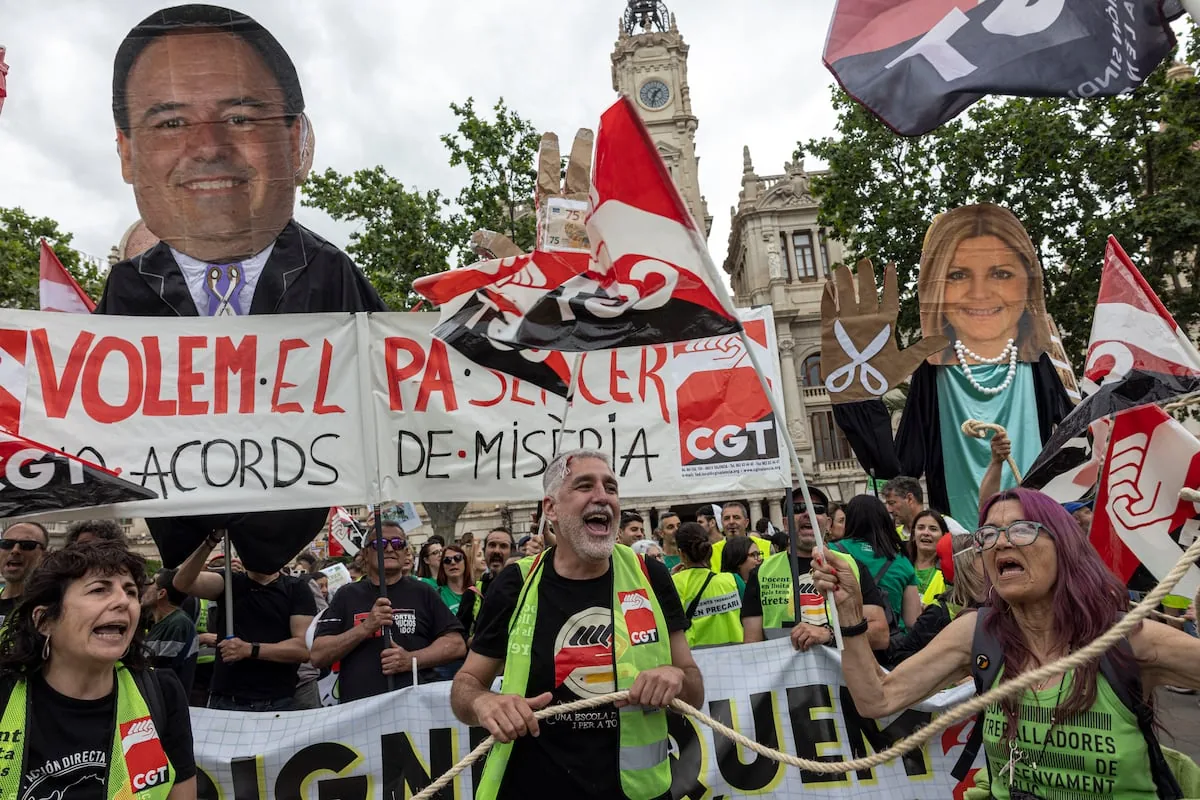
Perhaps that is why it is so striking that, more than a decade later, part of the debate around the current Valencian educational strike no longer revolves around ratios, funding, or school dropout, but rather on whether teachers have breakfast before a demonstration, if they protested less under the Botànic government, or if their demands are solely about salary issues.
The Pérez Llorca Council seems to have understood that this conflict is not only played out in classrooms but also in the narrative surrounding the protest. And here the strategy is clear: shift the focus of the debate and turn it into a discussion about the legitimacy of those who protest. It is no longer about educational conditions, but about the credibility of the teaching staff.
This strategy fits with what in communication is known as whataboutism: responding to a criticism by diverting the conversation to other parallel debates. The goal is not so much to debate as to shift the center of gravity until the conflict loses clarity.
And yet, the problem remains. The Valencian Community carries school dropout rates much higher than territories like the Basque Country, where educational investment has historically been greater. It is difficult to talk about prosperity while public education is seen as an expense rather than an investment.
Read more Foldable, stackable, and ventilated: the shoe organizer that fits any space
The risk is that the teaching staff gets trapped in that moral ground. Every time the debate shifts to gestures or habits, it moves away from the essential: classrooms, funding, and the future of the educational system. Whoever manages to set the framework of the conflict usually wins a good part of the battle.
If we Valencians have learned anything, it is that no one is going to give us anything for free. Improvements in education or public services do not come by themselves: they come when there is sustained conflict and enough pressure to change priorities.
Linguist George Lakoff taught us a few years ago that just telling someone not to think about an elephant does not stop their brain from imagining it. And that is precisely the strategy the Valencian Council is trying to apply: that we do not think about public education.
And maybe that is what this strike is really about: whether Valencians want first-rate public education or second-rate public education. That the barracks are left behind forever, that our teachers have decent conditions, and that the normalized situation of having 30 students in a high school classroom ends. And that is what is really at stake in this strike.
Read more The DGT fines scooters without identification: how to regularize them and get the ‘license plate’