







Everything is as usual. The team buses park near a pharmacy that immediately fills with doctors and masseurs who fill bags with flesh-colored nasal strips, the only ones sold in pharmacies, because many wear colored ones, following a returning fashion, that transform the features too much. Cycling as always. Very macho. Race commissioners who shout about football at dinners, flirt paternally with the restaurant waitresses, and at the start measure the width of the handlebars from lever to lever with a tape measure and force Adam Yates to open his a little, too closed. The Englishman, obedient, taps the levers twice with his fists, whose separation already reaches the 280mm required by regulations. Hours later, the commissioners get tangled up with the bonuses, do the math wrong, and take hours to decide the maillot jaune after making the wrong rider go up to the podium to wear it. A routine repeated in races all over the world. So where is the magical Galicia then? The imagination and the dream? The mist of Valle? Who said that O Gran Camiño is different?
Read more ICE detains a migrant interpreter in Texas despite decades of legal work in the United States
It was said, and is said, by Ezequiel Mosquera, a cyclist who before Strava used to train through the forests and fog of the Ancares with a folded road map in his pocket and a compass on the handlebar to orient himself, and now a race inventor. He started with O Gran Camiño in the snowy winter February four years ago and in its fifth edition, as an independent and different organizer, he has already managed to make the race have five stages and be held in April, sunny in Galicia. And he has not given up, on the contrary, on his principle: cycling as always and something more, each stage a narrative linked to the territory, to the Camino de Santiago and its mystique beyond religion, the landscape, the land, the vegetation, the sea. To sponsors who in almost all races put up so many advertising barriers that bury the beauty of the places, he offers a deal: I don’t know if your banners will show much, but I will achieve such a good broadcast, with such quality, that each stage will be a great documentary, so attractive that viewers will stick to the screen to enjoy it, and to recall legends, even if the riders sweating the asphalt and mountains are not the big stars.
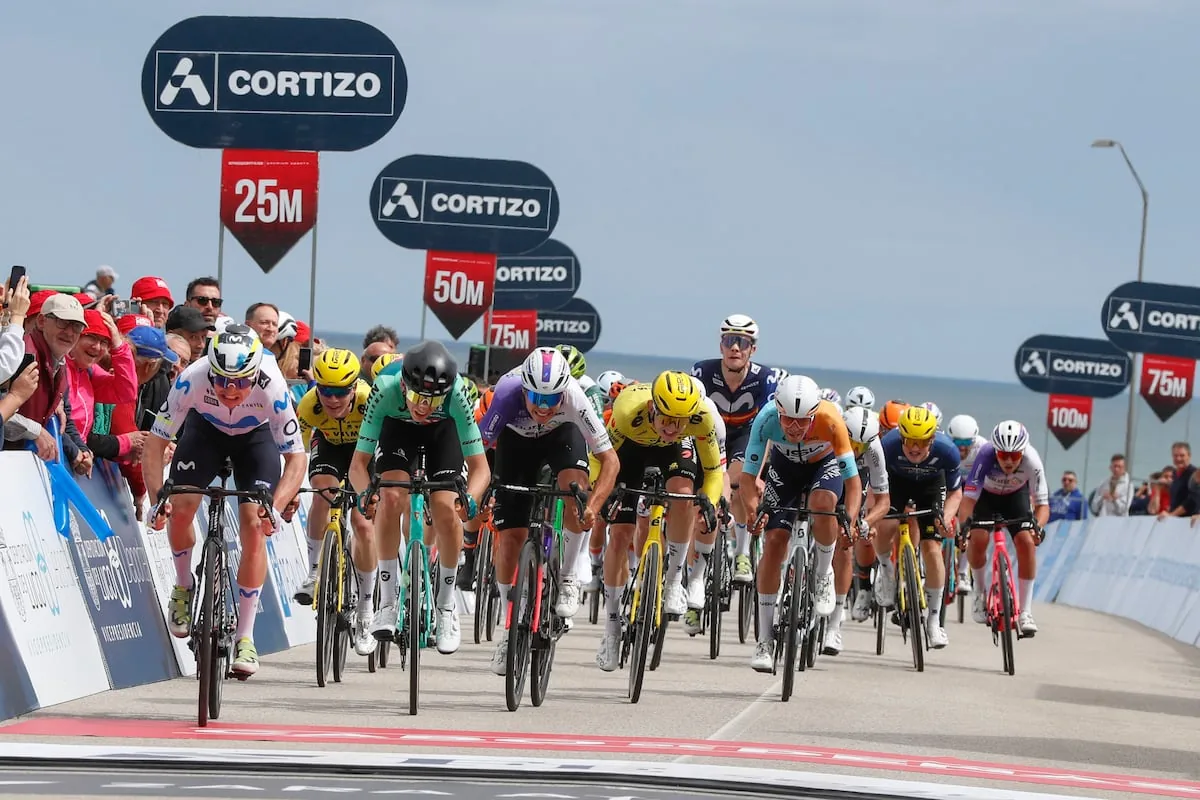
The figure is the image that Mosquera imagines dreamily when going to bed tired and that the director, Raúl San Román Otegui, pampers the next day, and eyes that relive the landscape, and a race drone pilot, miniatures that reach 200 kilometers per hour and launch towards the beach of the cathedrals, the Viking ships of the Muros estuary, the sands of Corrubedo and climb up the Arousa estuary to the pepper orchards of Herbón (not yet in season) and Rosalía’s house, and then link with the peloton that accelerates up Pico Muralla, between Rianxo and Rois, drafting the hyperactive Iván Romeo.
🔥 Some legs that scare.
👊 Top level of Iván Romeo, who casually drops Pinarello and Balderstone 10 kilometers from the finish #OGC26 pic.twitter.com/pL1ucKU6yg
— Eurosport.es (@Eurosport_ES) April 16, 2026
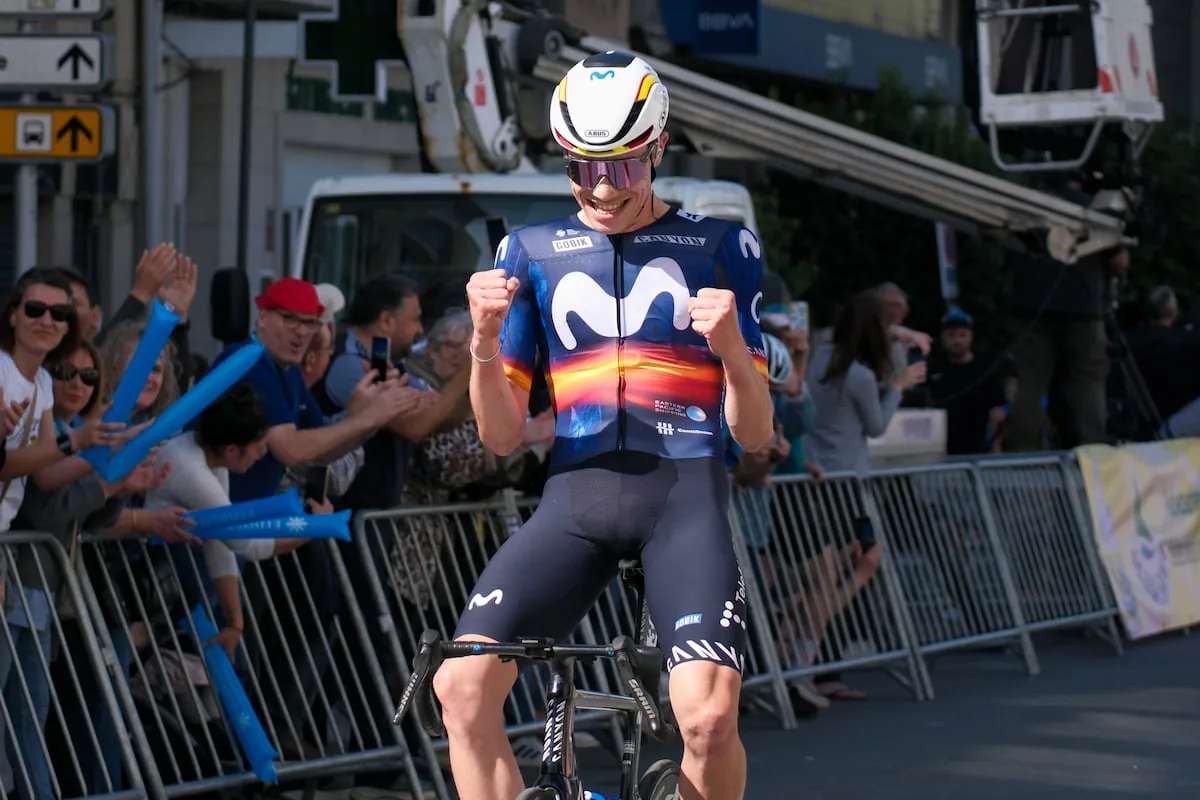
Romeo is in a state of grace, he says. The legs turn perfectly. “There are days like this,” says Romeo, arms at right angles, perfect composition of the classic cyclist profile, time trialist speed, watts bursting the power meter, flesh-colored strip on the nose. “Today was one of those days, I realized it from Pico Muralla. I told Arcas I had big legs and the spell worked again. The last three times I’ve won I told Jorge about the big legs. I have to keep the phrase because it seems to work.”
Read more Citlalli Hernández resigns from the Secretariat of Women to help Morena towards the 2027 elections
The pace is so fast that only six remain ahead towards the finish. With the man from Valladolid, those who were already known before the start to stand out: Adam Yates, Abel Balderstone, George Bennett, Alessandro Pinarello on a Scott bike and the boy Jorgen Nordhagen, the 21-year-old Norwegian who admires Contador more than Vingegaard and who a year ago, still a junior, held his own in the head-to-heads at the Tour de l’Avenir with the dazzling Paul Seixas who amazes in the Itzulia. “It’s really impressive to see how Seixas rides,” says Nordhagen, a young Visma rider who turns the last kilometers of the stage into a boxing match and suicidal cunning with the old Adam Yates in useless pursuit of the flying Romeo who wins the stage. “Without a doubt Seixas is making a big leap compared to last year, when I competed against him and was so close in the Rosière time trial climb. But this is no longer juniors, this is a completely different game, we are both on a World Tour team and giving our best. He has progressed faster. We are different. I can’t compare myself to him, but I hope to reach his level little by little, more slowly. That would be great.”
Nordhagen loses the stage, but the commissioners give him the yellow jersey. He goes up to the podium and wears it, but something disturbs the Norwegian, who feels unable to open the sparkling wine bottle to shower the crowd. An hour later, the commissioners correct themselves. The leader is Pinarello with equal hours, seconds, and tenths of a second, by only hundredths. It also doesn’t seem to matter much to Nordhagen whether he is leader by one or two seconds, or none. “Yellow is fine, but it doesn’t count until the last day,” laments the Norwegian, who will seek the overall victory in the last two stages. Hard mountain stages whose profiles he knows by the road book but about which no one on the team has spoken to him despite his teammate Vingegaard winning the 2023 O Gran Camiño on Monte Trega, a stone way of the cross in A Guarda, in the Raia del Miño. “Adam and I tried to play a little cat and mouse and I think I was wrong. In the end, I focused too much on him and let Romeo go.”
At the finish in Padrón they sing the victory of the man from Valladolid of Movistar José Ángel Vidal and Suso Blanco Villar, what strong and big hands they still have, that tortured the handlebar in time trials, the old glories of the town, who sing the praises of Galician cycling, so far from the centers of power, so hidden. “But Ezequiel will make it live again,” they say. Ezequiel Mosquera smiles and thinks, and dreams, and takes steps of greatness. “Everything is done by the territory,” he says. “And how I like to take a brush and draw routes through the forests and paths. You’ll see on Friday the Ribeira Sacra, the climb to Cabeza de Meda, next to the Cistercian Monastery of Xunqueira de Espadanedo…”
Cycling-wise, Galicia’s natural expansion goes through Portugal, neighbor and sister, and there Mosquera has already set foot, having taken over the organization of its three most important races, the Vuelta al Algarve, the Alentejo, and the Grandissima, the great Vuelta a Portugal in August. There he will export his model, which grows exemplary.