





The numbers barely add up, but the Russian government is forced to raise even further economic incentives that were already exorbitant to attract new recruits to the army. The Kremlin has avoided a second forced mobilization for four years thanks to the generous salaries it offers for going to the front of the war in Ukraine, but the pool of volunteers is not infinite. The peace negotiations that Donald Trump intended to promote are at a standstill, and time also pressures Russia in its invasion of the neighboring country. The alternative, forced recruitment, could trigger protests within the country.
Russian President Vladimir Putin has signed a decree that cancels overdue debts for new recruits and their families up to 10 million rubles (just over 120,000 euros at the current exchange rate). The only requirement is to have signed a contract with the army from May 1 onwards.
Putin approved a similar order in November 2024. However, this time it comes accompanied by other decrees—signed in mid-May—that grant the military preference in employment, healthcare, and enrollment of their children in nurseries, schools, and universities. In short, more benefits than ever.
2,400 euros per month
Likewise, payments for signing a contract with the armed forces have reached record figures this year. In addition to receiving a minimum salary of 200,000 rubles per month (about 2,400 euros), new soldiers in the Russian army receive a one-time bonus to which the Ministry of Defense contributes 400,000 rubles (4,800 euros).
This extra payment is supplemented by each region according to its criteria to cover their recruitment quotas. At least a dozen provinces have increased their payments between 50% and 80% in the last month and a half, according to the independent newspaper Mózhem Obiasnit. Thus, the average bonus or premium is around 1.47 million rubles (almost 18,000 euros), although in economic hubs like Saint Petersburg it already reaches 4.5 million rubles (about 54,000 euros). For comparison, the average Russian salary was around 73,400 rubles last year (886 euros at the exchange rate).
The increase in enlistment incentives contrasts with the government’s difficulties in balancing the public budget, despite extra income from the oil crisis triggered by the United States and Israel’s war against Iran. Although Russia has sold oil at higher prices, also increasing state revenues, the public deficit reached 2.5% of GDP in April.
The chairman of the State Duma Committee for Competition Protection, Valery Gartung, lamented this Monday: “What are we going to do with the deficit? Last year it was more than five trillion rubles, now five trillion more. About 11 trillion. What do we do? Print money like in 1992, when prices rose 30% every week?”
As long as there are resources, however, Putin will avoid forced recruitment as much as possible. The Kremlin faced protests across the country when it carried out the only mandatory mobilization in September 2022, when Ukraine shook off the initial Russian offensive. Today, however, it claims to have the entire front covered. “I can only say that [recruitment] is progressing ahead of schedule. We are fulfilling all plans by forming new units,” said Russian Defense Minister Andrei Belousov in early April.
Read more Why don’t the government partners want the motion of censure?
200 fewer recruits per day
Some analysts doubt this optimism. Based on budget data, military analyst Janis Kluge estimated a 20% reduction in recruitment in the first quarter of this year compared to the same period last year: supposedly, enlistment has dropped from between 1,000 and 1,200 soldiers per day in 2025 to barely between 800 and 1,000 currently.
Other sources cited by the Russian newspaper Viorstka also point out that the recruitment pace has slowed and that new volunteers are increasingly older. A military analyst consulted by this newspaper states that he can only comment on official figures before noting, somewhat unconvinced, that, in any case, he has not seen “personnel shortages” at the front.
According to the vice president of the Russian Security Council, Dmitry Medvedev, 417,000 people signed contracts with the Ministry of Defense in 2025 and another 36,000 went to war as volunteers. The big difference between the two, apart from salary, is that once they sign a contract, they are tied to Defense.
216,000 dead
The question is whether the recruitment pace is sufficient for a war of attrition. The British BBC network and the independent Russian media Mediazona have a team that confirms each death of a Russian soldier since the start of the war through various channels. According to their data, at least 216,205 Russian combatants have died up to May 1 of this year, although they estimate the real figure may be between 332,600 and 480,500 dead. To these would be added the irrecoverable wounded for the front, whose numbers usually equal or multiply those of the deceased in each conflict.
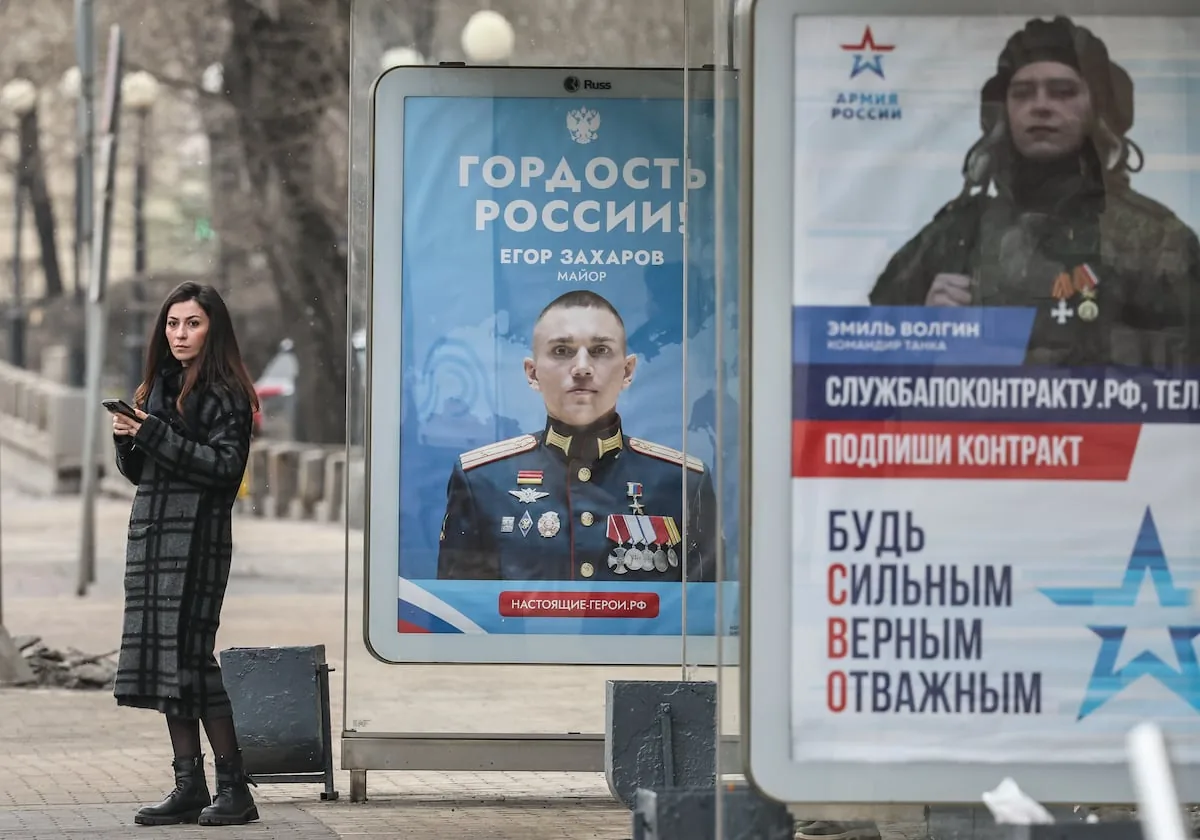
The wage gap between the army and civilian employment has sustained the flow of new recruits, the kontrátniki, in the last four years. However, Russian propaganda is not enough to hide the reality of the front, especially that of the assault troops, the shturmovikí, who can die shortly after signing their contract. For this reason, the authorities have focused their latest recruitment campaigns on drone units, supposedly better protected at the front.
Youth are the main target of this propaganda. Not only do they sugarcoat the harshness of war as if it were a video game, but they also receive pressure from their teachers to go to the front for at least a year. According to a leak from university rectors, the authorities have ordered more than 200 universities and technical study centers to enlist at least 2% of their students, which would mean about 77,000 more soldiers for a war that annihilates hundreds of lives every day.