








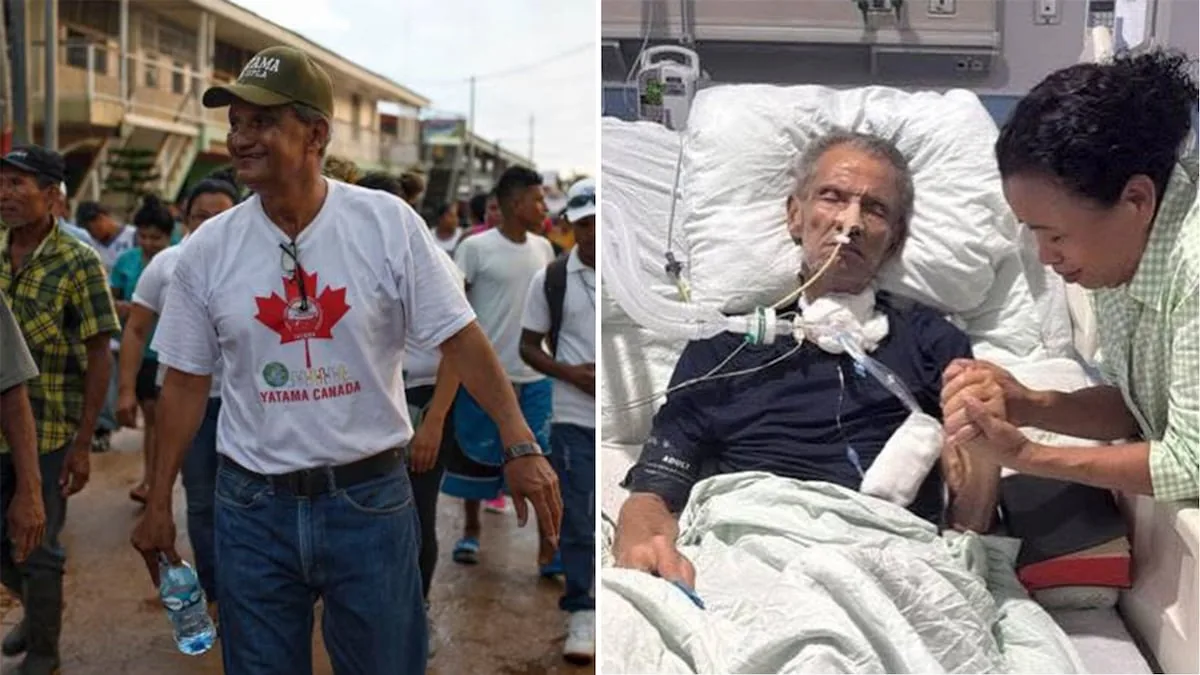
971 days ago, when the police of the Daniel Ortega and Rosario Murillo regime captured him in Bilwi, Brooklyn Rivera had the appearance of an older man, but without visible signs of extreme deterioration. He looked like an indigenous leader with the vitality necessary to spend several days fleeing from the officers pursuing him in the North Caribbean of Nicaragua, after having become a critic of the ‘co-presidents’ couple. At least that is how it appears in the photo leaked after his capture, an image that exponentially differs from those presented on May 27 by the Government, in which a man is seen extremely emaciated, bedridden in a hospital bed and with a tracheotomy.
Read more The ghosts of the Airbnb World Cup
“His current condition is delicate, with mechanical ventilation through a tracheotomy and intravenous feeding; he presents multiple organ failure, cirrhotic liver, and active lung infection caused by resistant bacteria,” the regime reported in a statement issued under international pressure and complaints from the political prisoner’s family. The leader of the indigenous party Yapti Tasba Masraka Nanih Aslatakanka (YATAMA) was detained on September 29, 2023, and since then, he had been under enforced disappearance due to concealment of whereabouts.
His family never knew where he was being held. Despite the outcry to know his condition, the regime never provided information about Rivera, who at one time was an ally of Sandinismo in Parliament. “We don’t know if he is alive, in a morgue, or seriously ill in a hospital,” denounced the indigenous leader’s daughter, Tininiska Rivera, who is exiled in Spain, last March. This Wednesday, after learning of the regime’s statement, Rivera’s daughter made a public denial: “The day they took my father, he left his house in optimal health conditions, walking and able to take care of himself. Therefore, the regime cannot now pretend to blame previous conditions for the physical deterioration of a man who has been under State custody for almost three years,” Rivera stated in a communiqué.
She also denounced that the family has not been able to see the indigenous leader since his capture. “Our family has lived all this time under uncertainty, anguish, and official silence, without independent access or verifiable information about his real condition,” she said. “The statement and the photographs released by the regime only demonstrate the unworthy, inhuman, and degrading conditions in which they keep my father, providing evidence of flagrant violations of his fundamental rights,” Rivera accused.
During the first months of 2026, Sandinista sources spread the rumor that Rivera had been transferred to a hospital in a very compromised health condition. This triggered a stronger international campaign to know his whereabouts and condition, which included provisional measures from the Inter-American Court of Human Rights (IACHR) and the “consternation” of the United Nations Expert Group for Nicaragua, which in May demanded proof of life of the political prisoner.
In an attempt to dodge criticism from the Donald Trump administration about political imprisonment, the Ortega-Murillo regime has presented some prisoners of conscience who had been in the same condition as Rivera for months or years: in enforced disappearance. One of the latest was Angélica Chavarría, former partner of General Humberto Ortega Saavedra —brother of the co-dictator and who died in official captivity on September 30, 2024— shown five days ago. However, the authorities always ignored requests to provide proof of life of the YATAMA leader.
After Chavarría’s presentation, Rivera’s family and human rights organizations intensified the demand for proof of life. The co-presidential regime responded surprisingly and differently. Instead of showing him on camera reading a message written by the penitentiary authorities, as they did with her, with the indigenous leader they issued a statement and a series of alarming photographs about his condition.
The regime tries to shake off responsibility
“Due to an obvious deterioration in his respiratory conditions, he was transferred to the Fernando Vélez Paiz Hospital on March 7, 2026, where he has been treated,” the official statement says, whose dates confirm the truth of the rumors spread. The regime, however, tries to shift responsibility for his condition by arguing that Rivera had preexisting health conditions before his capture.
Read more The demanding bull of Pedraza de Yeltes
“Brooklyn Rivera Bryan, 73 years old, entered the National Penitentiary System on September 29, 2023. Since then, he has presented different episodes and symptoms typical of altered health conditions for several years,” the officialdom claims. In addition to the tracheotomy and being connected to invasive mechanical ventilation, the political prisoner suffers an active lung infection from resistant bacteria, receives intravenous feeding, and suffers from hepatic cirrhosis and multi-organ failure.
However, an internist consulted by EL PAÍS has a different opinion after analyzing the clinical picture disclosed. He assures that the evolution of the respiratory infections described by the regime itself is compatible with “late and negligent care” while Rivera remained in La Modelo prison.
Organizations such as the Legal Defense Unit have previously warned about the unsanitary conditions of the cells where political prisoners are kept, a context that worsens the risk of infections and the physical deterioration of inmates. “Had the first bacterial infection been diagnosed and treated promptly, and had there not been a nosocomial superinfection with ultra-resistant germs, the patient’s clinical prognosis would probably be more favorable,” explained the specialist.
The first reactions from human rights organizations, apart from condemnation, reflect fear of a possible death of Rivera. A fear based on facts: since 2019, at least six political prisoners have died in prison, house arrest, or under state custody in Nicaragua.
They are Eddy Montes Praslin, Santos Flores Castillo, Hugo Torres Jiménez, Mauricio Alonso Petri, Carlos Cárdenas Zepeda, and General Humberto Ortega Saavedra. “The images released by the regime today, May 27, reveal the severe physical deterioration of the Miskito indigenous leader, Brooklyn Rivera. They are compelling evidence of the practice of the most horrendous cruel and inhuman treatment,” said the political party Unamos.
The official statement holds that Rivera has received biweekly visits from his son, Wailandin Rivera Solórzano, and that former indigenous deputy Nancy Elizabeth Henríquez and Commander Lumberto Campbell — loyal to the co-presidents — have visited him weekly. The version cannot be independently corroborated, as Henríquez was released under house arrest and total isolation, a condition that makes it impossible to confirm if she has had real access to Rivera.
The statement about Rivera is reminiscent of the one the regime issued about General Humberto Ortega Saavedra before acknowledging his death. It was a terminal report that preceded by just a few hours the announcement of his passing. Meanwhile, more than eight political prisoners remain in enforced disappearance, without their families having received a single sign of life.