







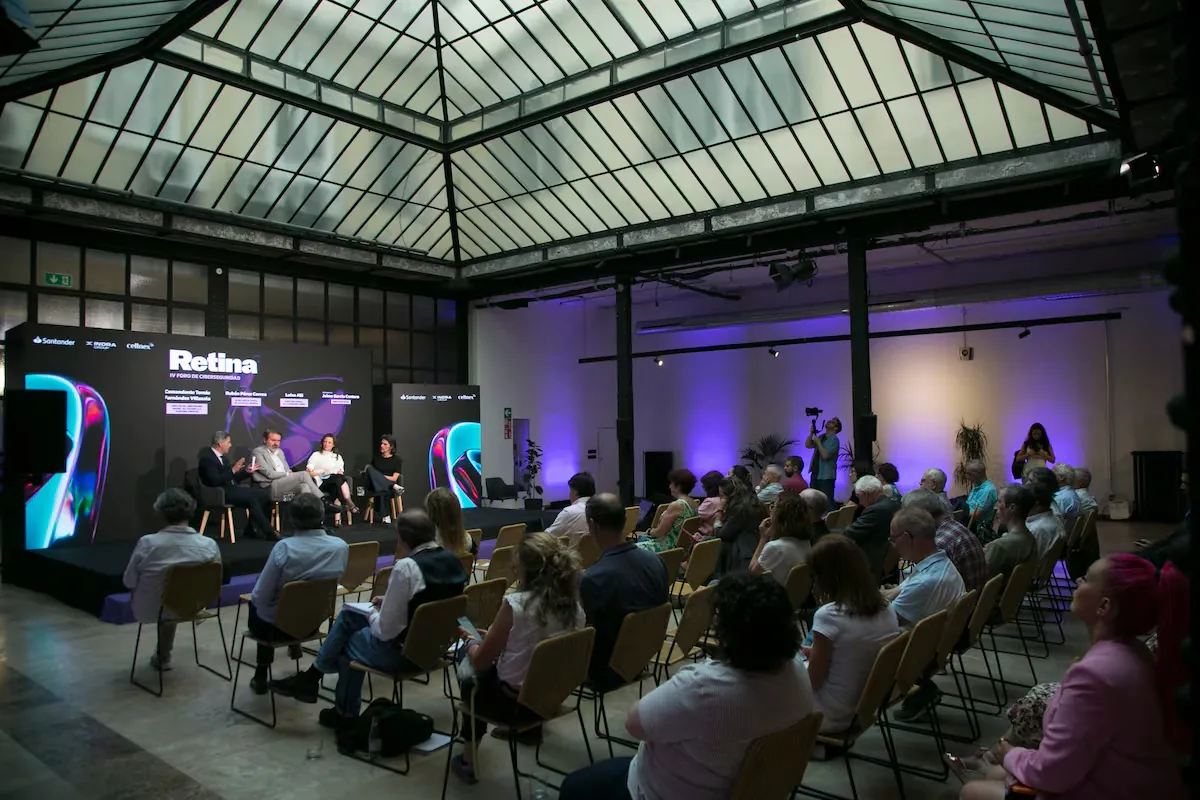
It used to be a hidden word among thousands in the dictionary of the Royal Spanish Academy (RAE). Today cybersecurity seems to skip the alphabetical order and appear at the beginning of all the definitions. From being the golden princess atop the glass palace to descending into Dante’s hells. This is the challenge that unfolds on a Monday afternoon in late May, while the sun rappels down the superb skylight of the Espacio Larra in Madrid. The IV Retina Cybersecurity Forum shines, with Banco Santander as promoter, Cellnex and Indra as sponsors, and under the sustainability certificate Eventsost.
Read more Zapatero, the unmeasured mediator
That same day Pope Leo XIV published his first encyclical, Magnifica Humanitatis. “The digital revolution is changing the grammar of conflicts and there is a worrying loss of historical memory” that facilitates distorted rewriting. The Supreme Pontiff warns about fakenews, data abuse, the threat of social networks, the technological ease to manipulate emotions. A planet at the service of the great billionaire technocrats. Do you remember the first words with which Francis (1936-2025) began his pontificate? “Come vorrei una Chiesa povera e per i poveri!” (“How I would like a poor Church and for the poor!”). The new Pope faces a world with fifty open conflicts. “There is no algorithm that makes war acceptable. Artificial intelligence [AI] can only make it faster and more impersonal, with victims reduced to data,” writes the Pontiff. Cybersecurity is the wall against those who question the human condition. In principle, it is fought with more technology, but it is more complicated.
It is a story of politics, global strategy, hybrid war, critical infrastructures, defense industry, and national sovereignty. The narrative of rapid change, having defense incorporated into the educational system; Finland and Taiwan, with Russia and China nearby, are pioneers in this area, and also in seeing how we act with people (especially young people) in vulnerable situations. And beware! Being thousands of kilometers from Russia, with these new technologies, does not make us invulnerable. Digital sovereignty seems far away, but Spain can be a great software developer. AI is scalable and one could jump on at any point of the curve. No one wants, like the Estonians, to see Russian fighters flying over their airspace.

He takes the stage, wearing a white shirt and jeans, perhaps the great guest of the day. His life is a novel. Too often dark, too often painful, to places only he remembers, alone, at night. Marcial Piriz, the chief commissioner of the National Police, has just retired after 45 years and two months of service. We must thank him: he faced the terrorist group ETA for four decades. He has dismantled the military apparatus several times and arrested members such as Francisco Javier García Gaztelu Txapote and Juan Antonio Olarra. The terrorist group is defeated, it no longer exists, it was defeated police-wise and judicially. “It was never a self-dissolution.” With the history clarified, “future generations must not forget the suffering it caused,” demands Piriz, and those who were there. The anatomy lacked telling some moments.
Let’s return to the technological. To the present. Piriz is concerned about radicalism outside the law and also demographic actions. “Not migration, which I support, but the hostile use certain countries can make of those people,” he warns. Others are geographic. By tradition, our border was the Maghreb; now it has shifted 2,500 kilometers further south, it is now the Sahel. “But we must closely follow what happens in Morocco and Algeria. They are not enemies. However, there are Ceuta, Melilla, and the Rock of Gibraltar, or Morocco’s claims in the maritime exclusion zone. “It is not a problem of hostile powers but of internal security. Russia, for example, has greenlit the assassination of dissidents,” he warns. There was an assassination attempt on former politician Alejo Vidal-Quadras and a Russian helicopter pilot who had defected from Ukraine was killed after receiving six bullets in Villajoyosa (Valencia). In the Netherlands and France, they also suffer assassinations. “It is a reality and there is no perception of risk in Spanish society. It is not being taken seriously,” he admits. “Something similar happened with ETA,” he recalls. The Hipercor massacre (Barcelona, June 1987) had to happen to awaken horror.
Harmful disruptions
Listing in an Excel column the threats — the commissioner details — that Spain faces, they are: terrorism (incendiary devices have been introduced inside several planes, which fortunately did not detonate); violent radicalization; destabilizing threats from states; the harmful effects of technological disruption and cyber threats. Coming from hostile nations such as Russia, North Korea, Iran, and Venezuela, until recently.
In this virtual world, one might say, due to its violence and speed, that they pour like water over the Iguazu Falls. The decorations of Lieutenant General José María Millán Martínez, director general of the Center for Information Systems and Technologies (Cestic) of the Ministry of Defense, shine in Espacio Larra. He advocates a “true military transformation” with the purpose of “winning the war.” He manages everything from missiles to defense. The word had been somewhat sidelined. “Information is a strategic resource and must be secured,” he emphasizes. “We live in a new society. And on the great network we trade, enjoy, share information, commit crimes, and fight.” Everything is supported by three huge pillars: processes, people, technology,” the lieutenant general advances. “If we have vulnerable data, it is impossible to create technology.”
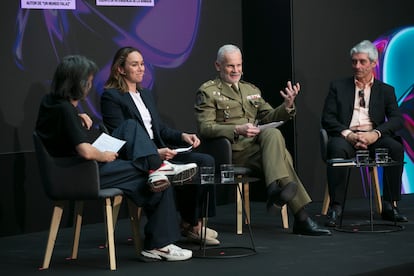
The level of danger is so high that it mixes information and hybrid war. Both — who would have written it in the 21st century — are new. “Information is something that makes people very vulnerable,” comments Ángela Navarro Paredes, lieutenant of the Navy Supply Corps. “It no longer only serves to make people believe something about a circumstance, but also works to discredit governments, institutions, or magnify the outcome of certain crises. This is important when talking about defense,” she adds. “The Armed Forces are operating in the multidomain to counter these cyberattacks.”
Read more Barcelona exposes and rethinks work
Times are exponential “Do we know how long a Ukrainian drone lasts until it returns to the ground? Since it is developed? Between four and eight weeks. Usually, after two months countermeasures have been created so it is not a problem.” What investment should a country make if change is constant? “70% of data is the oligopoly of three or four mega-corporations that have started acting as geopolitical actors. If this continues, private corporations will be the winners,” reflects Colonel Ángel Gómez de Ágreda, pilot and author of Deceptive World (Ariel, 2026). Industrial technology and strategic autonomy are needed. Use your own innovation. We see it in Israel, despite all its armament: it faces Hezbollah with drones. And ethics? “It would be unheard of and dangerous for a soldier not to know how to distinguish between what is right and what is wrong. The ethical basis can be easily lost due to new AI developments,” warns the lieutenant general.

Endless stories
Yes, she is a hacker. Straight red hair, black suit, and pink blazer. She does not go unnoticed in the real world. In the virtual one, she fights another war. Telecommunications engineer, she spends hours and hours immersed in computer programs that seem like cenotes. Her sentences are unique. They lack subjects and often predicates. Secrecy rules. Sectorial or geographic. Sometimes everything is in the dark. Sandra Bardón is Cybersecurity and Continuity Exercises Lead at the United Nations International Computing Center (UNICC). “I defined the cyberattack campaign as the neverending story, after the well-known book by Michael Ende.” Always in constant change. She teaches how to protect and safeguard sensitive information both at the World Health Organization (WHO) and UNICEF. Above all, she wonders how important security is on the executives’ agenda.
“The keywords of our days are artificial intelligence. But I always say the same thing. Technology, today, continues to be handled by people. Without them, no organization or company would exist,” she observes. “They are the ones who need to be trained to deal with incidents.” One very harsh example, without subject or predicate, is her “infiltration” into the network of a country where unfortunately 14-year-old girls are raped. She, after all, had a mother and father. And people from the organization who helped protect her and provide psychological support. “What happens if the channel is intercepted?” she questions. We are making that girl vulnerable again. We know where she lives. Who her parents are. If discovered, they would have to leave the city and the country,” she describes. Hence the importance of training for extreme moments. They build attack and defense situations, she complains that her hours should be better valued, family reconciliation organized, and how talent here also costs more money. Another well-known hybrid war. The neverending story of neoliberal capitalism.
Critical infrastructures and bodyguard towers
“The known is finite, the unknown infinite; from an intellectual point of view, we are on a small island in the middle of an unexplained ocean. Our task in each generation is to recover a little more land.” British philosopher T.H. Huxley wrote these lines in 1887. The truth is that we are accumulating knowledge — replicating that image — by the shovelful. In the analogy, generative artificial intelligence (AI) would be the excavator. Three Spanish giants play the game of critical infrastructures on Earth and in space.
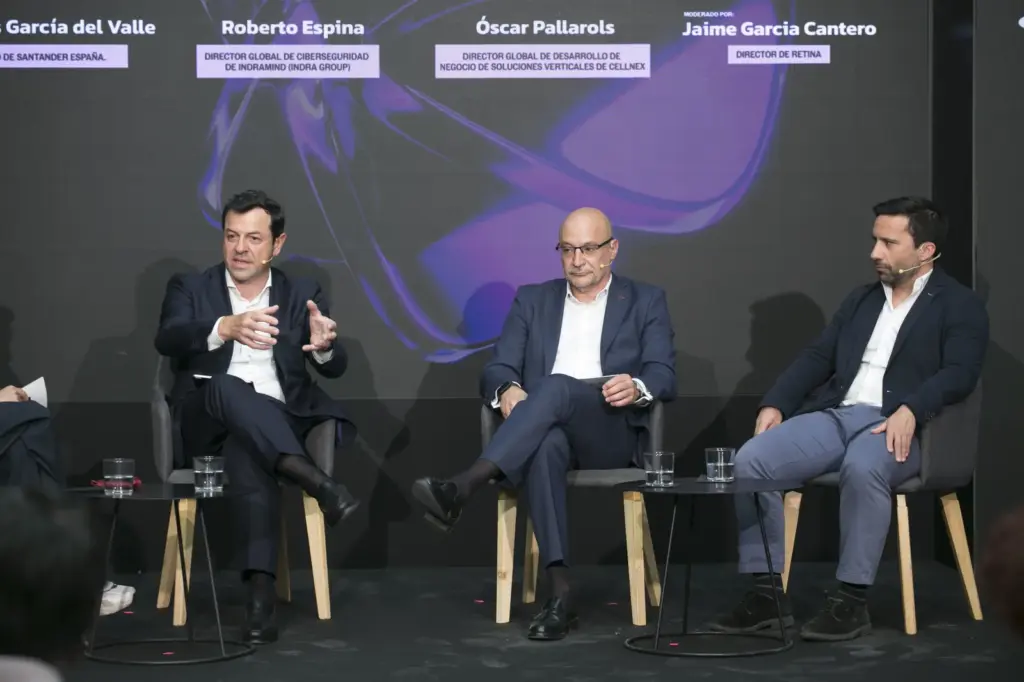
Cellnex is well known. It held strong through the pandemic. Today it has 120,000 communication towers installed in about ten countries. Óscar Pallarols, its global director of Business Development for Vertical Solutions, has a clear voice: “The value of our infrastructures is unique.” They are like a second communication layer if the first fails. When firefighters fight a forest fire in Les Gavarres (Girona) or the Mossos carry out an intervention in a highway tunnel, they do not use mobile phones but radios connected to the Emergency and Security Radiocommunications Network of Catalonia (Rescat), owned by the Generalitat, operated and maintained by Cellnex Telecom, and designed not to fail even when the power goes out. Rescat connects more than 60,000 users from 250 bodies: 12,000 Mossos d’Esquadra, 11,400 local police, 4,400 firefighters, 2,400 Civil Protection professionals, 1,900 Medical Emergency Service personnel, and 1,500 rural agents, plus dozens of smaller organizations. To access this network, a certified terminal is needed, with an average price between 500 and 600 euros. Is Cellnex a critical infrastructure? Certainly, if a risk counterbalance is wanted, it is unquestionable. Do you remember the 2017 La Rambla attack with a van? Cellnex was the transmission and aid channel. Communication towers located at the border could work alongside drones to protect the space. There are options. There is technology.
“The level of cyberattacks is so high and the response speed needed so great that it would be impossible to defend ourselves with human resources, so we use artificial intelligence,” narrates Roberto Espina, global director of Cybersecurity at IndraMind (Indra Group). His way of understanding the world is 360º and follows the NIST framework (identify, protect, detect, respond, recover). Additionally, it incorporates the development of digital identity, biometrics, and technological sovereignty based on AI. Behind it are about 3,000 people integrating the civil, defense, and new internet era triangle. And important details appear: “The severity of exposure of a hospital is not the same as a failure on a road,” specifies the Indra manager. “Each requires different protection.” The power supply, as we saw in last year’s blackout, is essential. The strategy, alongside AI, runs parallel — Roberto Espina details — to the development of offensive solutions and providing proprietary responses in cutting-edge technologies. “In Spain, things have been done correctly. The public and private sectors have worked very well together. “But we need national technology and less European, something that will take time,” he estimates.
The other edge of the triangle may be the regained paradise of any cyberpirate: a bank. “Certainly, it is where the most damage is done,” acknowledges Jesús García del Valle, CISO of Santander Spain. “For us, the challenge is that the entity is always operational, to protect customers, and that [the platform] has the resilience to keep operating.” And he adds: “This virtue is increasingly important; citizens are taught how they can continue with their financial needs.” Banking depends on other critical sectors, so the best way to defend is to band together. “And we must carry out awareness work that is still not broad enough,” he concludes. For example, questioning the “urgency trick” many scammers use. In banking, haste is also not good.
Read more Pemex records 1,490 spills and leaks during the current Government of Claudia Sheinbaum