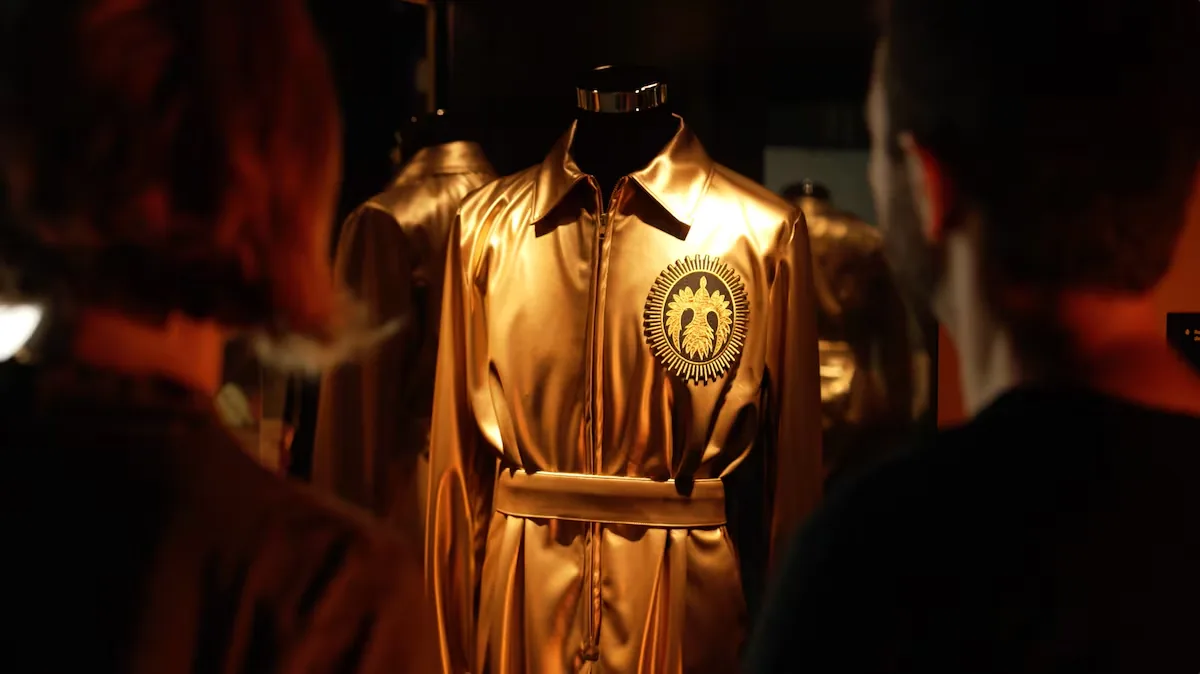







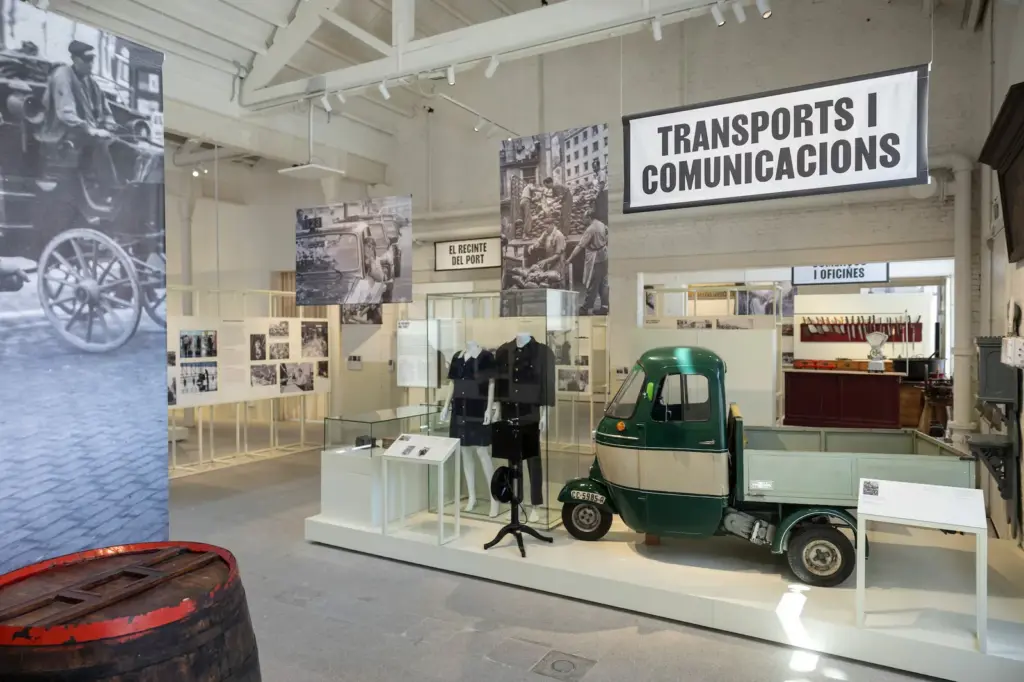
“The history of work in Barcelona is a constant struggle to improve the conditions of workers.” This is how Sou per suor. Quatre segles de treball i lluita a Barcelona begins, the audiovisual that, supported by the bar counter of an eighties bar, can be seen at the end of the exhibition Barcelona, ciutat i treball. Located in a hall of the recovered Fabra i Coats factory complex, and well accompanied by another exhibition dedicated to the history of the large textile factory of Sant Andreu, this new space of the Museu d’Història de Barcelona finally provides the Catalan capital with what — after two decades of debate, neighborhood struggle, and intense dedication by the former director of Muhba Joan Roca — should be the basis of a worthy Museum of Work.
Read more Pemex records 1,490 spills and leaks during the current Government of Claudia Sheinbaum
This is true if we believe not only the expository narrative of Muhba at Fabra i Coats but also the power of what is shown there and everything surrounding this cultural, heritage, urban, and associative node. The philosopher Santiago Alba Rico — who was there on May 23 during the Fira Literal and for a seminar on utopias by the Contexto y Acción and Cipriano García foundations — said that there is nothing like it in Madrid or anywhere else in Spain. As the panel and the presentation card of the new Muhba space say, “work is an important part of the identity of people and the city” and “has shaped neighborhoods, defined ways of life, and left a deep imprint on many generations.” Recovering and rethinking the history of work in Barcelona is “telling an essential part of the lives of its women and men,” who, in turn, “tell the Barcelona of the past and the present.”
More jobs and less unemployment than ever
On May Day 2026, besides many more than the 2,500 demonstrators that the Guàrdia Urbana underestimated marching with red flags through the city, Barcelona had exactly 1,262,043 people affiliated with Social Security (2.6 million in the whole province and 3.7 million in Catalonia; the number of people registered under the self-employed regime was 44,325). Thus, one-third of the workers in Catalonia are Barcelonans, by residence or adoption, during working hours. And this figure, which has not stopped growing since 2014 — despite the COVID hiatus, the great resignation phenomenon, and the uncertainties generated by AI — exceeds by more than 160,000 people the number prior to the start of the 2008 economic crisis.
Unemployment, at historic lows in a city where in 1985, just before the Olympic nomination, it affected between a fifth and a quarter of the active population, today hovers around 8% and was quantified on May 1 at 62,792 people (314,000 in Catalonia). According to the latest municipal survey on social values from 2025, unemployment and working conditions are only the fifth concern of Barcelonans, when work had always occupied the podium of citizens’ concerns and, on occasions, had directly topped it. However, the fact that concerns about access to housing and social exclusion and inequalities are on the podium is not unrelated to salary and working condition situations.
In any case, that it worries less and occupies more does not mean that work, defined by Muhba as “doing activities for the production of goods, services, or ideas to satisfy one’s own or others’ needs or demands,” is no longer central to society. In fact, “it can be paid or unpaid work, free or forced, formal or informal, and self-employed or employed by others.” And it can also “be oriented towards production and the market or, as in care work, play a central role in reproduction, in maintaining life and well-being, even though these tasks have often not been recognized as work.”
Catalan Manchester, factory of Spain
In any case, the Barcelona that has recovered the population level of 1980 — thanks to nearly half a million people of foreign origin who have come to work — and that already exceeds 1.7 million inhabitants (the real metropolis is around six million, and Catalonia, eight) cannot be understood without the world of work. This is modestly explained by the exhibition Moviment obrer. De la ciutat industrial a la metròpoli digital, which can be seen in the lobby of the national headquarters of CCOO of Catalonia on Via Laietana. And it was summarized in 1985 by the legendary exhibition curated at Born by historians Jordi Nadal and Jordi Maluquer Catalunya, la fàbrica d’Espanya. The country is defined by the industrialization of the 19th and 20th centuries, and Barcelona, known interchangeably as the Catalan Manchester and the Rosa de Foc when it reached the turn of the century with half a million inhabitants, upon reaching one million in 1930 had already become “the industrial capital of the Mediterranean and the main workers’ concentration in Spain.”
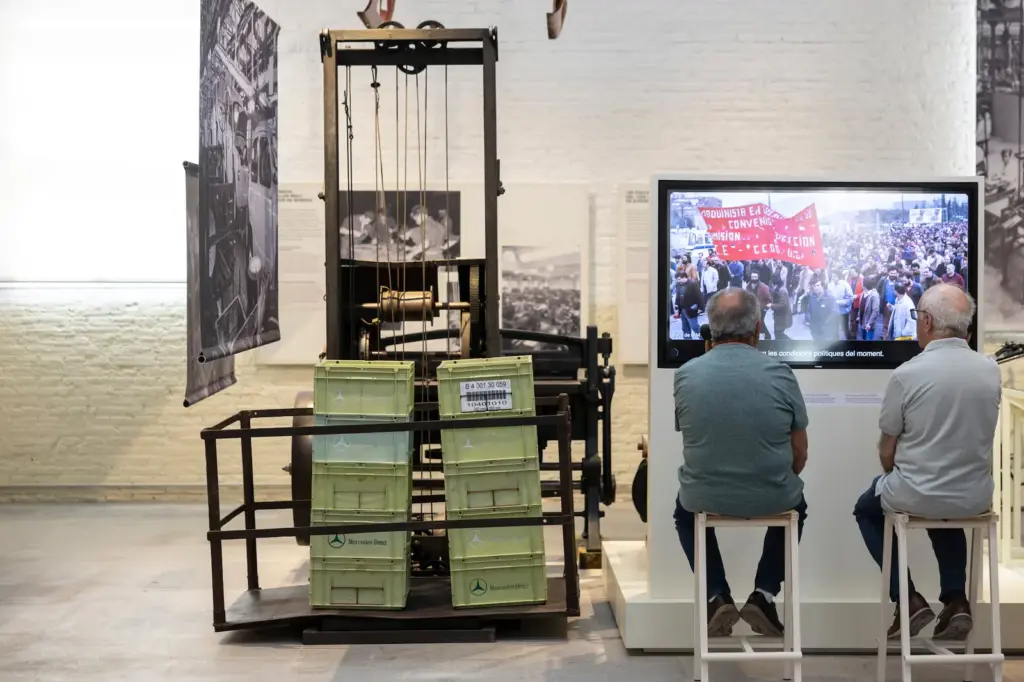
If the Civil War and Francoism did not erase this identity despite the involutive destruction, systematic repression, rationing misery, and uncontrolled and corrupt desarrollismo, neither have successive economic crises, industrial reconversions, and new technological revolutions or changes in the production model, with loss of class consciousness, been able to eliminate the workers’ memory in democracy. This is defined by a well-worked narrative by Joan Roca and his team, also signed by his successor at the direction of Muhba, Carles García. The audiovisuals Sou per suor, Les veus del treball, and A la vaga!, by Carmen Cazalla, Aina Mercader, and Marta Delclós, which collect testimonies from workers and unionists, and references to mobilizations ranging from the 1854 selfactinas revolt to the 2021 Glovo strike, summarize this well.
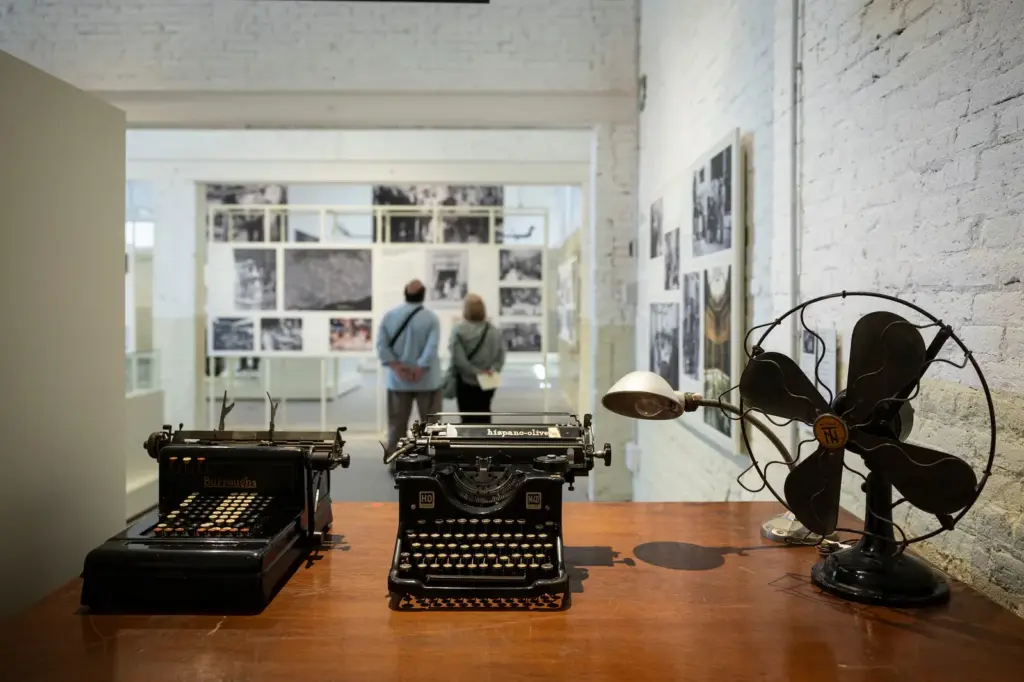
Filled with documentation and photos from various archives — including a film showing workers of España Industrial in 1910 and 1927 — and much machinery and pieces from the Muhba collections, Barcelona, ciutat i treball is a good exhibition by 20th-century museological standards and for a family, school, and neighborhood audience. However, aside from the fact that in the inaugural setup the screens of Les veus del treball sobre sanitat i educació were swapped and, weeks later, the error has not yet been corrected, the only criticism to make is that the exhibition feels small or short in a city where 21st-century interactive or immersive setups triumph.
Capital gains, tourism, and care
Barcelona cannot culturally bet everything on the MNAC, the Macba, the CCCB, the CosmoCaixa, or the Picasso, Barça, and Design museums. Nor on the tourist extractivism of the modernism of the Golden Square and Gaudí’s work, which would not exist without the work of workers and industrial captains and the work of laborers, engineers, and architects. And which, above all, would be impossible without the capital and capital gains accumulated by the bourgeoisie in all kinds of commercial activities (including slavery), in the production of factories like Fabra i Coats, Can Batlló, and Can Ricart (three examples of industrial heritage unevenly treated), or in the modern “factory” of tourism symbolized by the Sagrada Família and which today represents 13% of Barcelona’s GDP and 15% of Catalonia’s.
It is a shame that budget restrictions and the poor political (also pedagogical and touristic) calibration of Joan Roca’s ambitious idea leave the new Muhba space at Fabra i Coats far from the great Museum of Work in Hamburg or the counterparts in Bath, England, Norrkoping, Sweden, or Setúbal, Portugal. Not to mention the Workers’ Museum in Copenhagen and the museumized phalanstery of New Lanark, Scotland, a UNESCO World Heritage site. In other local or sectoral leagues play the Museum of Work and Living Industry of Santa Perpètua de Mogoda, the Terra or Rural Life Museum of Espluga de Francolí, and the National Museum of Science and Technology of Catalonia, in Terrassa, with branches at the cement factory of Castellar de n’Hug, the Sedó colony of Esparreguera, and the Farga Palau of Ripoll.
In the 21st century, the legacy of the “city of factories and workshops” that is also present and future begins to be honored. And that goes beyond what is usually framed between the 18th century and the current world: from indiennes, textiles, commerce, metallurgy, and automotive, to the tertiary city of services, tourism, liberal professions or public function, and knowledge economy that surpasses the real estate label of 22@, because it includes biomedicine and nanotechnology. Without forgetting agricultural jobs and port and transport logistics, in Barcelona, city and work, care jobs and domestic work, child exploitation well into the 20th century, migratory waves, and women’s work are very present. All marked by “labor segregation, wage inequality, and precariousness,” but key, since “in the mid-19th century women represented half of the working class in Barcelona,” to be able to “understand the economic development and history of the city.”
Chimneys and non-capitalist time
It is a legacy that must be rethought because it also goes far beyond what lies between the past and the future of the three chimneys of the Canadenca of the Paral·lel (including the anarcho-syndicalist Salvador Seguí and the strike that in 1919 won the eight-hour workday) and the three chimneys of the Besòs thermal power plant (including the strike promoted by CCOO in 1973 and the death of worker Manuel Fernández Márquez by police gunfire). In fact, there are as many chimneys scattered as urban totems — more are preserved than industrial halls because they occupy little surface of urban land that is worth a fortune — that there are already those who, as at the Poblenou Historical Archive, contextualize them with research works like Vint-i-nou xemeneies i una torre, Poblenou 1843-2043.
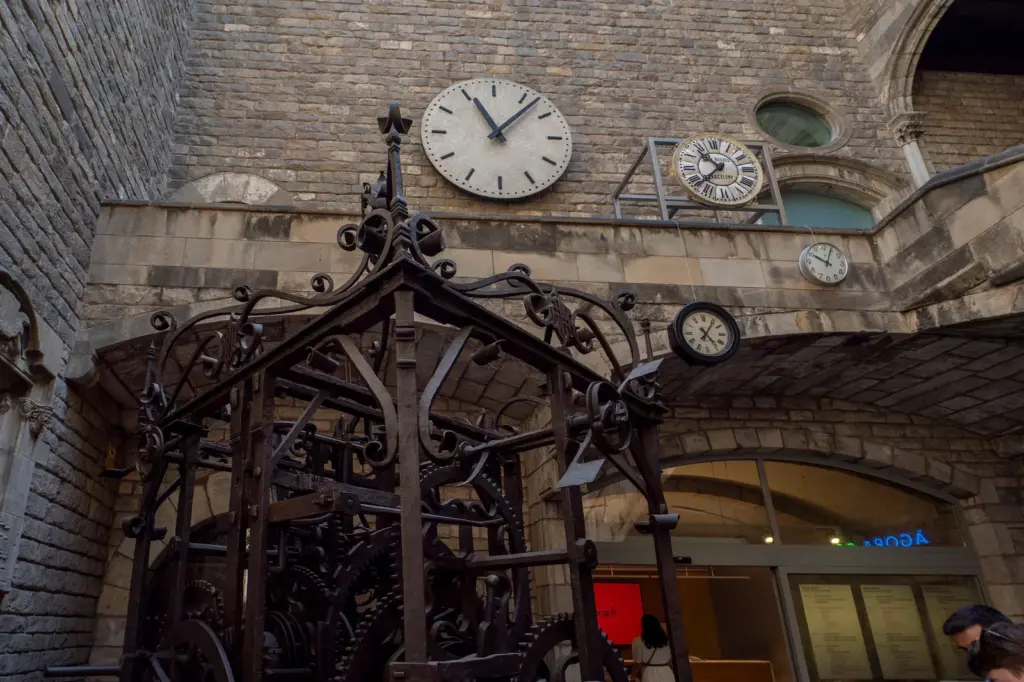
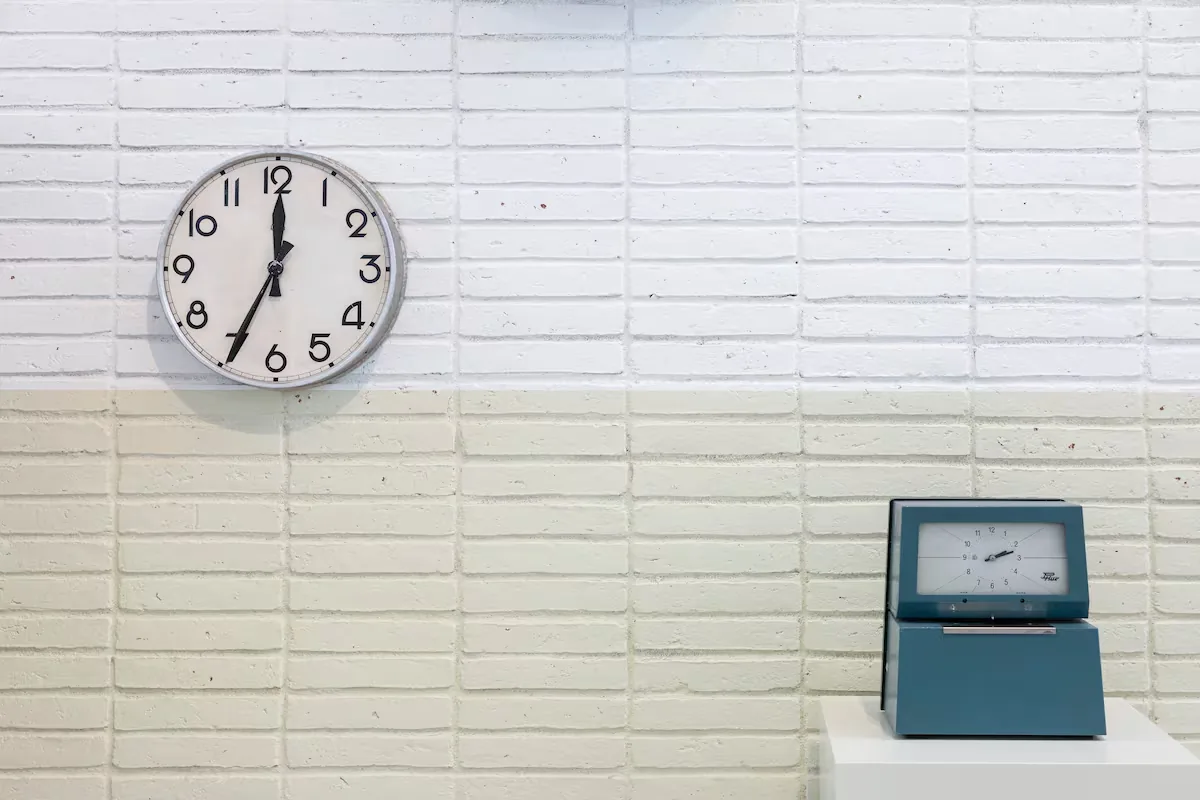
To understand work in the city, clocks are as or more important than chimneys. There are some, as well as time-stamping machines, in the Fabra i Coats exhibition. But it is at the entrance of the main Muhba headquarters, next to Plaça del Rei, where it is explained that “life in Barcelona was governed by the rhythm of mechanical clocks since 1396” and others are exhibited. Among them, precisely one from Fabra i Coats, and also the “Flamencs clock,” commissioned in 1575 by the Consell de Cent and which until 1864 marked the cathedral’s bell ringing. Its useful life coincides with the centuries in which, as explained in Barcelona, ciutat i treball, throughout Europe the medieval calendar holidays were reduced “due to the idea that they were the main factor of economic delay.” Industrialization increased working days until, at the turn of the 20th century, it was common to work up to 3,000 hours annually.
It was the struggle of the workers’ movement (UGT was founded in Barcelona in 1888, CNT in 1910, and CCOO in 1964) that gradually reduced these hours. And it is still, along with wage increases, prevention and occupational health, and welfare state improvement, one of the main objectives of class unionism. Since 1983, the Workers’ Statute legally sets 40 weekly hours with an annual count and a minimum of 30 calendar days of vacation, which leaves the maximum working time at about 1,800 hours. Many collective agreements reduce this figure, and unions seek to lower the workday, also by law, to 37.5 hours first, and 35 or 32 weekly hours as the final goal. The idea is to work less, share jobs, and live better. To, as philosopher Alba Rico said at the Fabra i Coats seminar, “gain non-capitalist hours” and fight the appropriation of time, data, work, and human life made by feudal technocapitalism.
Read more The chemical-free repellent gaining prominence this summer to keep pests at bay