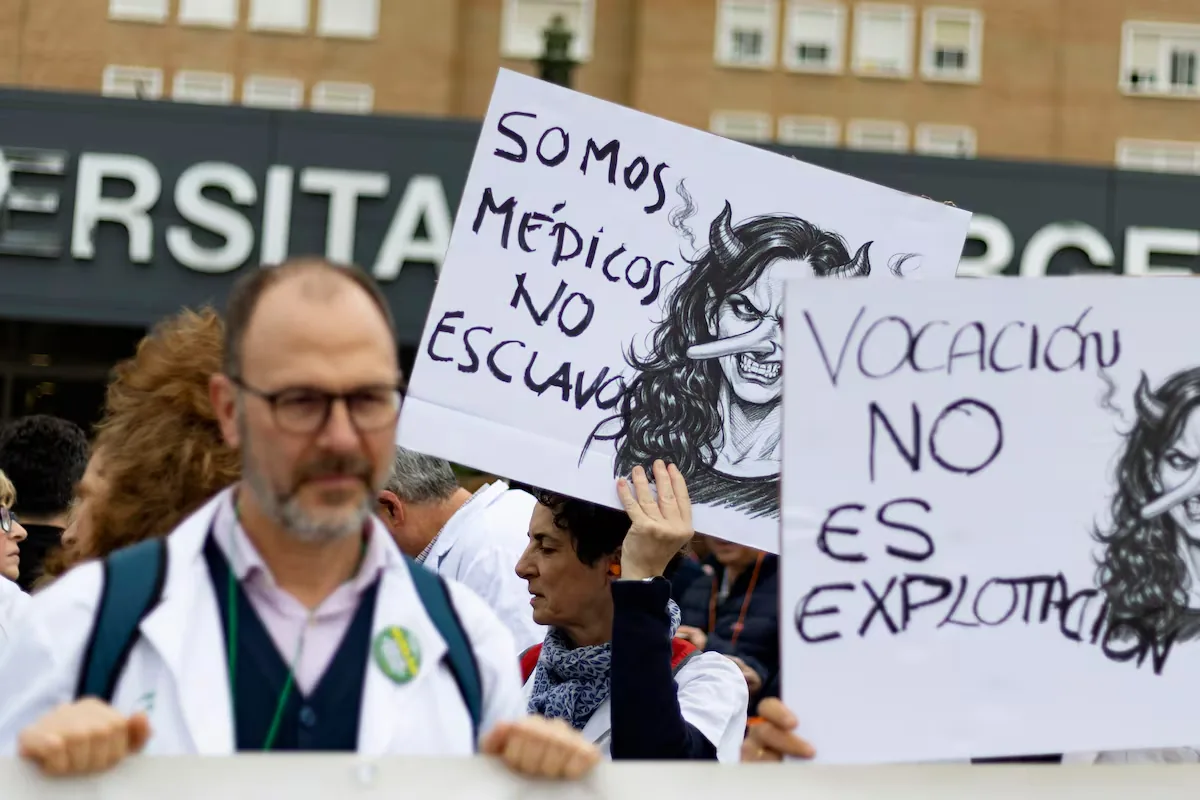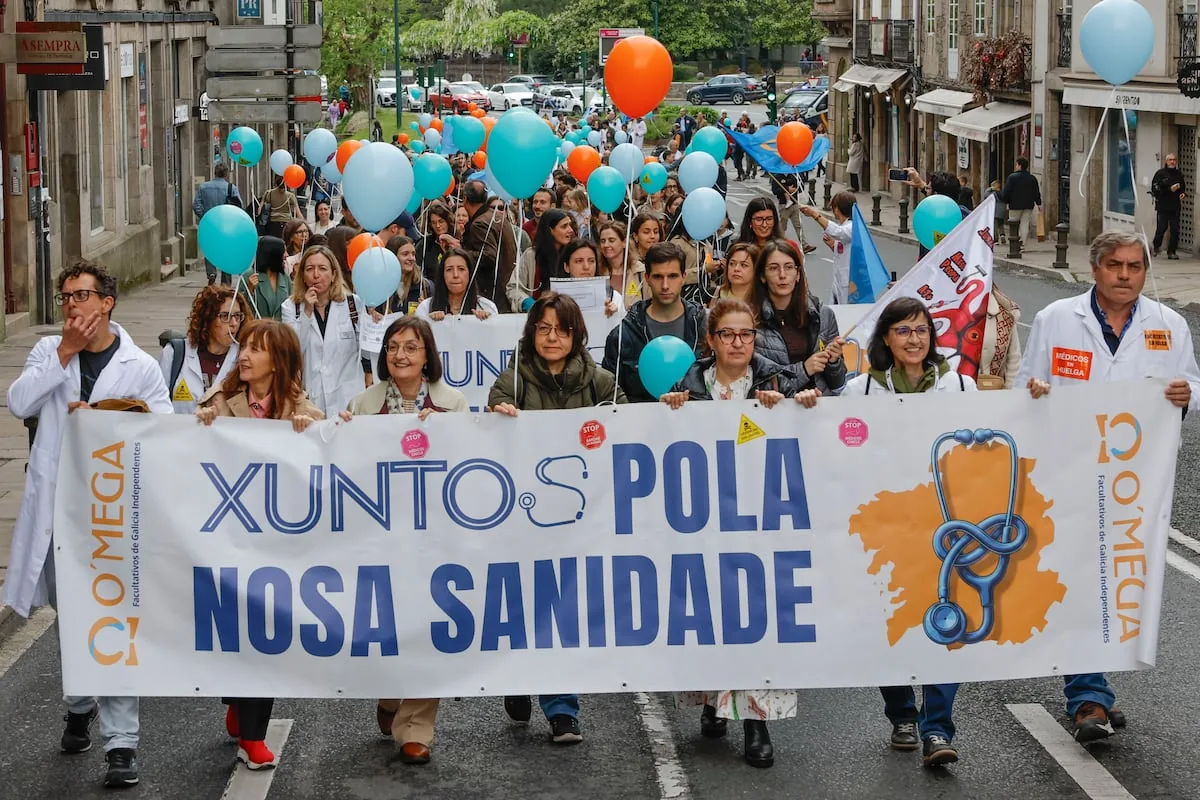
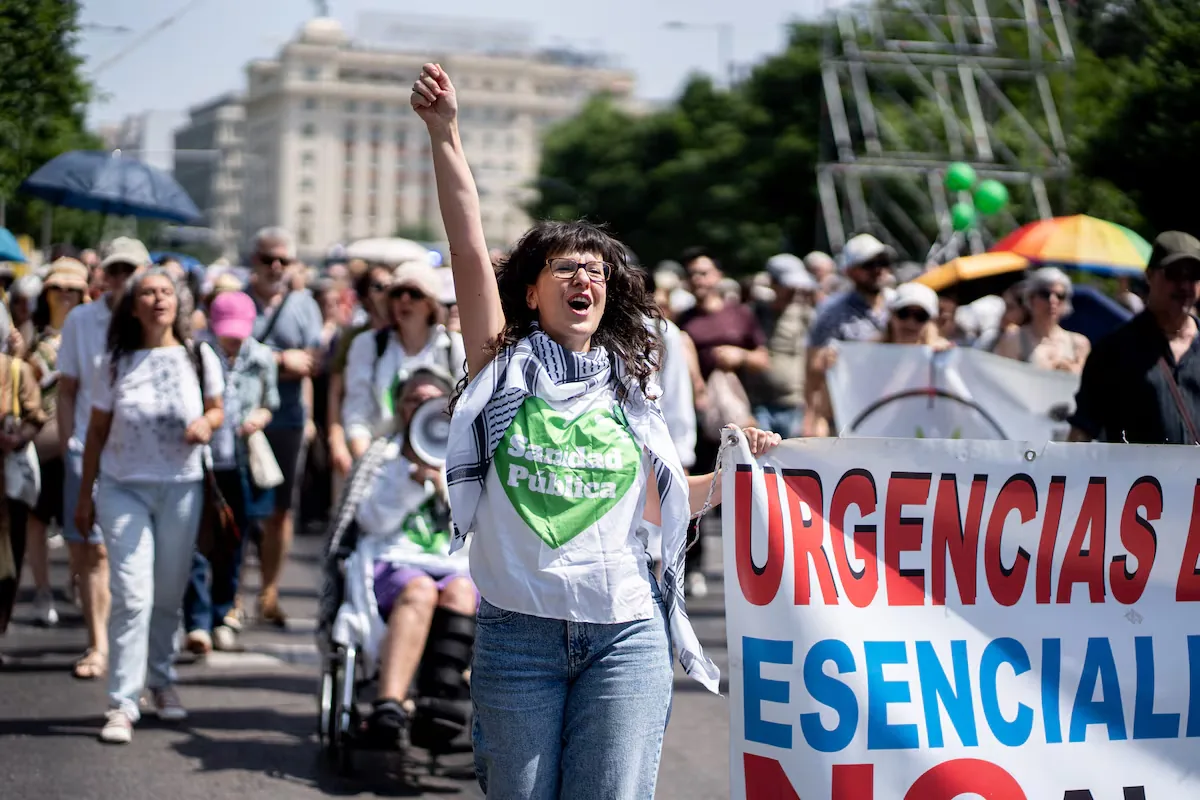
Thousands of people fill the center of the capital to demand the right to health. “They steal it from us, they sell it to us,” they chant. “Cutting healthcare is a criminal act,” “these are not deaths, they are murders,” they shout over and over again. They attend the march called this Sunday by the platform Neighbors of the Neighborhoods and Towns of Madrid. They are distributed in four columns to demonstrate that it is a structural problem. The south one starts from Atocha, but there are so many people that, before setting off, it already surpasses the Royal Botanical Garden. Their chants can be heard from the Congress of Deputies. The west one leaves from Sevilla, the north from Colón, and the east from Salvador Dalí square. “The mobilization takes place in a situation where the state of public healthcare in Madrid is critical,” say the organizers of the call, supported by a hundred entities, after estimating an attendance of more than 40,000 people compared to a maximum of 10,000 estimated by the Government Delegation. They intend to “end the planned dismantling” of the healthcare system.
Read more Italian Grand Prix live | Marco Bezzecchi wins in Mugello
Alvar Chalmeta, a resident of Carabanchel, attends the march. “Our health cannot be the loot of any private company, it must not generate economic profits, it has to generate social welfare,” he insists. He denounces a systematic delay in tests, surgeries, and specialist appointments: “It is a silent way of pushing citizens towards private insurance. It is a covert privatization that creates first- and second-class patients depending on their bank account.”
Family doctor Ana Encinas also did not want to miss this protest: “I am here to fill our streets with dignity.” She has worked for 20 years at the Nuestra Señora de Fátima health center. She reports exhaustion and weariness. “We are the richest community and we are at the bottom in healthcare investment. In Primary Care the situation worsens, there we are the last of the last. We do not reach 11% when the World Health Organization recommends 25%,” she emphasizes. She explains that with a good budget allocation, outpatient clinics can attend to 85% of the demands.
“There are more than a million people on the waiting list to go to a hospital: 700,000 waiting for a specialist or a first appointment, 200,000 for diagnostic tests, and more than 100,000 for surgeries. Meanwhile, people are dying,” laments Encinas. She assures that in many centers with emergency services there are no doctors. “There is a shortage of 500 family doctors and 200 pediatricians,” she comments. It takes an average of 10 days to attend to a patient from the time they request an appointment. “Sometimes, they arrive at the consultation and no longer have pain, they have gone to Emergency or to private care, if they can afford it. But when the illness is serious, they send them back,” she says.
The government of Isabel Díaz Ayuso agreed to pay 2.354 billion more than budgeted to Quirón and Ribera Salud in its first six years of government. The bill for the hospitals of Torrejón, Villalba, Móstoles, Valdemoro, and Jiménez Díaz adds up to 6.6 billion between 2019 and 2024, Encinas recalls. “It is a savage hemorrhage and it must be stopped,” she insists. She only sees one possible tourniquet: repealing the Law on enabling new forms of management of the National Health System and articles 66, 67, and 90 of the General Health Law, which allow the integration and contracting of private centers within the public system, through agreements and contracts with the Administration.
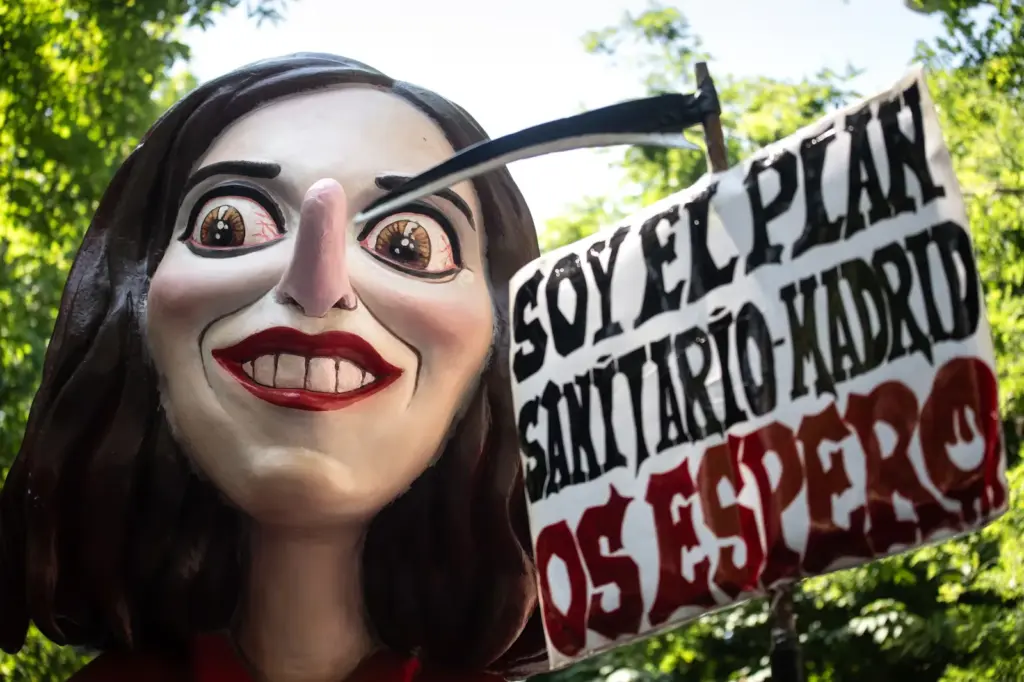
But she emphasizes that the regional government is the one with the powers to invest, hire staff, and establish their working conditions. “The Community of Madrid is the flagship of privatization,” she sums up. Meanwhile, the demonstrators keep singing: “Companies out of healthcare.” Leading the protest is a giant puppet with Ayuso’s face made of papier-mâché. Next to it, a person dressed as a skeleton holds a scythe to evoke death. “I am the Madrid health plan, I’m waiting for you,” reads their banner.
Read more Turning the screw on the deadliest tumor: a targeted therapy doubles survival in pancreatic cancer
Next to her walks Lucía García, a nursing assistant technician at the 12 de Octubre Hospital. “The most mistreated healthcare staff in all of Spain is in Madrid. We still do not have the 35-hour workweek. My base salary is 749.58 euros. We always work at minimum levels, using days off to cover incidents. It seems unbelievable that we are the richest autonomous community,” she protests. She assures that her colleagues flee this region because in Castilla-La Mancha they find better conditions. “Patients are told that in the public system they will be seen in two months, but that they can be referred to another private management center the next day, it cannot be. Ayuso’s government is strangling the public system to fatten private insurance,” laments García. Day after day she lives with frustration.
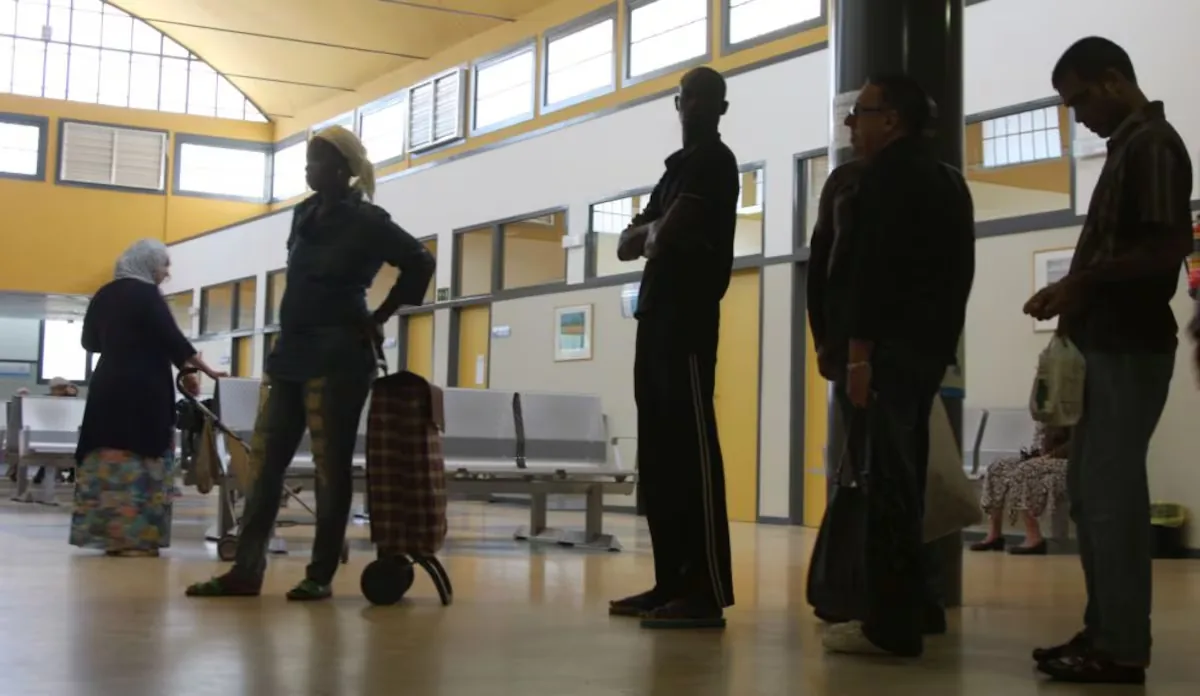
Chalmeta accuses Ayuso of applying “a squid ink policy.” He believes that, to hide her activity and “her direct responsibility in the abandonment of health,” she blames the migrant population. He recalls how in September 2020, in the middle of the pandemic, the Abrantes health center was left without service. “I arrived and there was a sign announcing that there were no doctors, neither in the morning nor in the afternoon. Just like that, 30,000 people were left stranded.” Even then, the platform calling this march organized a mobilization. More than 200 protests for healthcare have taken place over the last six years in Madrid.
“Now we are worse than ever. The General Ricardos health center has an average wait time of 20 days. The cuts are brutal,” explains this Carabanchel resident. He says that, if you look at the distribution of money per inhabitant, Asturias, for example, dedicates almost eight hundred euros more than Madrid to healthcare. He assures that at the 12 de Octubre Hospital, the sterilization of surgical material was privatized. “According to operating room workers, this arrived dirty or poorly prepared, causing operations to be suspended and receiving bottles with stains for babies with delicate health,” he comments. He reports that the contractor itself admitted to sterilizing material from companies in the public center’s facilities: “The goal is business, not health. They say there are no doctors in Madrid, yet a private pediatric clinic opened in Carabanchel a few months ago.”
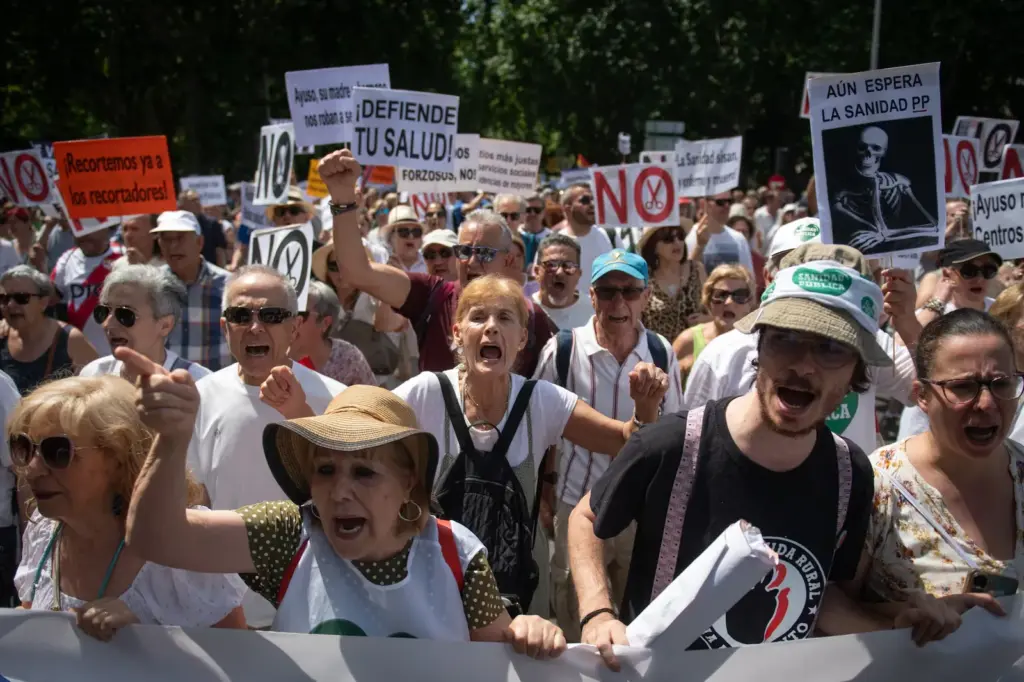
The Health Minister of the Community of Madrid, Fátima Matute, has labeled this Sunday’s demonstration as “ideological, sectarian, and detached from reality.” “What worries me is managing day to day and what I am really focused on is that indefinite doctors’ strike, which is really what we all have to fight for and is a problem that the Ministry of Health has to solve,” she said.
The five public hospitals with private management are a minority within the public network, which totals around thirty centers. However, they accounted on average for 58% of the appointments that changed hospitals in 2022 and 2023, according to data from the Madrid Health Service. That is, while fully public management centers lost patients, private management centers gained them, accumulating more than 200,000 annual appointments from users coming from other hospitals. “What have we broken in the Community of Madrid, what have we done wrong to deserve this mistreatment? When did we go from being heroes to having the worst conditions in all of Spain?” García asks. While demonstrating, she remains unanswered.
Read more The Spanish team takes a mass bath in the first training session before the World Cup