









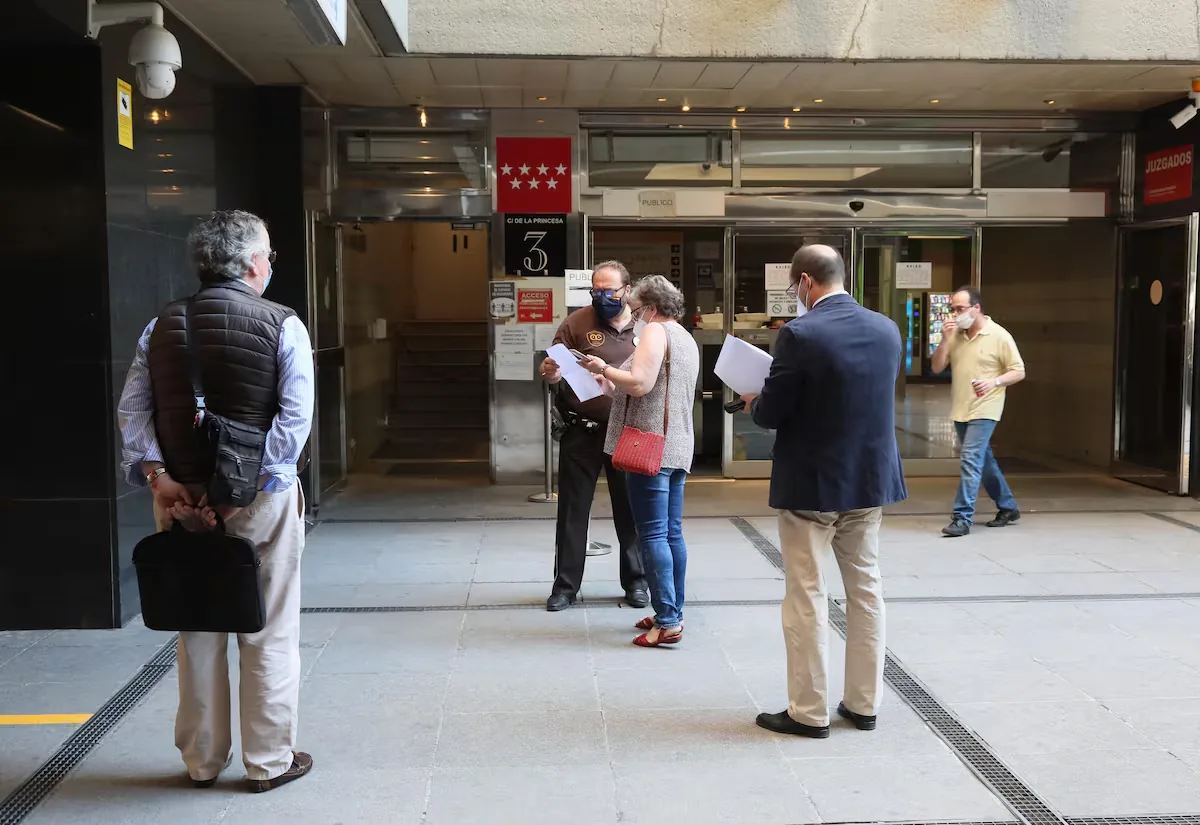
The CC OO union has denounced the situation of “functional collapse” in which the social courts of 41 Spanish provinces find themselves due to the accumulation of labor claims regarding claims for amounts and recognition of rights. This situation is similar regarding claims for individual and collective dismissal or claims for unemployment benefits or Social Security, and is generating long delays for holding trials for all these reasons. Faced with this situation, the union demanded this Wednesday that the Government implement a shock plan to alleviate waiting times for holding labor trials and open a social dialogue table with the involved Administrations (Ministry of Justice and autonomous communities with competencies, mainly). With the initiative, solutions are sought in the medium and long term, according to what the general secretary of CC OO, Unai Sordo, demanded this Wednesday during the presentation of a detailed study by the union’s legal services, present in 94 offices throughout the country.
Read more The exhibition ‘Moments’, which celebrates the 50 years of EL PAÍS, begins its tour through Spain
The most notable data from the work point out that, after analyzing more than 1,000 files of all kinds updated until May of this year, the average time it takes to schedule a labor trial in Spain is currently 450.4 days, equivalent to 15 months. And, in the case of individual dismissals, the delay is 375.3 days, equivalent to just over a year, despite the fact that the justice system itself marks these processes as preferential resolution.
The deterioration in deadlines is increasingly greater, according to the latest data from the General Council of the Judiciary (CGPJ). CC OO has also analyzed these data, although they have less updating (the closed data correspond to 2024) and are estimates, not a record of actual files, so they do not match the union’s data. In this case, they indicate that the estimated duration of dismissal processes in the Social Courts increased by 14% in just one year, going from 7.2 months in 2023 to 8.2 months in 2024.
Even more than individual dismissals, the processes related to Social Security claims, such as claims for unemployment benefits, retirement, permanent disability, or contesting medical discharges, take longer to resolve. The national average delay is 389.7 days, equivalent to 13 months, according to the union study data.
With these figures, and with the intention of making a territorial evaluation by provinces and types of procedure, CC OO has developed a technical scale according to the waiting times to schedule trials. Thus, it rates the response to workers’ judicial protection as “satisfactory” if the scheduling occurs within the first two months after filing the judicial claim; “concerning” if scheduled between two and four months; “detrimental to the worker’s judicial protection” if the trial is held between four and six months after the claim; and “functional collapse” if it exceeds half a year in urgent processes (dismissals, wages, Social Security) or 10 months in ordinary processes.
Read more Why La Casita de Bad Bunny is actually a lie
According to this classification, eight out of ten provinces (the 41 mentioned above) are in a situation of “functional collapse” in scheduling trials for claims of amounts and fundamental rights, which are the most voluminous processes. A total of 36 provinces are in the same situation also regarding Social Security claims. And more than half (29 provinces) fall into the same category from the point of view of resolving dismissal cases. The communities most affected by the most extreme delays are, according to CC OO, the Valencian Community, Andalusia, Catalonia, the Region of Murcia, and the Community of Madrid.
For Sordo, “late justice in the social order is not simply slow, it is justice that can cease to be effective, that is, it can cease to be just.” He highlighted that, in all cases related to labor claims, “the worker endures the challenged measure for months before effective judicial protection occurs,” whose guarantee is required by the Constitution.
The current situation of the social courts is due, according to the secretary of Trade Union Action of CC OO, Javier Pacheco, to an increase in labor claims in recent years that has coincided with a parallel decrease in available resources (both personnel and material, and in all communities). Thus, the volume of cases entered in the social jurisdiction has grown significantly, going from 345,151 in 2015 to an estimated figure of 452,786 in 2025, which represents an increase of 25%. Dismissal procedures stand out especially, which have increased by 17% in this period to the 164,484 expected for 2025; and claims for fundamental rights and public freedoms, which have increased by 99%, up to 7,324 claims.
Pacheco emphasized that all these delays only apply to first-instance procedures. Because if after a first sentence, the worker or the company decides to appeal the ruling, an estimated 7.2 months of delay must be added for trials in the Superior Courts of Justice and another 13.2 months if appealed to the Supreme Court. In total, more than three years of trials to achieve a final ruling.