








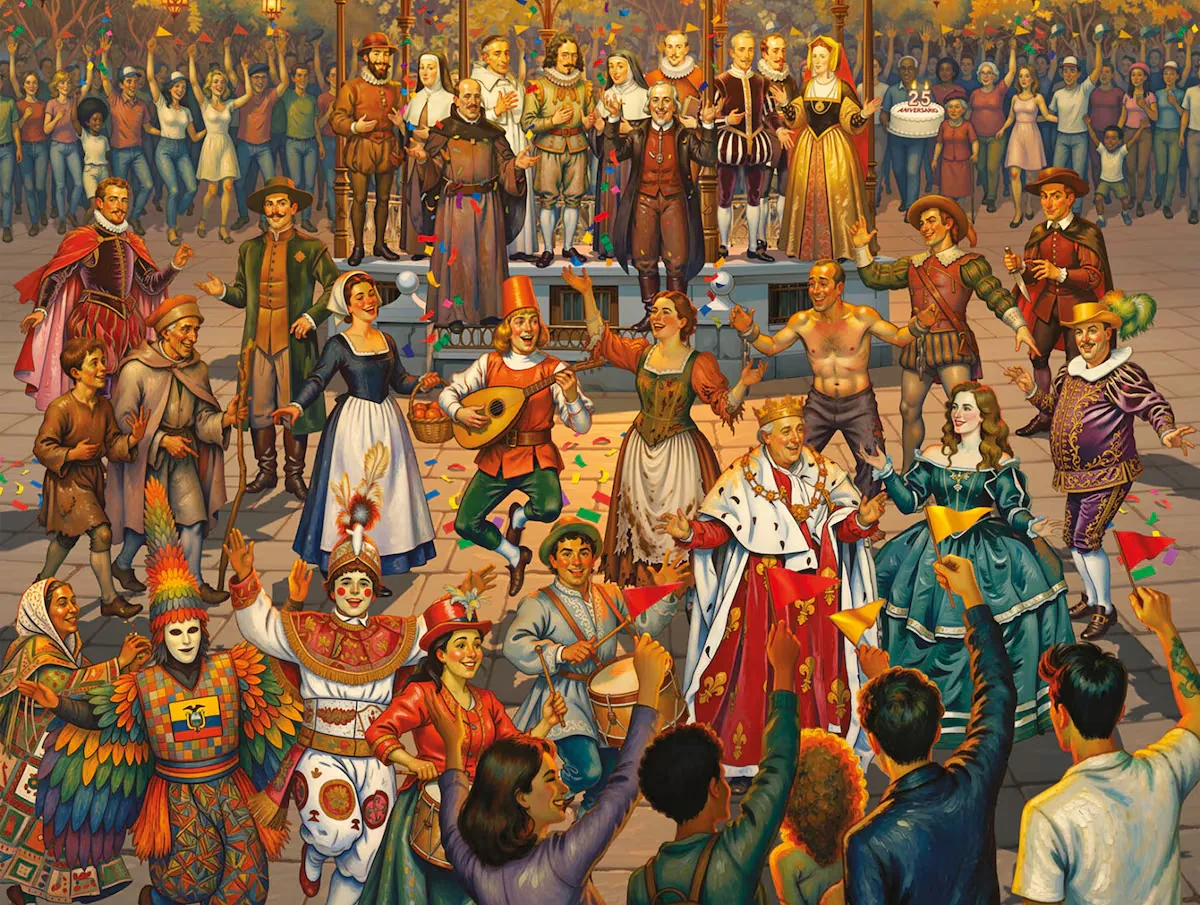
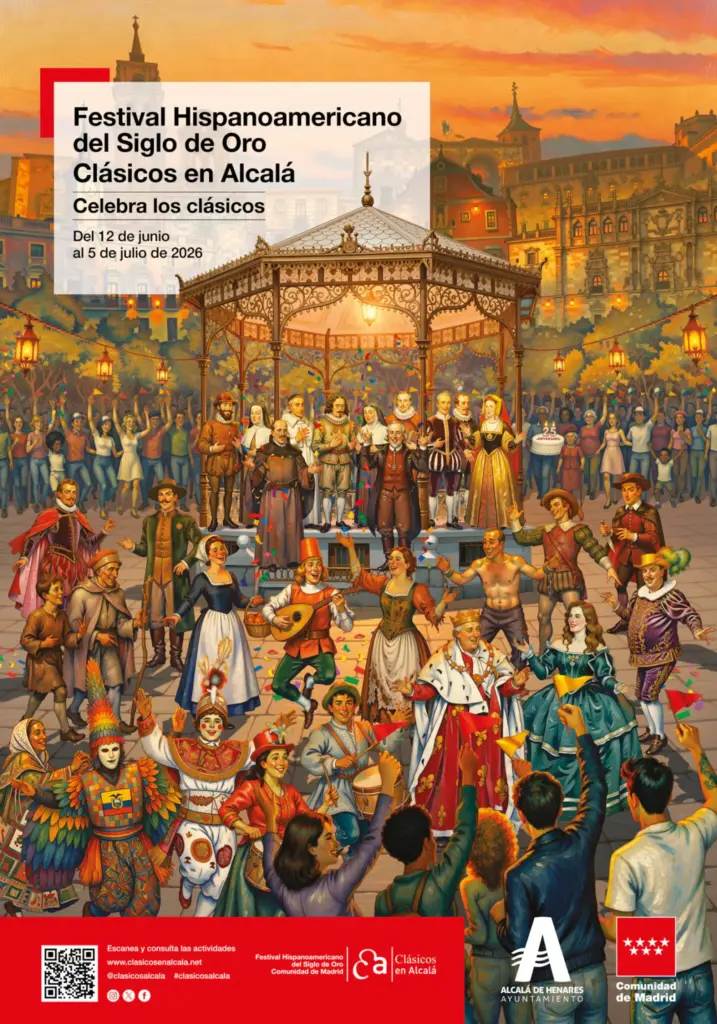
Characters with elements that do not correspond to perspective, the same image repeated over and over again with small changes and lighting and shadow failures. All these defects that usually occur in the generation of illustrations using artificial intelligence (AI) are present in the latest poster promoting the Ibero-American Golden Age Festival-Classics in Alcalá. The author of the work, Javier Tejera, has acknowledged that for him, AI is a tool that helps him “accelerate illustration processes.” The Community of Madrid, organizer along with the Alcalá de Henares City Council of the theatrical event, defends itself with “the freedom of every artist to develop their work” to validate the poster.
Read more In Spain there are more than 15 million pets
This illustrator, coming from the world of video games and with 25 years of professional experience, assures that he uses Gemini and Grok. “They are tools that you also have to know how to master,” he justifies in statements to EL PAÍS. The Bruto agency, which hired Tejera for this work, has not made statements on the matter, although at first it assured that AI had not been used in this work and, later, that it was only taken into account for “finishes and lighting.”
Tejera has acknowledged that he created each character individually and then assembled the poster. “I help the AI with a preliminary drawing where I establish the parameters, dimensions, and type of drawing. I was inspired by the colors of Toulouse-Lautrec,” he emphasizes. In short, Tejera’s work has been based on correcting the inaccuracies generated by the AI in response to his requirements, as stated by Kike de la Rubia, president of the Association of Illustration Professionals of Madrid (APIM).
The poster promoting the festival, which will take place in the Complutense town from June 12 to July 5, consists of several planes. In the first, figures such as Don Mendo, typical characters of Hispanic American theater, Segismundo, Don Juan Tenorio, and Lazarillo de Tormes appear. In the second, on the music kiosk in Cervantes Square in Alcalá, authors such as Lope de Rueda, Sor Juana Inés de la Cruz, Tirso de Molina, Santa Teresa de Jesús, and Lope de Vega appear. Behind them, in the third plane, a kind of modern audience. Above all of them, a backdrop with the facades of the Cisnerian University, the City Council, the Magistral, and the Archbishop’s Palace crown the scene.
The specialists consulted take only a few seconds to assert that the work is not original. They present several examples to support their position. For example, the Ecuadorian bird-man in the front row. Even though he is in front of the character in white on the right, his arm passes behind him. “A human illustrator would not do this, especially if they paint realistically and spatially, as is the style of this poster,” clarifies De la Rubia.
From APIM, they have detailed that they are aware that “this poster had an earlier version in which this occurred in many other figures on the scene, as their arms and legs disappeared behind characters and objects in the background.” On the other hand, in the middle of the scene, Góngora and Calderón de la Barca appear, almost levitating and leaning on a tiny railing. “It presents them performing impossible balances, something that anyone professionally dedicated to illustration would avoid doing.” Faced with this, Tejera defends himself, commenting that “it’s true that it’s strange,” but he couldn’t find a better way to represent them.
A sticker poster
The main reason experts have for thinking this poster is an AI product is the audience that appears in the third plane. The Association admits that “it’s the same character in the same posture, with some characteristics changed such as gender, hair, and t-shirt.” The president of the organization adds that, “although it’s the background and not decisive for the image, anyone dedicated to illustration would not draw clones with such a high level of detail.”
Tejera recounts that to sketch the faces of these people, it was enough for him to “draw a circle where he wanted a head to appear.” His corrections have been based on removing extra fingers from hands or making the banderillas move in the same direction as the wind. “For the characters in the foreground and mid-ground, I did draw a specific head with lines so that the AI would interpret the features I wanted,” he adds.
Similarly, the lighting and shadows also do not match on most objects and people. “There should be a multitude of secondary shadows and shadows that darken characters and other elements. That’s why the image looks flat, as if everything were stickers,” APIM points out.
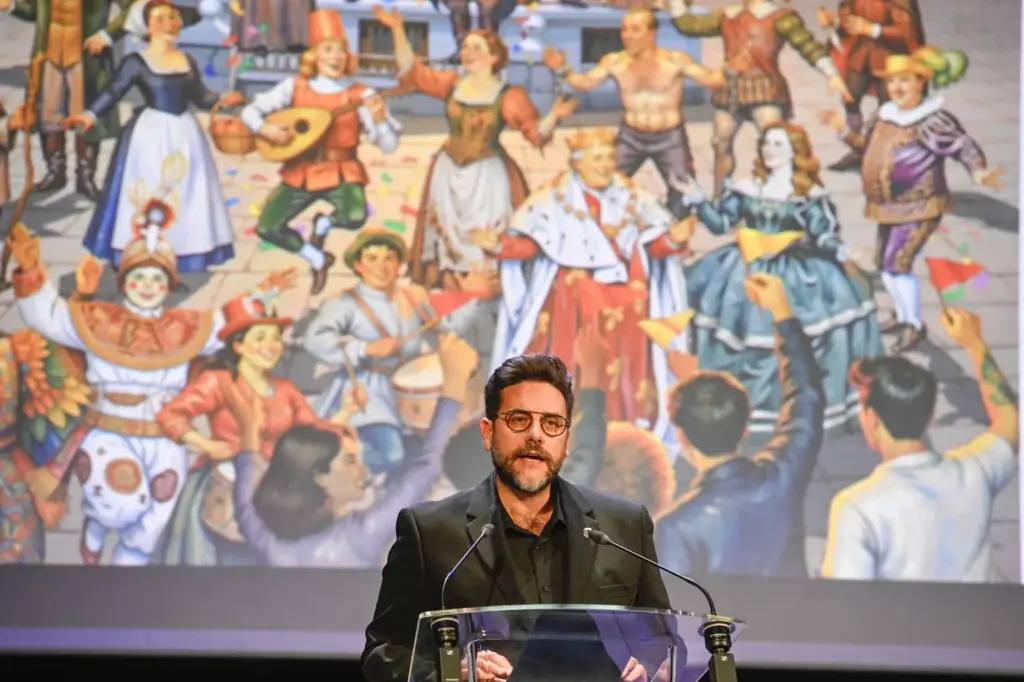
Illustrator and graphic designer Luis Demano elaborates that the faces of the characters are in the “characteristic AI style.” “The best thing is to go into the details, enlarge the image. There we see that some elements are blurred and the proportions do not correspond. This is not quality work,” he maintains. He also speaks of the color palette, which he defines as “demented” as it is the result of “a hodgepodge of images in which visual elements are not accentuated nor is any rhythm generated.”
This analysis by various professionals in the sector corroborates the report prepared by Winston.ai, a website that examines images and their AI level. In this case, it indicates “an AI probability of 98.6%,” and points out that “the main evidence includes significant anatomical distortions in the faces and hands of the background figures.”
AI and the plagiarism it hides
Both illustrators consulted are in favor of ethical regulation of the use of generative AI. “The only thing that could be asked of the public administration is that with everyone’s money, it does not promote works that do not respect professional ethics. Generating images with AI is plagiarism, because it produces them after the theft of millions of copyrighted artworks from their creators,” demands Demano, affiliated with CGT. He adds: “Art is not about going faster or slower. We have to ask ourselves why we have to go faster. This way, our work will be worth less and less.”
The president of APIM adds that “as illustrators, we have the legal right for our work not to be transformed without our consent, especially if the work is used for others to profit or save money with it.” The Association points out that public institutions “cannot be negligent and fail to identify the problem, or know about it and downplay its importance, since in the process of giving value to, for example, theater in this case, they fall into the contradiction of taking it away from another artistic profession such as illustration.”
The Ministry of Culture of the Community of Madrid argues that it “does not believe in censorship and, on the contrary, does believe in the freedom of every artist to develop their work.” Furthermore, they corroborate that Tejera “has carried out a digital illustration process in which the appropriate tools for image creation and editing have been used, including AI, hand drawing on a graphic tablet, or Photoshop.”
Read more ‘Manoliño’ and other dolphins who risk approaching people to escape their loneliness