

If the people from La Línea managed to steal words from English —there is liquirbá, licorice, from liquorice bar— and the Gibraltarians did the same with many other expressions —voy para atrás, from go back—, how could there not be a term to designate something as defining for their lives as the border? In Llanito, that crossing is the focona, a phonetic deformation of Four Corners, known as such because of the crossroads it was in the 19th century. Then came the physical Fence, the harassment and closure under Franco, the reopening in the 1980s, the justified terror of hard Brexit, and, from midnight tonight, its disappearance, symbolically demolished on the Gibraltarian side. Barely 12 hours later, Pedro Sánchez also wanted to have his moment with the pickaxe and attended the dismantling of one of the gates that remained open there. “Today the last wall of continental Europe falls,” declared the Spanish president.
Read more The PSOE increases the gap with the PP despite corruption scandals, according to the CIS
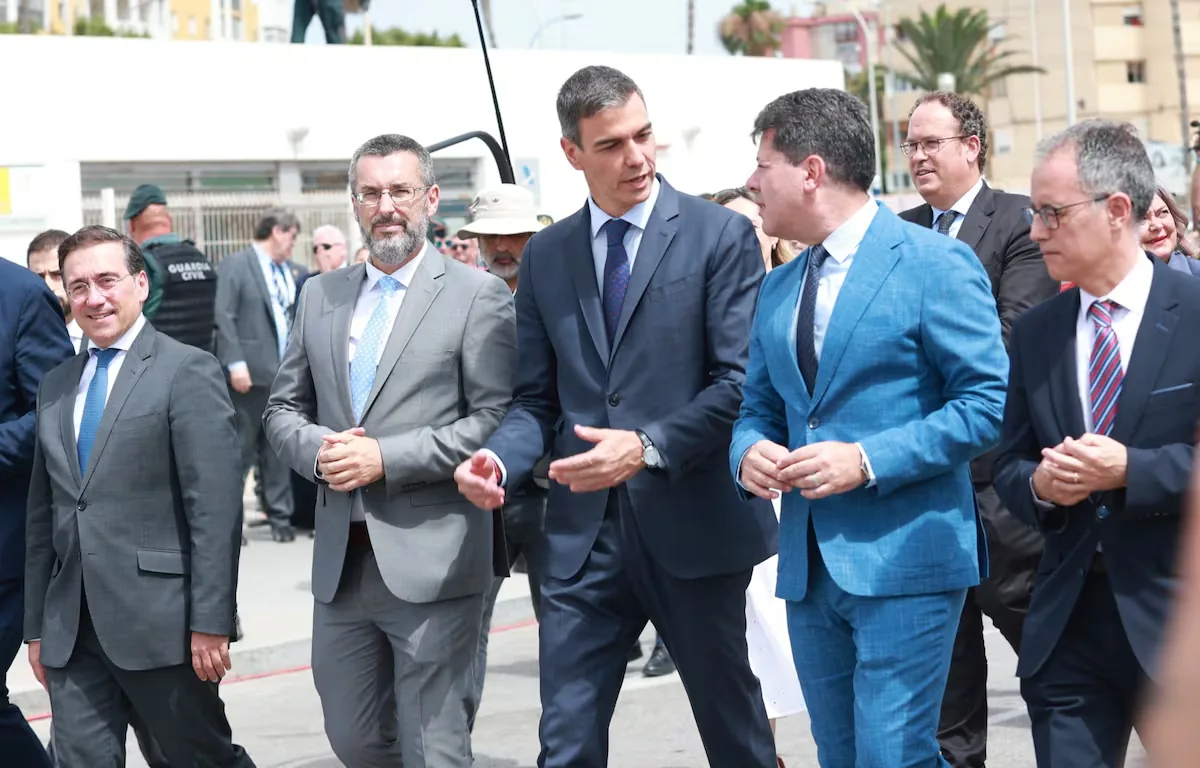
“The Pillars of Hercules are no longer a limit, but a door to a shared future. Conflicts exist not to be managed, but to be resolved,” explained the president, after observing the removal work of the gates, explained by the president of the public company in charge of the work, Tragsa, Jesús Casas. On his brief walk, the president walked the Spanish section of the border on foot, accompanied by the Chief Minister of Gibraltar, Fabian Picardo, the Minister of Foreign Affairs, José Manuel Albares, and the mayors of the Campo de Gibraltar. However, Sánchez did not use Gibraltar airport for his arrival —which from now on will open to commercial flights with countries other than the United Kingdom— nor did he set foot on Gibraltarian soil during his visit.
In fact, although Sánchez did not explicitly speak about the sovereignty of the Rock, he did explain that Spain has faced these five years of treaty negotiations that have meant the end of the Fence “without renouncing the principles that each one holds.” “Spain has always been aligned with the founding interest and international law. It is a fair agreement that protects our interests,” the president clarified in a press statement without questions held at the border. “We believe that politics reaches its greatest dignity when it finds the courage to solve inherited problems,” he added.
Everything at the border this Wednesday has a transient air, like someone moving into a half-renovated house and placing just enough to live. There are dismantled sections and open gates where there used to be controls; empty police booths and buildings without a clear use now. There are also new constructions, temporary to an unknown extent, such as the National Police facilities, now elevated and annexed to the airport where controls have been relocated. “For now, the staff will not change, but we estimate that half will be surplus,” explains a police officer about the deployment of 90 agents operating in the area.
Sánchez has defined this half-dismantled border today as “a wall as a conscious decision to keep a wound open.” “That is what it was for cross-border workers,” Sánchez explained, adding that the agreement includes benefits for more than those 15,000 employees —70% of them Spanish— such as the guarantee of unemployment benefits or the creation of a cohesion fund to correct inequalities. Furthermore, he announced that the pensions of these workers, a matter yet to be finalized, will be resolved: “They will be protected and can be supplemented against the Spanish minimums.”
This Wednesday everything had a new feel in Gibraltar and, as often happens in the first days, excitement mixed with nerves and uncertainty. It was the day for Juan Ramón from Cádiz to check with his sister María Luisa how it now takes about eight minutes to cross by car the route from the La Atunara neighborhood in La Línea to the legendary Morrisons supermarket in Gibraltar. Or for Kayleigh, a 32-year-old worker at Gibraltar hospital, to discover, still confused, the new prices on products in her city —from today a 15% tax on imports operates to reduce the gap with Spain regarding VAT— while not hiding her excitement: “It’s very exciting. After years and years of queues, this is going to be good.”
That Gibraltarian tax is just one of the various aspects that are part of this new reality in relations, less visible than the disappearance of border controls, but which will greatly influence the lives of the 40,000 Gibraltarians and the 64,400 people from La Línea. “This is going to be a domino effect and it will be necessary to ensure how the treaty impacts positively and negatively,” explained Darren Cerisola, Gibraltarian spokesperson for the Cross-Border Group, referring to the impact the new situation may have on tobacco shops, alcohol or electronics stores, which will now be less competitive in prices. Beside him, Loren Periáñez, his Spanish counterpart in the same group, expressed optimism: “We trust that, in those cases, taxation will be offset by increased tourist flow.”