









The PSOE recovers and would obtain 33% of the votes in hypothetical general elections, according to the July barometer of the Center for Sociological Research (CIS) published this Wednesday. The socialists grow 1.7 points after having fallen almost five points in June due to corruption scandals affecting that party and former Prime Minister José Luis Rodríguez Zapatero. According to the July CIS study, the PSOE is placed 7.9 points above the PP, which loses two points after several months of increases. Alberto Núñez Feijóo’s party would obtain 25.1% of the votes if general elections were held today. Vox loses half a point compared to the previous month and would get 15.3% of the vote. Sumar also loses three tenths, as does Podemos, and they stand at 6.1% and 2.5% of the votes, respectively.
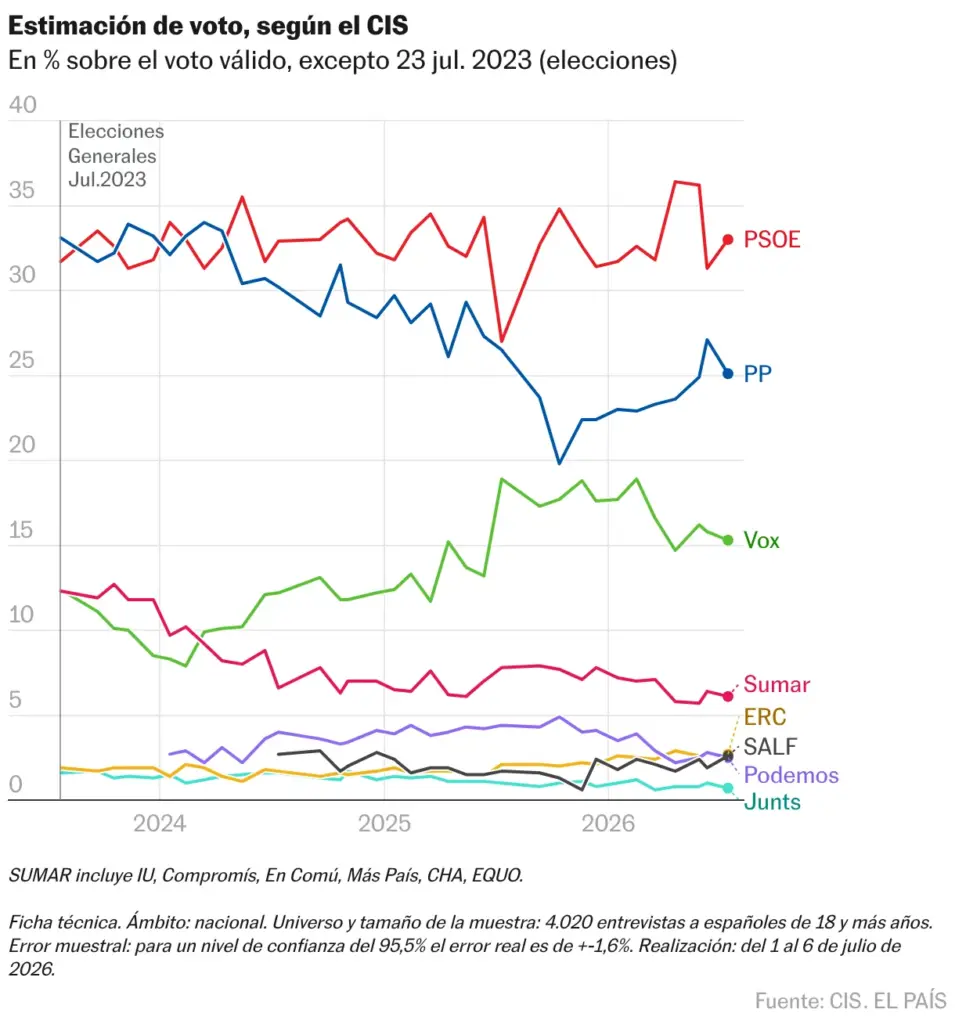
The July study, which consists of more than 4,000 interviews, is published one day after the conviction of the brother of the Prime Minister, David Sánchez, for a crime of prevarication, but it was conducted in the first days of the month. Thus, it reflects the effect of the government agreement reached by the PP and Vox in Andalusia for the investiture of Juan Manuel Moreno and the controversy over the ‘grandchildren’s law’ —the PP claimed that the Government intends to “manufacture new voters” with “electoral engineering” with this section of the Democratic Memory Law, while Vox raised the tone and sought to suspend postal voting for expatriates—.
Housing continues to be the main problem in Spain for 43% of citizens (three points more than the previous month). Concern about immigration grows 4.5 points compared to the previous study and becomes the second problem in the country, something that happens after the extraordinary regularization of immigrants was approved. The third problem in Spain is political issues in general. However, when asked about problems that affect them personally, citizens respond differently. First, the most affecting issue is housing, followed by the economic crisis and the state of healthcare. Immigration is a “personal” concern for one in ten respondents; it ranks fifth on the list of problems.
Assessment of leaders and ministers
The current Prime Minister, Pedro Sánchez, is the preferred choice to lead the government currently, according to 26.7% of citizens. The second leader on the list is Feijóo, chosen by 13.9% of Spaniards. However, 20.9% of respondents indicate that they do not want “any” of the current leaders in La Moncloa. Among Sánchez, Feijóo, Yolanda Díaz, and Santiago Abascal, the PSOE secretary general is the one who receives the best rating, although he does not pass. After the 4.25 that the current head of government receives, Díaz has a 4, Feijóo a 3.64, and Abascal a 2.96.
Neither Sánchez nor Feijóo inspire much confidence among citizens. Less than 30% of respondents say they trust the president (46.4% say he inspires “no confidence”). The opposition leader also does not inspire much confidence: 18.4% trust Feijóo a lot or quite a bit, compared to 34.3% and 45.5% who say they have little or no confidence in the leader of the Populars.
Among the members of the Council of Ministers, the best known by citizens are the second vice president and Minister of Labor and Social Economy, Yolanda Díaz; and the Ministers of the Interior, Fernando Grande-Marlaska, and Defense, Margarita Robles. The least known are the Ministers of Education, Vocational Training and Sports, Milagros Tolón; Youth and Childhood, Sira Rego; and the Government spokesperson and Minister of Inclusion, Social Security and Migrations, Elma Saiz.
Of all, the highest rated is the first vice president and Minister of Economy, Trade and Business, Carlos Cuerpo, who passes with a 5.62. He is followed by Pablo Bustinduy, Minister of Social Rights, Consumption and Agenda 2030, whom Spaniards rate 5.36; and Ernest Urtasun, Minister of Culture, who receives a 5.02. They are the only ones who exceed 5 out of 10. The minister who receives the worst rating is Marlaska, whom citizens give a 3.73.
The Pope’s visit
The July CIS Barometer dedicates several questions to the recent visit of Pope Leo XIV to Spain. Practically all respondents have had information related to the Pope’s visit and 76.8% rate it as positive or very positive. There is also a high percentage of citizens (70.4%) who consider that the papal visit improved Spain’s image and more than half (54.8%) say that the Pope is “an ethical and moral reference for society as a whole,” compared to 37.1% who indicate that he is only for Catholics.
Leo XIV wanted to show his commitment to immigration with different gestures and speeches in Spain. After the official welcome at the Royal Palace of Madrid, the Pope visited a Caritas center in the Lucero neighborhood, in the Latina district, which serves 2,500 people a year, mainly undocumented immigrants and homeless people, and days later he visited the Canary Islands, where he emphasized his defense of immigration and denounced those who “take advantage of desperation, withhold documents and exploit workers.” 76.2% of citizens agree or strongly agree with Leo XIV’s position on immigration compared to 17.6% who say they disagree.
The visit has improved citizens’ opinion of the Pope. 40.1% say that with his visit, Leo XVI’s image has improved, while 53.1% say it has not changed.
Read more From Twitter to X: the social network that polarizes the most continues to dominate 20 years later