









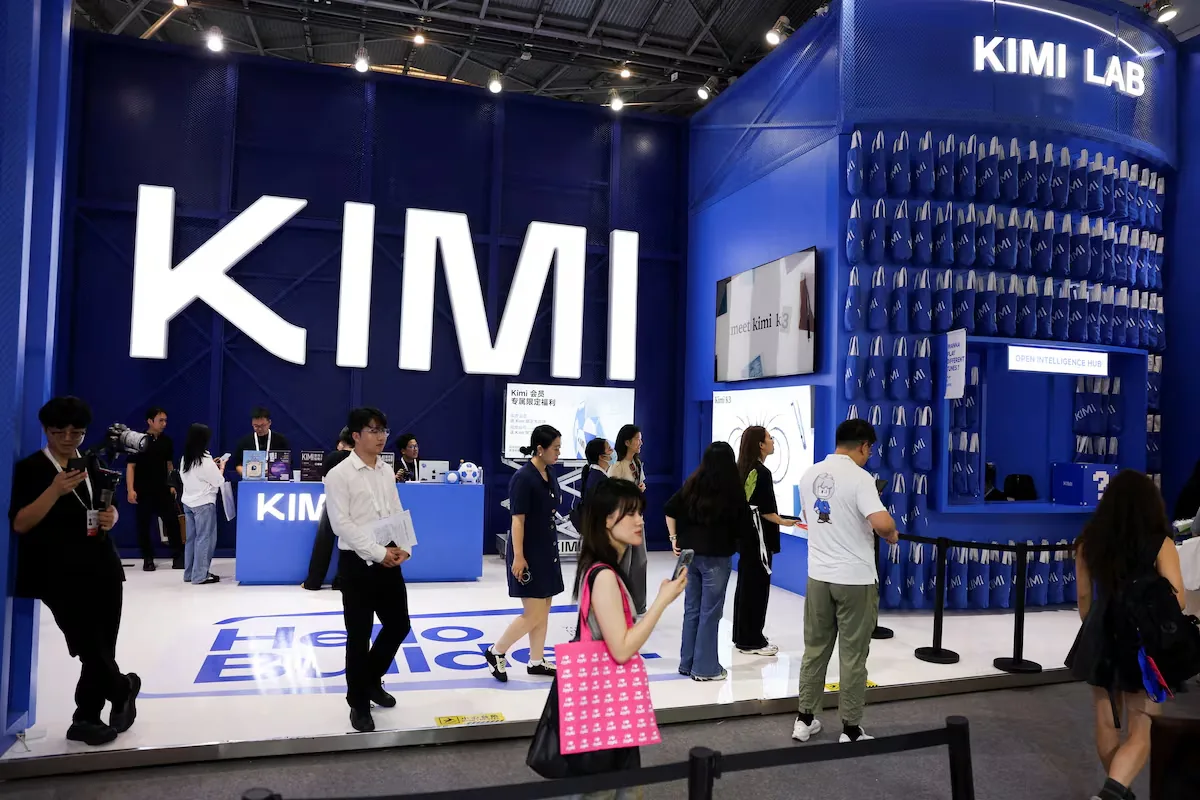
The frantic race to lead the generative artificial intelligence (AI) industry has a new frontrunner. It is called Kimi K3 and has emerged from the labs of the Chinese start-up Moonshot AI. The model has created a lot of buzz in the sector, as the results of the public performance tests published by the company place it ahead of Claude Fable 5, the most powerful from Anthropic, or GPT5.6 Sol, the best from ChatGPT. The fact that it is open source, meaning its internals can be manipulated and modified by any user, makes it a formidable adversary for proprietary models, such as those from Google (Gemini), OpenAI (ChatGPT), Anthropic (Claude), or Microsoft (Copilot).
Read more The court that will try Ayuso’s partner for alleged tax fraud admits it is “overloaded”
The launch of Kimi K3, which will be available from July 27, puts China back in the fight. The Asian giant made a strong entrance in January 2025 with DeepSeek, a model that adapted to the chip blockade imposed by the US and managed to challenge the biggest companies in the sector. Although there are practically weekly developments in the generative AI industry, none from China had made so much noise again. Until early Thursday morning, when Moonshot AI, a company founded in 2023, presented its new toy.
The Kimi K3 model has been developed with 2.8 trillion parameters, that is, variables adjusted during training. This makes it the largest open-source model in the world (the largest DeepSeek model has 1.6 trillion). The weights of these parameters will be made public from that day: any researcher, institution, or company will be able to take the Kimi K3 code and adapt it to their own needs to configure their own tools, just like with DeepSeek models or Meta’s Llama.
Kimi K3 has proven to be especially good at programming. It ranked first in the LLM Arena ranking for creating online interfaces. It also performed well in other software development-related tasks, at levels comparable to those achieved by OpenAI or Anthropic. For example, it can create an interactive and playable 3D environment from a photo. The K3 model processes one million tokens, or basic text units, in a single task, allowing it to work with very large databases without losing accuracy.
Moonshot AI assures, however, that all this computing power is not used to respond to every prompt, or request. The model incorporates a system whereby only the appropriate parameter sets are activated to answer each question. This is one of the approaches experts recommend exploring to improve the efficiency of AI models: just as you don’t need to read the entire Encyclopaedia Britannica to answer the question of when Pablo Picasso was born, you don’t need to compute everything every time you want to perform a specific task. The more parameters involved in each operation, the higher the energy consumption; if it can be avoided to activate everything every time, the savings will be significant.
Read more A 7.4 earthquake is recorded in southern Mexico without the seismic alert being activated
Economic and geopolitical implications
The emergence of Kimi K3 not only means that China is taking the lead in the industry again. It may also have profound implications for the AI business itself. The K3 model, which is open source, offers better performance than the best proprietary models (i.e., closed source), such as Claude Fable. “How can Anthropic justify its prices now? If companies can use the best model while keeping their data under control, why would anyone choose to use Anthropic, which implies handing over their data?” asks Xiaowin Qu on X, former product director at Meta and entrepreneur in the AI sector.
What Kimi K3 means for USA AI:
1. FYI Kimi K3 is open weight and will be released on July 27, 2026.
2. When the best open weight model exceeds the best closed-source model, how does @AnthropicAI justify its Fable pricing? Why would anyone pay for that? Not to mention the Mythos…— Xiaoyin Qu (@quxiaoyin) July 17, 2026
From a geopolitical point of view, the high performance achieved by Kimi K3 also shows that the US blockade on the sale of Nvidia chips to China, considered the best in the world, has not been enough to stop the Asian giant’s progress in this industry. It would be “a nightmare,” Qu considers, if Huawei became the new benchmark in the manufacture of next-generation chips.
The presentation of the K3 model coincided with the launch of an international AI governance organization led by China. The World Organization for Cooperation in Artificial Intelligence (Waico) includes about thirty countries, including Russia, Pakistan, Indonesia, Brazil, Cuba, and Venezuela. “It is an important initiative by China to respond to the call of the Global South and unite the international community to vigorously promote the development and governance of AI,” said Chinese President Xi Jinping on Friday.