








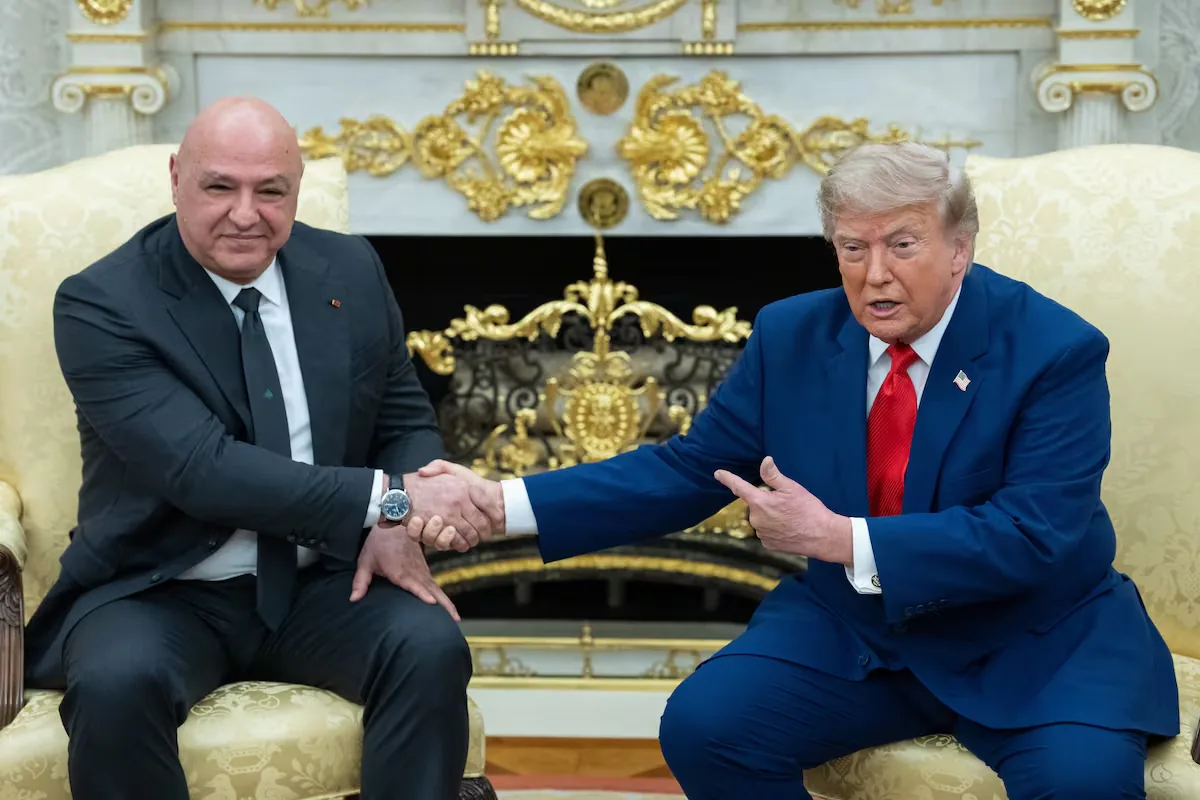
United States President Donald Trump received his Lebanese counterpart, Joseph Aoun, this Tuesday, the tenth day of the second phase of the war in Iran. It was a special occasion: Aoun is the first leader of the country to visit the White House in 17 years.
He arrived with the intention of demanding a complete withdrawal from his country by Israel. In an initial meeting in the Oval Office, Trump told the Washington press that he is willing to talk with the Lebanese militia Hezbollah. “I would talk [with the Lebanese militia] if [Aoun] asks me to. I am always willing to talk to everyone, even if sometimes they advise me against it,” he assured.
The peace agreement that the United States promoted last June 26 to end the conflict between Israel and Hezbollah is having its first results on the ground this week. The text, negotiated between the Israeli and Lebanese governments behind the back of the pro-Iranian militia, contemplates the creation of “pilot zones.” These are areas where Israel must lift the occupation in exchange for the deployment of the Lebanese army, which must demonstrate —under criteria yet to be known— that it controls the territory to the detriment of Hezbollah, before new Israeli withdrawals are carried out.
After the US State Department announced the first three pilot zones on Monday —which include, to the surprise of the Lebanese, two areas without an Israeli presence—, the occupying troops withdrew this Tuesday from Zawtar el Gharbiyeh, a small municipality near the city of Nabatie.
Images of the Lebanese army patrolling the village have caused impatience among its residents, who are waiting a short distance away to be allowed to return to the town, where devastation affects water and electricity networks and forces are demining a landscape that has been a battlefield for months.
Many, however, are skeptical. The US plan does not have concrete deadlines for the Israeli withdrawal, and even its successful implementation in each of the 68 municipalities under occupation would indefinitely prolong the forced displacement suffered by hundreds of thousands of citizens.
“A good man”
Among those skeptics is the Speaker of the Lebanese Parliament, the Shiite Nabih Berri, who sees it as the possible trigger for a civil war. Aoun reacted to his words in Washington. “In reality, the framework of the agreement does not require parliamentary approval. It is a prerogative of the president, according to our Constitution, and we are committed to it. I believe that [Berri] wishes to see the end of this war,” said the Lebanese leader. Trump added that he had been told that Berri “is a good man,” and that when he “sees the progress made [in achieving peace],” he is sure that he “will join in.”
The first move to implement the agreement has been tense: Lebanese troops have accused Israel of firing near their soldiers upon their arrival in Zawtar el Gharbiyeh, and families waiting on the perimeter heard the detonations with which Israeli uniformed personnel advanced in the destruction of homes in the surrounding occupied villages. Trump said he was aware of these incidents and would address them during his meeting with Aoun.
To add uncertainty, Hezbollah —which sees its conflict with Israel as the legitimization of its armed faction— rejects any agreement resulting from dialogue between Israeli and Lebanese authorities, whom it accuses of submission to the West. The group, which in March resumed fire against Israel in response to the war that the Jewish state initiated with the United States against Iran, faces an internal challenge with the arrival in 2025 of the first Lebanese Government to decide to disarm it.
The President of the United States began his meeting with Aoun by saying that Lebanon is a “country of great intellect that has suffered much for decades.” “We are going to help you,” he promised. “We have already fixed some problems, and you know you have a problem called Hezbollah.” Aoun then played the flattery card, usually useful with Trump. “I have been waiting for this visit for a long time; very eager to meet such an important president as you,” said the Lebanese leader, to which his host replied: “He knows how to win me over. He will get what he asks for.”
It does not seem at all clear that it is in Trump’s hands to grant Aoun what he needs: to make his plans gain popularity among the southern population. In that part of the country, the majority is favorable to Hezbollah and distrusts that Beirut’s controversial decision to dialogue with Benjamin Netanyahu’s executive will end with an Israeli offensive that has killed 4,328 people since March, according to the Lebanese Ministry of Health.
Read more A jeweler who shot dead two robbers, new hero of the Italian right