







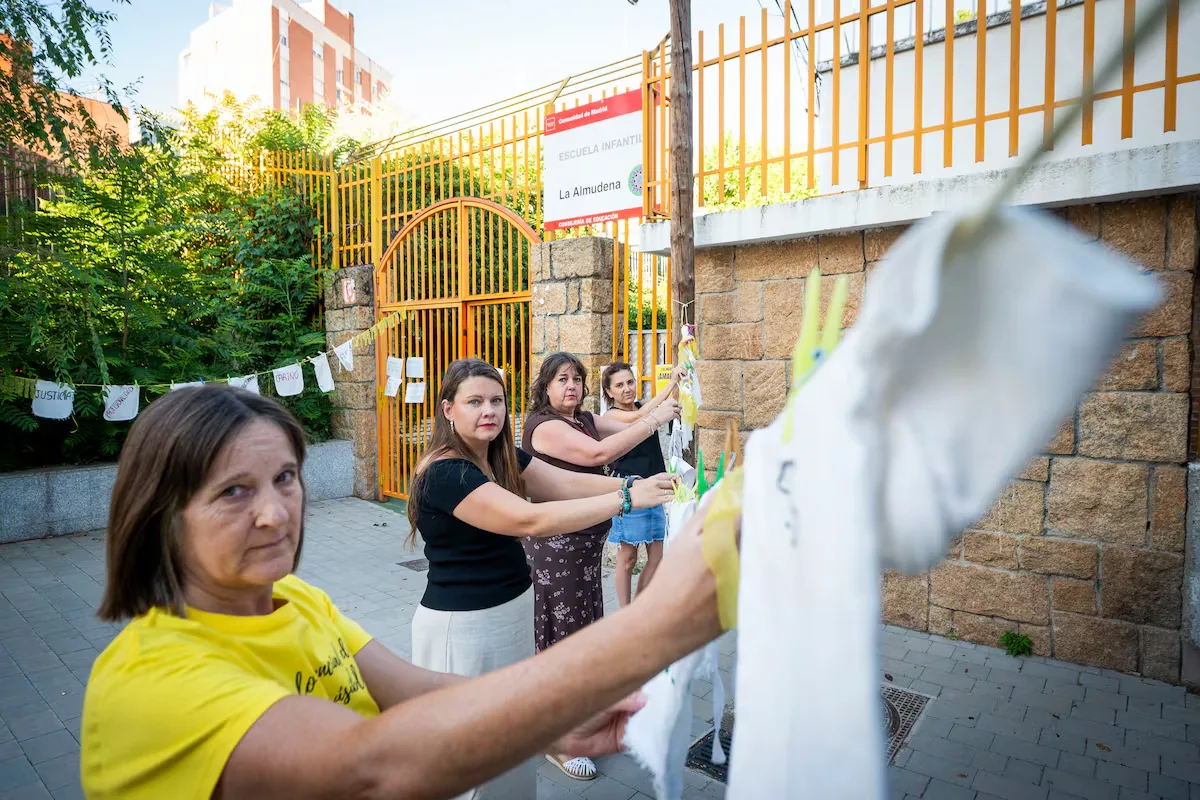
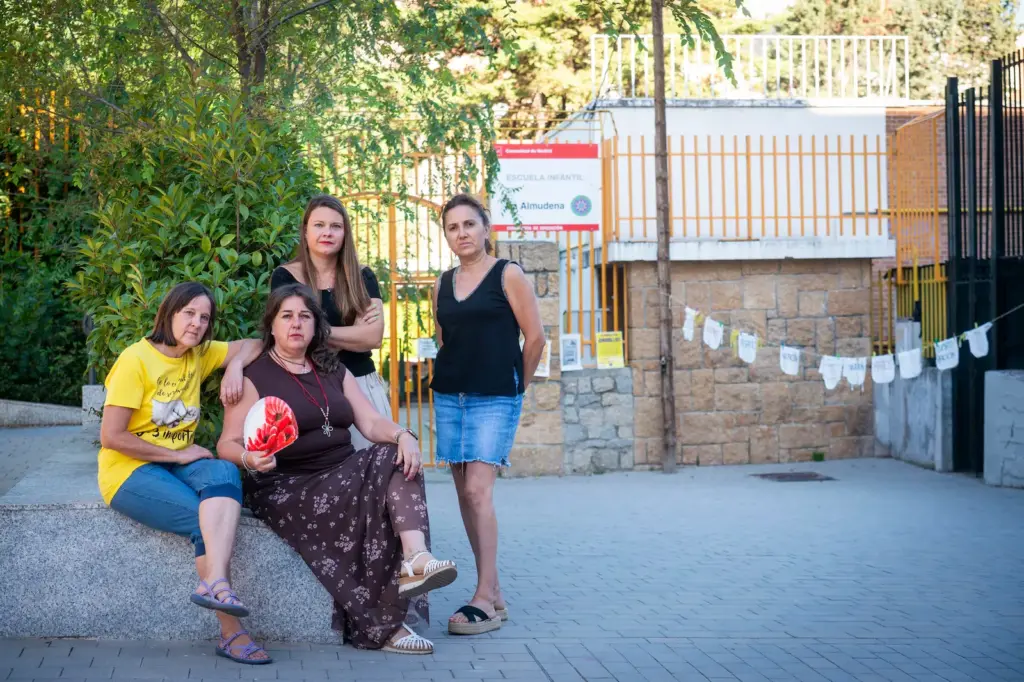
The objective in Madrid’s public nursery schools can be none other than to resist as best as possible until July 31. The 0 to 3 years age group is the only one that registers activity at this time of year, precisely the one that hosts the most vulnerable child population. High temperatures take their toll on educators and babies during this year’s third heatwave. Air conditioning problems are a structural challenge in many directly managed schools, where the Community of Madrid assumes management. There are workers surviving with fans and other devices, but the fear of a heatstroke occurring is constant, while thermometers exceed 30° in the classroom day after day. Some classes are closed because they are ovens. Dizziness and headaches are frequent among educators, who observe how sleep disturbances, loss of appetite, rashes, and gastroenteritis multiply among the youngest children. “Children throw themselves from the mat to the floor in search of coolness to sleep,” says Esther Sánchez, 53 years old. She works in La Almudena, located in Hortaleza.
Read more The school and the heritage of the future
The Community of Madrid does not specify how many nursery schools are air-conditioned or what percentage they represent of the total. In the territory, there are 262 public schools, of which 86 are directly managed and 176 are indirectly managed. Their ownership corresponds to different administrations: the Community, the City Council, and other municipalities. Its communication department merely points out that this academic year they are allocating a total of 17.8 million euros to improve air conditioning and mitigate the effects of high temperatures. “It’s 33% more than last year and means that, in the last three years, we have invested nearly 44 million euros in more than 700 actions,” they emphasize. But they do not say where these resources go, so unions, families, and educators do not know how many public facilities have proper air conditioning.
This newspaper also collects complaints from the Los Pingüinos (Alcorcón), República de Chile (San Blas), Pradolongo (Usera), and Los Ángeles (Tetuán) schools, amidst the indefinite strike by early childhood educators, which began on April 7, to fight against the precariousness of the sector. In all of them, aerothermal systems, air conditioners, or another effective system are requested. The fans, “pingüinos” (portable air conditioners), or adiabatic devices they have are not enough.
La Almudena was built decades ago and still has no blinds, with iron on the windows and a broken roof. “It scares me to think that a child is tired and is actually suffering from heatstroke,” Sánchez admits, after emphasizing that she constantly hydrates and fans the children. They spend the day in diapers, except when they go out to the playground.
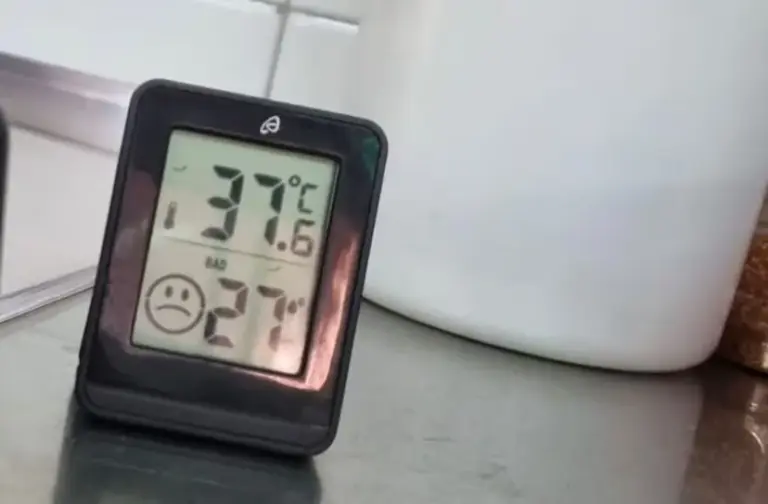
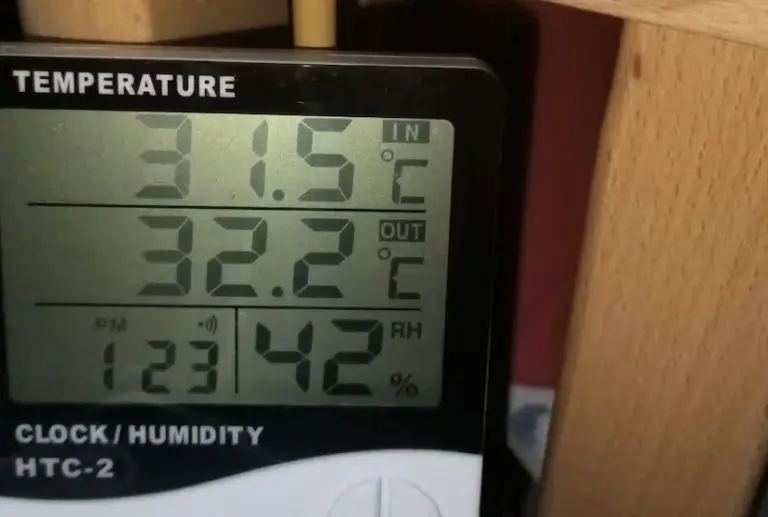
“We have three babies who arrive in the morning, lie on the floor and barely get up, they are exhausted,” says her colleague Paloma de la Torre, 55 years old. Cristina Torres, mother of a 21-month-old child, admits that she doesn’t put down her phone while working. She fears something might happen. “When we go to pick him up, the temperature is unbearable, reaching 32°, an inferno,” says the 42-year-old woman.
15 days ago, her little one was diagnosed with miliaria, a rash that appears due to retained sweat when pores are blocked. “On Friday, I found him sleeping soaked at school, he had been napping for four hours, we had to wake him up, they are lethargic. At home, with air conditioning, it’s different,” she says.
In Pradolongo, the situation does not improve. Last year, a worker suffered heatstroke at that center. This is confirmed by educator María del Puerto Pérez, 45 years old. “She collapsed on the floor and we had to call 112, we live in fear that the situation will repeat itself with a child,” she comments. This month, she has detected more nosebleeds. “Clearly, the temperatures reached in the classroom have an influence. There is also more gastroenteritis,” she indicates.
Environmental pediatrician Ferran Campillo reminds us that early childhood should enjoy a temperature ranging between 20 and 25°: “If it increases, it is normal to detect headaches, dizziness, behavioral, sleep, or appetite disturbances.” When it rises further, he explains, there is a greater risk of heatstroke. The doctor indicates that nosebleeds or gastroenteritis are characteristic of summer, but acknowledges that they can increase with continuous exposure to a high thermometer.
Read more Where are there heat alerts? Check which municipalities have health risks
Laura García-Andrade, a 41-year-old early childhood educator at La Almudena, has reported the situation to the Ministry of Education, the Regional Institute for Safety and Health at Work, and the Ombudsman. She has just returned from a two-day leave: “I suffer from migraines and my head turns into a pressure cooker when I spend so many hours with those temperatures.” She comments that the children are subdued. “They sit on the rocking chairs to lean, but they don’t play. If we bring out the vaporizer, they come running,” she recounts.
General labor regulations stipulate a maximum of 27° in enclosed indoor spaces with sedentary work and 25° for light tasks with moderate effort. Pérez recommends that families only use the service in July if it is essential: “We say this because we know the conditions we are in.” Worrying situations are becoming normalized, according to Encarnación Juárez, a 46-year-old worker at Los Pingüinos Nursery School. “Sometimes we tell our colleagues that we have to sit down for a while because we feel dizzy. Children also get sick more when the heat is intense, with vomiting and diarrhea,” she says.
Some children enter the center at 7:30 AM and leave at 5:30 PM, where several classrooms have already been closed because it is impossible to be in them. The workers regroup them in search of coolness so they can sleep, organize water games, and distribute vaporizers, but the thermometers offer no respite.
“The regional Executive continues to systematically refuse the installation of air conditioning systems in the centers, while the ordinary budgets allocated to them are so suffocated that it makes it unfeasible for them to undertake an investment of this magnitude. It is a direct competence and responsibility of the Community of Madrid that is being evaded at the expense of the children’s health,” denounces the UGT union.
Juárez managed to meet with the Minister of Education, Mercedes Zarzalejo, to convey the precariousness of the sector. “But she replies that ‘when it’s hot, it’s hot’,” she complains. “A baby cannot express that they feel unwell,” she repeats over and over again. The kitchen staff at La Almudena point out that the warehouse reaches 35° in the mornings and the place where food is prepared has registered up to 37°. “On July 1, some chickpeas soaking in water fermented. Potatoes, fruit, or vegetables are left in the warehouse because there is no space inside the cold rooms and, sometimes, they spoil. Milk, crushed tomatoes, or canned goods should not be at that temperature,” says a person who prefers to remain anonymous to avoid reprisals.


“We have a child who, as soon as he wakes up, runs to the fan in search of air,” says Alicia Alonso, a worker at República de Chile Nursery School. Another professional from Los Ángeles, who opts for anonymity, indicates that her center has two floors, although the upper one is not used. “It’s impossible to be there,” she admits. De la Torre confesses going to sleep worried about what might happen the next day: “We have gone to the Madrid Assembly, to Congress, to the European Commission… I don’t know what else we can do. This is inhumane.”