







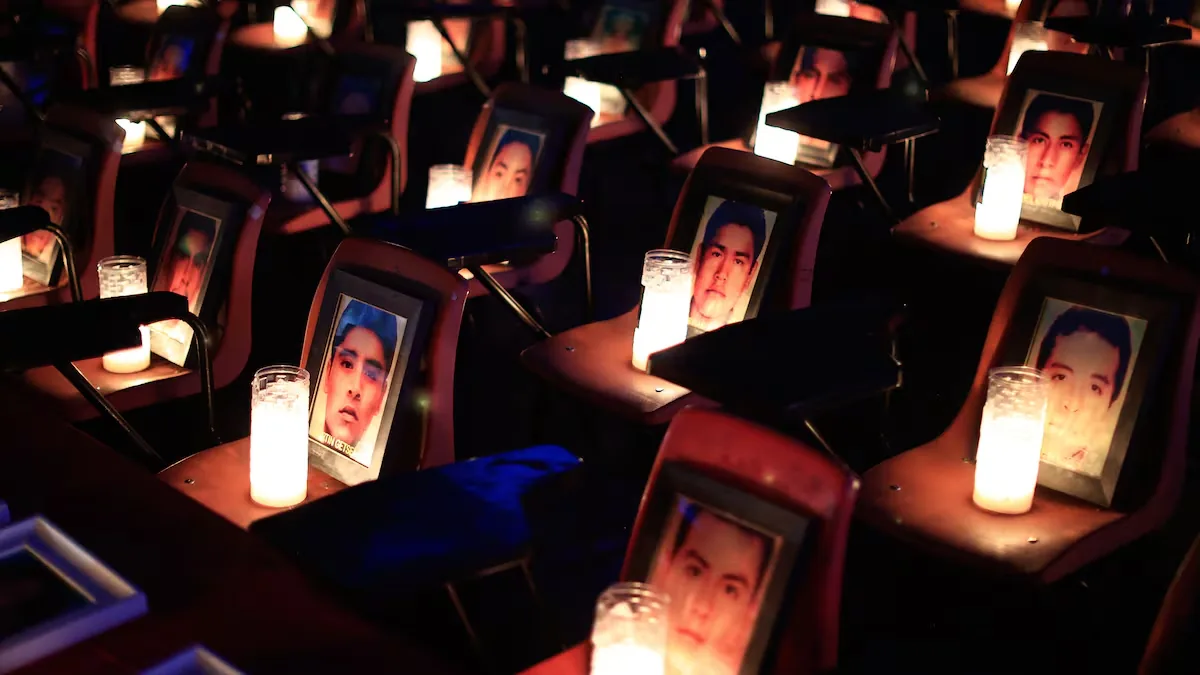
The Ayotzinapa case is a black hole that devours everything that approaches it in search of the truth. The mishandling and manipulation of investigations since Enrique Peña Nieto’s six-year term and the Army’s fierce opposition to being investigated during Andrés Manuel López Obrador’s period have been some of the obstacles to unraveling the matter, which boils down to some core questions: what happened to the 43 students who disappeared on September 26, 2014, in Guerrero, and who was responsible for their tragic fate? López Obrador promised the victims’ families that he would do everything to uncover the truth, while also advocating for the Army’s innocence, contrary to independent investigations that pointed to a degree of participation by elements of the 27th Infantry Battalion of Iguala in the events, and also against the wishes of the students’ families.
Read more Israeli settlers set fire to two mosques, cars and fields in the West Bank
In line with the former president, the National Human Rights Commission (CNDH) maintained a prudent distance from the Army. The head of the organization, Rosario Piedra, is very close to the former president and the ruling party, Morena. President Claudia Sheinbaum, López Obrador’s successor, ratified Piedra at the head of the commission in 2024. From there, the ombudsperson has materialized the officialist position. On July 2, the CNDH issued recommendation 208VG/2026, which, in summary, states that the greatest responsibility for the crime lies with the police corporations of the municipalities of Iguala, Cocula, Huitzuco, Taxco, Ixcateopan, and Tepecoacuilco, colluding with the criminal organization Guerreros Unidos.
Regarding the Secretariat of National Defense (Sedena), the nearly 900-page recommendation states that there is no direct evidence to prove that this institution or the 27th Battalion designed, ordered, or executed a plan for the disappearance or extermination of the students. The report concedes that Army commanders were aware of the massacre as it was happening, and even acknowledges the presence of several elements at some crucial points, as has been documented in the past, but states that this would result in individual omissions by soldiers, not institutional responsibility.
“To find the plain truth and justice, the narrative of the ‘Historical Truth’ has been as harmful as the narrative of the ‘Anti-Historical Truth’. Because while the ‘Historical Truth’ narrative maintained that the Ayotzinapa Rural Teachers’ College was infiltrated by organized crime groups, since all the blame was placed on the latter and on municipal police; in the ‘Anti-Historical Truth’ narrative, as the blame has been sought to be shifted to the Army as a ‘state action’, then, the Army had military personnel infiltrated among the students and that was the trigger for the events,” the report says, referring to the student who was enrolled in Sedena, Julio César López Patolzin.
The recommendation was addressed to several municipal, state, and federal institutions, with the exception of Sedena. Due to its favorable stance towards the Army, the CNDH report was widely criticized by academics and civil organizations, and directly by members of the GIEI, an international commission of specialists tasked by the Mexican Government with an independent investigation, and in which the families of the students have great trust. In response to the questioning, the CNDH came out this Sunday to defend the meaning of its recommendation and to lash out against the critics’ “campaign.” In a long and angry argument, the organization states that the accusations are “ridiculous,” “absurd,” “laughable,” “malicious,” or “deceptive.”
Read more 300,000 kilos of fodder to supply livestock farms in the Madrid fires
The CNDH denies having omitted to thoroughly investigate the role of the Army or the Iguala Battalion. “The draft recommendation began from the imperative to investigate the institutional responsibility of the Army. Even starting from the widely disseminated assumption that it was truly responsible for the events […] the existence of a specific extermination plan against the Ayotzinapa students was sought, as the Army had indeed had in some cases documented by us in the past,” it explains. The CNDH also highlights the three criminal cases currently open against elements of Sedena. “Whoever says that the Army is the beneficiary of this recommendation is lying; it is the victims,” it maintains.
The organization criticizes some organizations involved in the investigation of the case or that provided legal defense to the victims’ families. “Shouldn’t it also be subject to investigation how much money has flowed to organizations and ‘defenders’ in the name of the Ayotzinapa Case? We believe so, and that is what is proposed in the recommendation, because while many resources have gone to them, most of the victims have had to suffer deficiencies, neglect, even abuse and real criminalization, to the extent that some of them have died in lamentable conditions,” it claims.
As an example, the statement denounces that more than 67 million pesos have been allocated to the GIEI. “It’s already more than 11 years. How much money (millions of dollars) has reached NGOs and lawyers in all these years at the expense of the case, and how much to the victims and the schools?” it points out. The questioned recommendation has triggered reactions in politics, such as in the federal Congress, where Movimiento Ciudadano (MC) has demanded the appearance of Rosario Piedra. It is foreseeable that the ruling party will close ranks with her, as it already did by ratifying her re-election at the head of the commission at the behest of President Sheinbaum in 2024.
Read more Los desalojados con mascota en Villamanta: “Lo primero que hice fue coger a mi perro”