







August Strindberg is one of the causes of the sleep epidemic that has plagued theaters for over a century. Before the innovations proposed by the author of Storm, a play restaged yesterday at the Teatro Español, spectators went both to see the play and to be seen by the rest of the audience, as the house lights remained on during the performance. Until Wagner, first, and Strindberg, later, decreed that all attention should be focused on the stage. In the prologue of his play Miss Julie (1888), the Swedish author argued, in line with naturalism, that the house lights should be turned off to maximize the illusion of reality. He did not take into account the laws of physiology: after a long and routine workday, darkness invites sleep to many exhausted spectators.
Read more The theater and dance premieres of the week
This and other innovations of his came to stay. He believed that the audience and actors should share an intimate space, according to the chamber theater he had seen during his exile in Germany. The Andrea D’Odorico hall of the Teatro Español, where Storm is performed, is even smaller than the Intima Teater in Stockholm, where August Falk, a 24-year-old director and actor, premiered twenty-five pieces by Strindberg between 1907 and 1910, who became its artistic director. That hall hosted a 32-square-meter stage and 161 seats, no more. Iván López-Ortega, director of the newly premiered production, is the same age as Falk was then. Perhaps Eduardo Vasco, who leads the Español, wanted to give us a wink. Storm is one of the four chamber plays the Swedish playwright wrote at age 58 for the Intima. That is Vasco’s age today.
López-Ortega, who is also responsible for the set design and original music of his show, has arranged the audience on three sides around a stage that will have the same meters, or a few less, than the Intima stage, reopened in 2003. Three velvet curtains hide its interior. The beginning, with music from a clarinet that is heard through the curtain, could not be more suggestive. Smoke comes out of the instrument, as if we were watching a fragment of The Public or Untitled Comedy. When the curtain is drawn back (I reveal it), a green landscape appears with the house where the tormented protagonists of this drama live. It is a model, before which the actors seem like giants. Three of them move like puppets. Two others are flesh and blood.
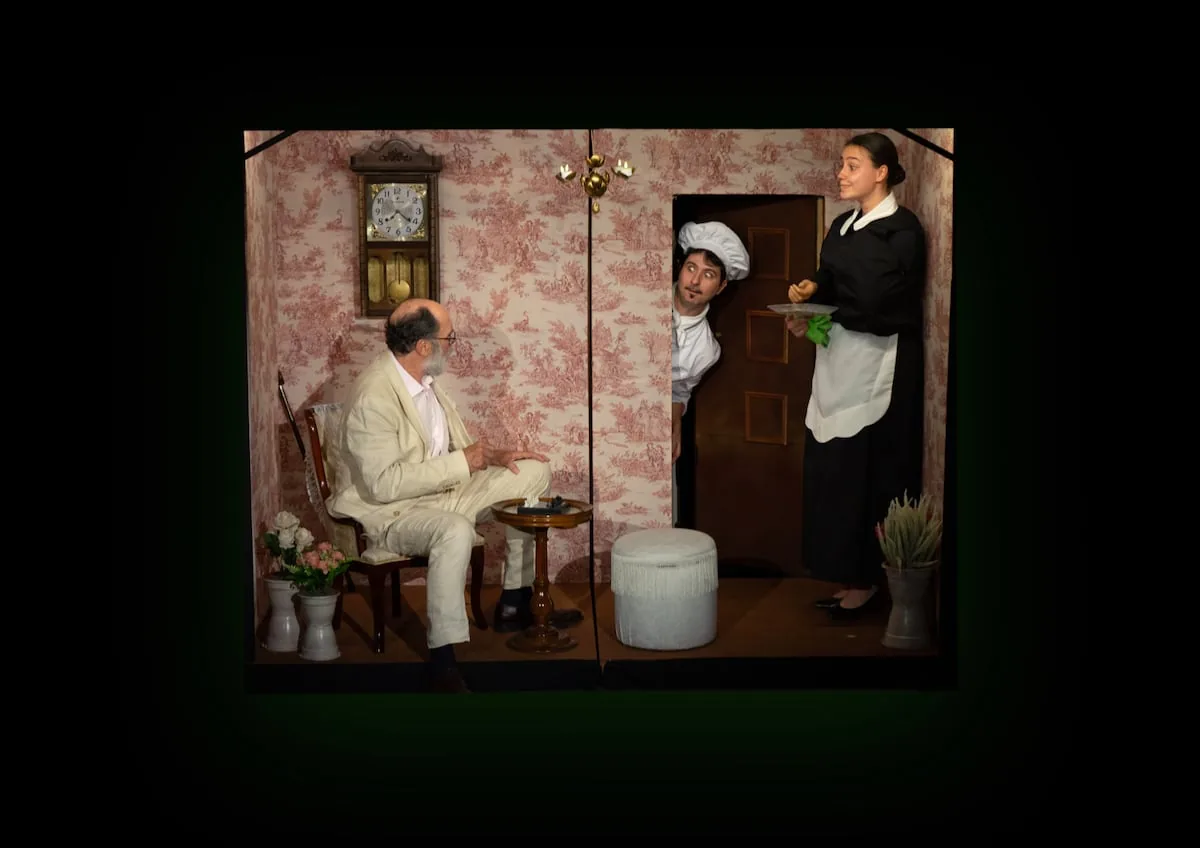
The director outmaneuvers Strindberg. He frames the two brothers realistically, but flies in his approach to those around them: the wife, the maid, and the confectioner seem to have escaped from a large puppet show. Likewise, the outside world is toy-like. Remote-controlled or hand-pulled cars come from outside. At one point, the four-story house, through whose small windows giant hands appear (just like those coming out of the walls in Repulsion, by Roman Polanski), opens in two, so we can access a large room that, however, is cramped for those who inhabit it: if they stretched their necks, they would hit their heads on the ceiling. This room is a replica of the one that appears in the original production of The Pelican, one of Strindberg’s masterpieces. The performance is full of winks like this, for those who catch them.
Read more Katia Itzel García, the World Cup and a whistle against machismo
The toy building of the set design, which only lacks the ability to speak, alludes to A Doll’s House, a central work by Ibsen, the ultimate reference and artistic rival of the young Strindberg
That toy building, which only lacks the ability to speak, alludes to A Doll’s House, a central work by Ibsen, the ultimate reference and artistic rival of the young Strindberg. Joaquín Notario, Lara Grube, Rocío Suárez de Puga, Óscar Fervaz, and Paula Muz, actress and clarinetist, deliver a beautiful and tuned performance. Grube embodies the sister of the mature, separated, and taciturn man around whose diminished mood the play revolves. In the original version, they are two male brothers. The gender change, in this case, no matter how well the female character wears her pants, distorts the bitter, slightly misogynistic nature of the relationship these creatures maintain with each other and with the wife of one of them. The playfulness established with these changes takes the play to another territory, although it does not detract from its mystery. The confrontation between the protagonist and his wife, which constitutes the climax of the play, is diluted in this production in favor of a rushed ending, perhaps due to time constraints, as everything programmed in this hall tends not to exceed sixty minutes in duration.
Storm
Text: August Strindberg. Direction: Iván López-Ortega
Cast: Joaquín Notario, Lara Grube, Rocío Suárez de Puga, Paula Muz, and Óscar Fervaz
Read more Migrations begin regularization with 13,000 applications from foreigners
Teatro Español. Madrid. Until May 3