

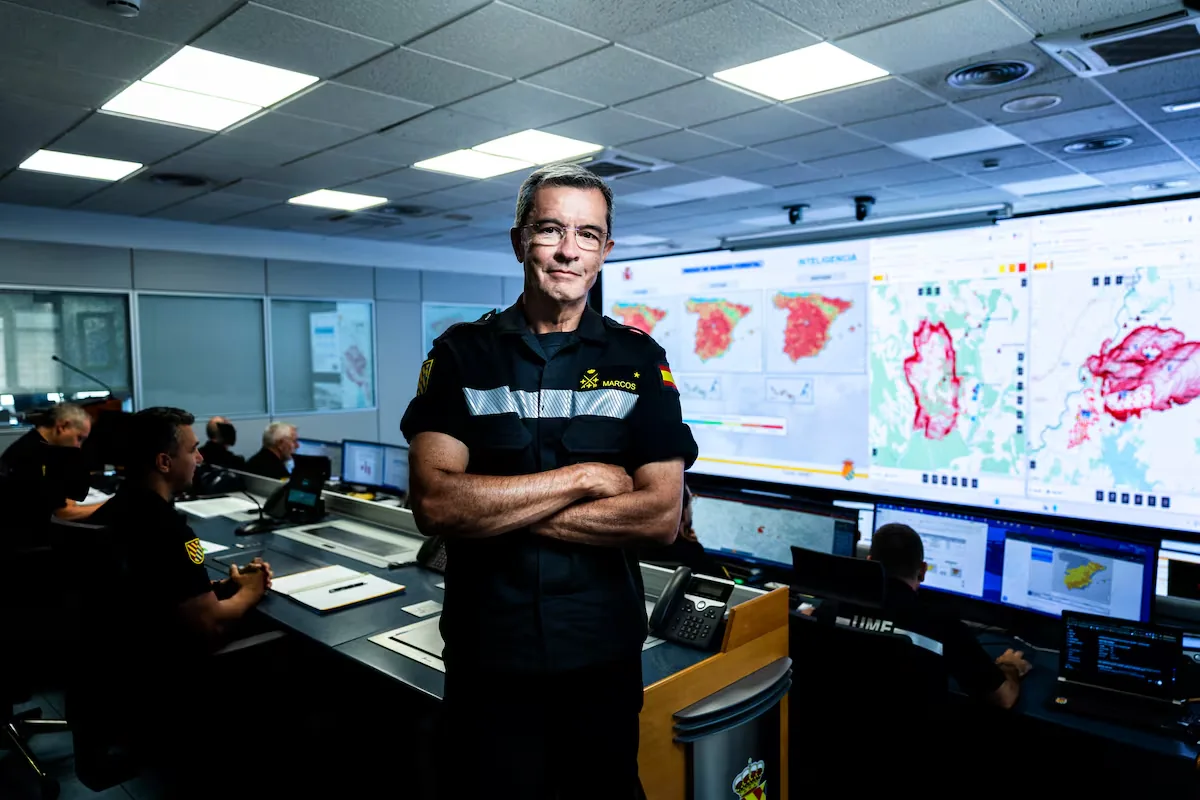
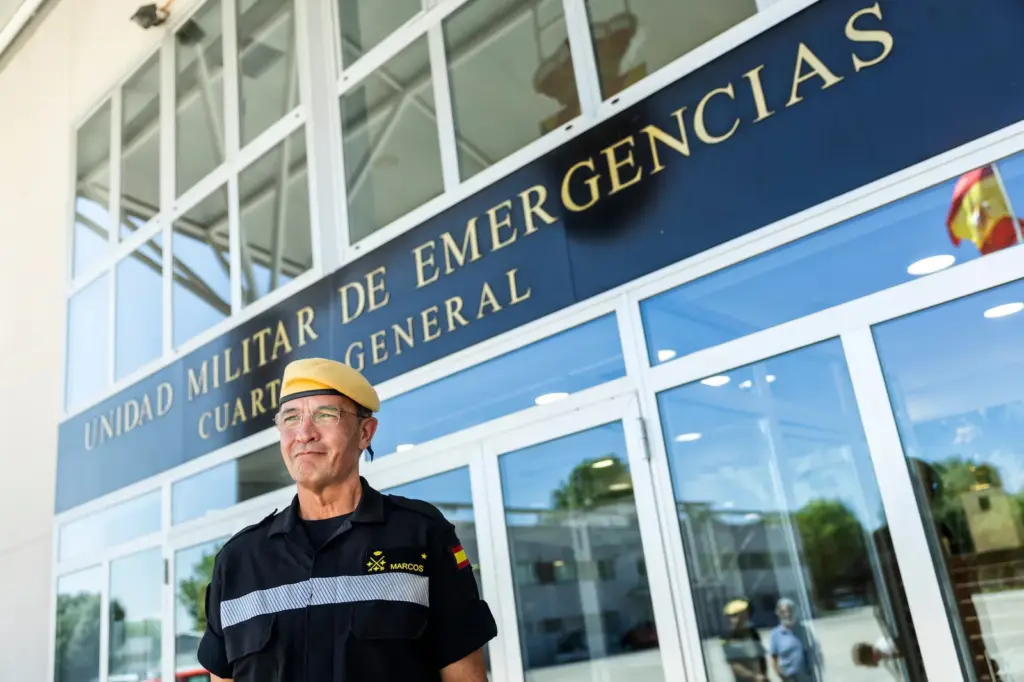
While this interview is taking place, at 12:30 last Friday at its headquarters at the Torrejón de Ardoz Air Base (Madrid), the Military Emergency Unit (UME) is deployed in Val de Maqueda and Pelayos de la Presa (Madrid), in Burgo Hondo (Ávila) and Vall de Uxó (Castellón), in Fermoselle (Zamora) and Villafranca del Bierzo (León). In total, 700 soldiers fighting on the front line against the flames and another 200 in support. For three years, Lieutenant General Francisco Javier Marcos (Toledo, 61 years old), an officer from King Felipe VI’s promotion, has been in charge of the most demanded unit of the Armed Forces, a Seventh Cavalry called upon when the situation gets really bad. On July 24, the Government decreed for the first time level 3 emergency due to forest fire and the head of the UME took operational command of the fight against the most devastating fire in Spain’s history.
Read more Cayetana Álvarez de Toledo: “I still haven’t understood the thing about Ayuso and the penthouse”
Question. What has it meant to assume operational command of the Madrid-Ávila fire extinction?
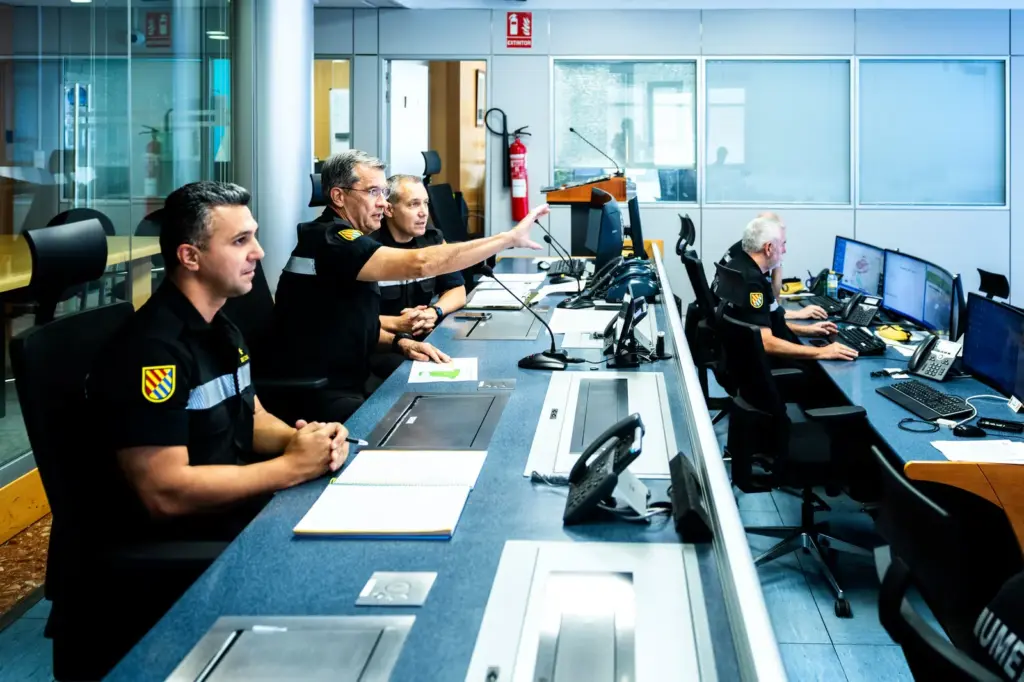
Answer. Taking on the responsibility of leading the State’s response in circumstances of extreme severity and absolute exceptionality. A very complex situation, especially in the early moments, when there is little information and many lives are at risk. In minutes, you have to coordinate the resources of all administrations — municipal, regional, and central — as the law provides. The distinctive mark of the UME is its ability to integrate, in a headquarters of 200 soldiers, the rest of the Armed Forces and all public and private resources into a very solid, unbreakable backbone that bends but does not break.
Q. When did you become aware of the scale of the fire?
A. At the moment when the autonomous communities contacted us and we started working, we saw that the fire was very dangerous and the circumstances were very unfavorable, especially due to two factors that worried me. First, the merging of the fires. It was the most dangerous hypothesis, but at that time not the most probable, [although] later it was. When the most dangerous hypothesis becomes the most probable, it is an explosive mix. Second, the high number of towns and the high population density in some areas. The reconnaissance elements alerted us to the height of the front; the perimeter’s extension, which was multiplying by the second, and the virulence of the flames.
Q. What was your priority?
A. I said from the beginning that the first priority was the safety of people and the defense of population centers. Loud and clear. The second was to guarantee the movement of personnel, evacuations, confinements, under the best safety conditions. And the third, the attack on the fire. Some were shocked, but in an emergency of this type, you cannot only look at the flame. You have to look up and say: “The flame is important, but the most important thing is people’s lives.” My concern was the people. Transfers and unit movements had to be coordinated. That night there were nearly 2,000 responders moving with initial nervousness, the population worried, the flames uncontrolled… It was a perimeter that reached 285 kilometers. It’s enormous.
Q. There have never been so many evacuations and confinements in Spain.
A. There has never been in Spain an emergency caused by forest fires that has caused such numerous and diverse population movements. Besides population centers, there were isolated houses. We could not leave anyone behind. That generated a distribution of logistical and tactical routes that had to be coordinated. And it was night, action was necessary. That was the most critical moment.
Q. Did anyone resist evacuation?
A. No one should refuse, but it is logical, we are human. When one is at home, convinced that nothing will happen and wants to defend their properties and, for many, their life. There were second homes, but also many houses that for those people were their home, their land. It was difficult to convince them, but we had very few cases and the legislation allows mandatory evacuation in national emergency situations. In very few occasions was it necessary to resort to that. People behaved exemplarily.
Q. The fire ended without casualties.
A. The real success is that there were no deaths. No serious injuries, only some bruises. Among the evacuees, there were many elderly people, but there was no serious episode.
Q. In the Gallardos fire there were 14 deaths. What went wrong?
A. Criticizing how that fire was managed would seem unfair to me. We supported the Andalusian Government as soon as our presence was requested and I think it was well managed. There was erratic, violent wind in a rough area that made mobility difficult and caused the fire to spread very quickly. If those lands are prepared and we avoid continuity [of vegetation], we cut the fire’s advance. If those houses do not have those trees so close… Now I look at everything from another perspective. When I see plants and tree canopies close to windows, it looks very nice, but are people aware of what they are risking?… The fire itself was not excessively complex, but it is essential to heed the experts’ indications.
Q. What is a sixth-generation fire?
A. It is the trendy name given to fires that evolve rapidly, that no one can stop. It is the conjunction of three factors: intensity, height, and the flame front. When these circumstances occur, it is said they are beyond extinguishing capacity, you cannot stand in front because it will take you down. So we perform delaying, passive maneuvers. Hence my third priority, and not the first, was to attack the fire. If we had focused on attacking, we would not have succeeded and many towns would have suffered irreparable tragedy. Against this type of fire, the only thing we can do is defend ourselves. Having more resources will not solve it. Many people say: Why not more? This fire had sufficient resources; an excess of resources in such an area only [causes] collapse. More resources is not more safety.
Q. Does Spain have enough resources against these fires?
A. There are enough for usual emergencies. Fires of a thousand, two thousand hectares. Of course, there are never too many. Logically, there are communities [autonomous regions] that prioritize more or less. I will not get into that because it is not my concern. As for the UME, right now there are sufficient resources. But no country in the world, not even the most capable, can face large catastrophes alone. We all have to turn to international aid. What must be done is to normalize that community response.
Q. Is the cause of these large fires climate change or rural abandonment?
A. I think it is everything. If one analyzes the statistics, in recent years we have doubled the number of interventions. Fires are larger, more intense, closer to each other. Temperature peaks are higher in affected areas, more extensive. Something is happening. Climate change is influencing, especially due to intensity and simultaneity. This has a direct effect on the UME, as we are called more often, for longer, and in more severe fires.
Q. It is said that fires are extinguished in winter.
A. Yes. Proper forest management is urgent. There must be an agreement among the different administrations. 56% of Spain’s surface is forest and that must be well managed. The speed at which the fire ran in this last emergency posed a risk to my soldiers. From 15 meters per minute it is out of control and here it ran up to 50 meters, in some cases 60. There will always be fires. The key is to prevent them from becoming large fires. If we achieve proper forest management, make the different administrations aware that work must be done in peace time, when there are no emergencies, it will be easier to avoid them.
Q. The UME returned less than a month ago from the Venezuela earthquake.
A. It was a tough experience from which we returned with mixed feelings. On one hand, satisfied to have arrived among the first, despite communication difficulties, and for having managed to save two lives. But also, with some sadness for not having been able to save more. A tragedy of this magnitude undoubtedly marks any responder.
Q. What do you say to those who say you arrived in Venezuela before the dana in Valencia?
A. I understand the pain and nervousness of those who experienced the dana firsthand and from the first moment. And I understand because the UME was also there from minute one and for weeks. We know the suffering of the affected neighbors, how their towns were left… And we know because we accompanied them from start to finish and helped them to be able to move forward despite the magnitude of the emergency.
Read more A group of migrants riot at the Tapachula migrant station