




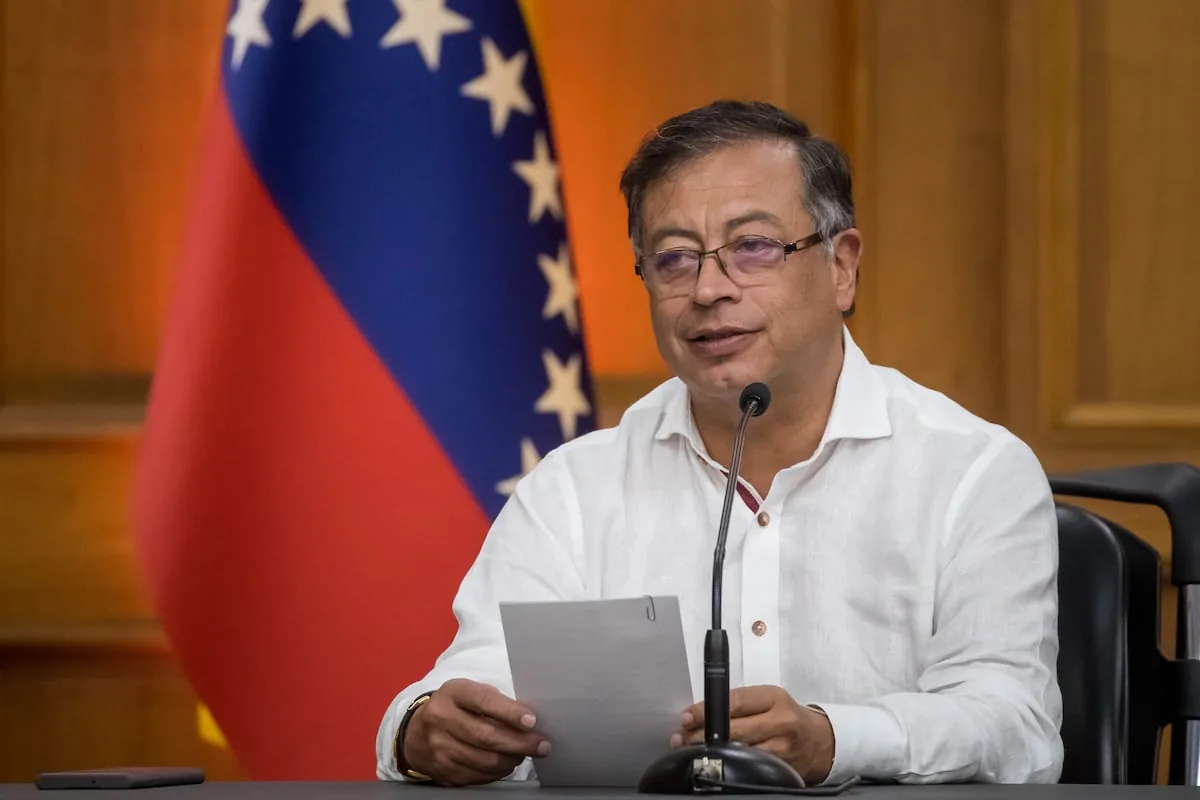
The president of Colombia, Gustavo Petro, announced this Friday from Barcelona that he will travel to Venezuela on April 24 to meet in Caracas with the acting president, Delcy Rodríguez. The leaders of the two neighboring countries had rescheduled their long-awaited bilateral meeting after having canceled at the last minute, due to “force majeure,” the meeting they had scheduled for March 12 in Cúcuta, the main Colombian city on the border. Initially, as EL PAÍS anticipated at the time, the foreign ministries had indicated that the meeting would be on April 23 and 24 in Maracaibo, but Petro now confirms that it will take place in the Venezuelan capital.
Read more Young woman found dead after disappearing in Mexico City
“If Muhammad does not come to me, I will go to the mountain. And so I am going to Caracas,” Petro said in a casual tone during an interview on Los Desayunos de RTVE and the Efe agency, as part of his visit to Spain to participate in the progressive summit convened by Spanish President Pedro Sánchez and Brazilian Luiz Inácio Lula da Silva. “I have gone several times, part of my trips is what has led to me being put on the OFAC list,” he added referring to the US Treasury sanctions. The president of Colombia landed in Barcelona on Thursday, after having sealed an unexpected diplomatic truce with Donald Trump earlier this year, following the intervention of the United States in neighboring Venezuela to capture Nicolás Maduro. His visit to Venezuela will in any case be the first since the fall of Hugo Chávez’s heir.
President @petrogustavo announced that on April 24 he will travel to Caracas to address energy transition issues.
He recalled that in the past he raised with Maduro the need to allow the people to express themselves freely and to open the way to a democratic transition,… pic.twitter.com/cDdEtU1crN
— Presidencia Colombia 🇨🇴 (@infopresidencia) April 17, 2026
Petro was participating this Friday in an academic panel at the University of Barcelona and was meeting with Pedro Sánchez, while on Saturday he will give a speech at the Global Progressive Mobilization, will be at the plenary session, and is also expected to participate along with a dozen other presidents in the IV Meeting in Defense of Democracy, “with the aim of defending the principles and values of democracy, multilateralism, and respect for the international order based on rules,” according to the Spanish Government.
Read more Chess Analysis | Caruana’s Grit
During the talk on Los Desayunos, Petro proposed the convenience that chavismo and the opposition form a shared government in Venezuela for “one or two years.” “They have to co-govern for a while to build trust,” he insisted, so that this stage later leads to “truly free elections.” He also hinted that there is “a great fear” among the Venezuelan people about the possibility of a “political vendetta” in the event of the return of the opposition leader and Nobel Peace Prize winner María Corina Machado. “Oil is Venezuela’s curse,” Petro concluded, summarizing his well-known positions against oil exploitation.
The meeting between Petro and Rodríguez scheduled in March at one of the border bridges connecting Cúcuta with the Venezuelan state of Táchira was canceled at the last minute. That was going to be the first international trip of the acting president, but it was frustrated without further details on the causes. Without the presidents, the bilateral meeting was held with delegations from both governments at the Miraflores Palace in Caracas, where Petro sent both his foreign minister and his ministers of Defense, Commerce, and Mines and Energy.
Petro, who unsuccessfully tried to mediate between chavismo and the opposition at the time, also said this Friday that he did not consider himself a “friend” of Maduro, and that he even encouraged him to hand over power if that was what the people wanted. In Colombia, the president was often criticized for not condemning Maduro more forcefully. Although Bogotá never recognized any winner in the Venezuelan elections of July 28, 2024, the Colombian also never broke diplomatic relations that he restored at the beginning of his term, in August 2022, after years of irreconcilable differences.