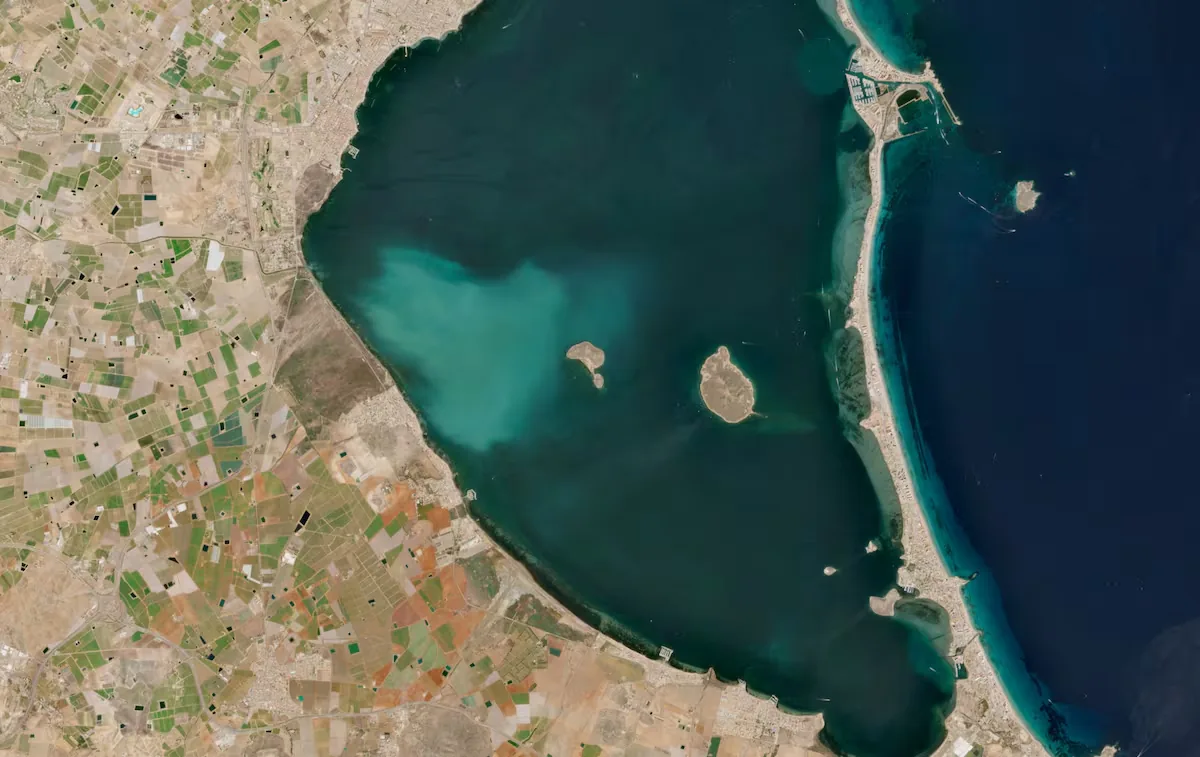
In the fall of 2022, a white spot was detected for the first time in the southwestern area of the Mar Menor, the largest hypersaline lagoon in Europe. It might seem harmless, but its persistence — it has remained unchanged for four years — and its ability to block sunlight have turned the lagoon bottom in that area into a kind of desert. Seven kilometers of underwater vegetation have disappeared, and at its epicenter, fish species have dropped from the usual 21 to only three, concludes a study by the Spanish Institute of Oceanography (IEO-CSIC) and the University of Murcia. The cartographic analysis and satellite images show that the spot affects 12.3 square kilometers, 9% of the 136 over which the Mar Menor extends.
Read more Junqueras proposes agreeing on permanent teams of education experts that go beyond each government
The phenomenon, known as whiting, occurs due to the increase in the water’s pH, which causes the precipitation of calcite microcrystals that become visible ― they are not drags of any material, they form in place ― and give the area a milky appearance. These are not very common processes, but they have been detected in other parts of the world such as the Bahamas, the Arabian Gulf, or southwest Florida. Although they have been studied for decades, “the mechanisms that explain their formation and persistence remain a subject of debate,” the research emphasizes.
They are usually considered phenomena of little ecological importance due to their temporary nature. But the one in the Mar Menor is different: “It is the first episode of this type that has not disappeared in years when normally it would vanish in days or a few weeks,” notes Víctor Orenes-Salazar, a researcher of the study, published in the journal Marine Pollution Bulletin. Hence the ecological consequences they have detected in the flora and fauna.
Although what is happening is still being studied, the problem intensifies because the spot is located in a lagoon that has endured continuous mistreatment for decades with changes and loss of deep habitats. In the 1970s, the connection channels with the Mediterranean were artificially deepened, which caused increased salinity and the entry of an algae that replaced the native one. In the 1980s, agricultural intensification arrived, with inputs of thousands of tons of nitrates, until the lagoon said enough in 2016 and turned into a kind of green soup. To top it off, in 2019 and 2021, massive fish die-offs occurred due to lack of oxygen.
“Our results suggest that this phenomenon is further simplifying communities that had already undergone significant transformations,” comments Adrián Guerrero Gómez, from the Department of Zoology at the University of Murcia and also an author of the study.
If the spot had been temporary, it would have been “like it was cloudy.” “Ecosystems are used to temporary lack of light, but not to this chronic blockage whose effects end up affecting photosynthetic organisms,” explains Orenes-Salazar. The light blockage has caused turbidity to be up to nine times higher in that area than normal: during the studied period (2023-2024), only 3.9% of sunlight reached the bottom compared to 18.3% in healthy areas.
Read more Racism in Puerto Rico: a daily problem with hardly any data to support it
The loss of vegetation began to be detected a year after the appearance of the whiting. That was when Orenes-Salazar proposed investigating what consequences the fish might be enduring, as those meadows are essential as refuge and breeding and feeding grounds for marine fauna.
The researchers analyzed three types of areas: transition zones, where the spot appears and disappears; those continuously covered; and others in the Mar Menor not affected by the phenomenon. To do this, they studied nearly 4,000 fish specimens. In healthy areas, 21 different species were detected; at the edge of the spot, 10 appeared; and in the affected core, only three. Among those that have left the place are the seahorse, pipefish, and gilthead bream.
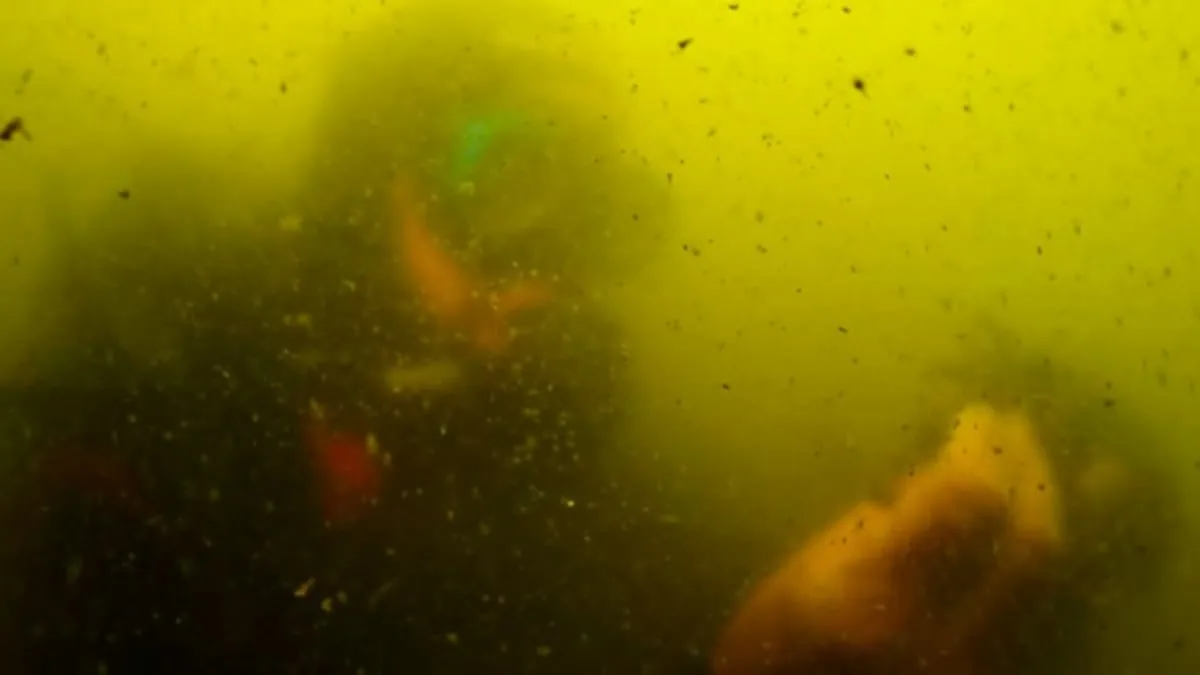
“In fact, we don’t like diving there, it’s very unpleasant, it’s unhealthy, it’s scary, I dive to depths of up to 45 meters and I don’t have as bad a time as when I go there at three or four meters, because visibility is zero, you can get disoriented. It’s almost an irrational fear, you get a kind of emptiness in the pit of your stomach,” the scientist describes the immersion in suspended calcite.
What will happen to the spot? “We don’t know, it’s a process linked to the hydrological cycle, that seems more or less clear, but many variables intervene and the research is very complex,” answers Orenes-Salazar. A study from last year considers that the “extraordinary persistence of the phenomenon” seems closely related to the hydrogeochemical context of the lagoon and the basin that drains into it. It would be due to the continuous discharge of groundwater from the adjacent aquifer, enriched over decades in nitrogen and carbonates as a consequence of intensive agriculture. The increase in pH in areas influenced by these inputs favors the precipitation of calcite crystals.
Read more One hundred years of national parks: conservation as our best investment