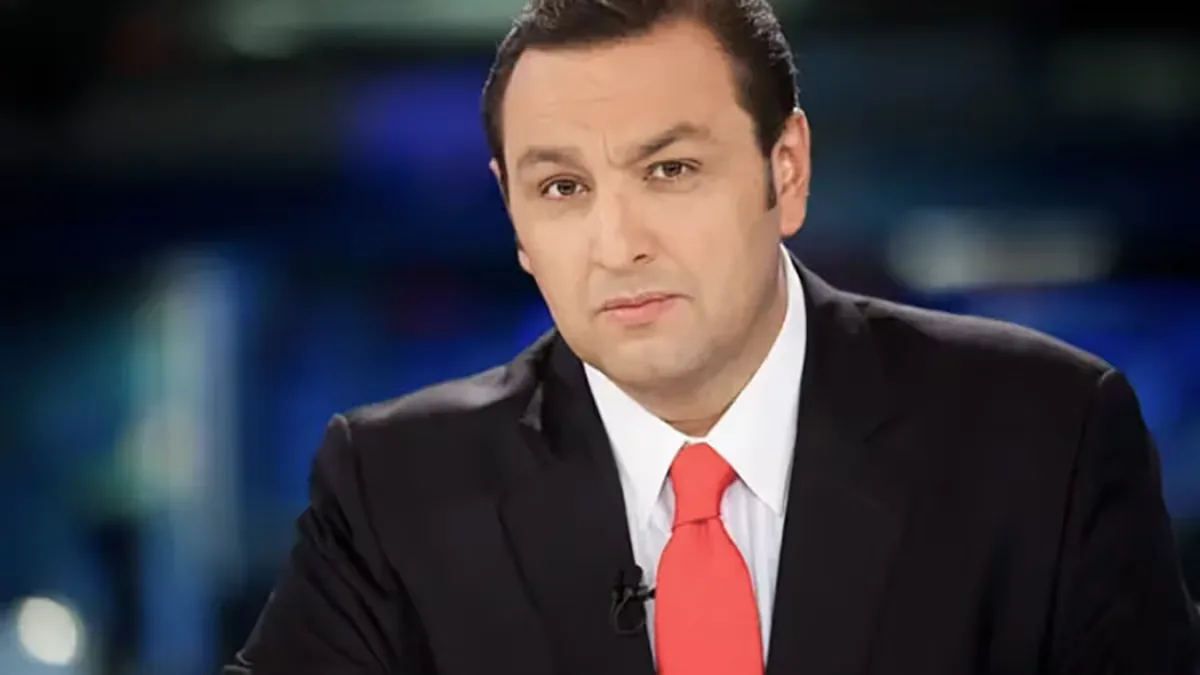
The case against Jorge Alfredo Vargas, the well-known presenter accused of sexual harassment during his time at Noticias Caracol, took a turn this week. While the Prosecutor’s Office was advancing in the hearing of charges, this Wednesday three of the four alleged victims revealed that they were linked to the criminal investigation without ever having filed such a complaint and after stating that they do not wish to participate in the process. This despite the fact that the justice system has insisted on their presence and provided them with a public defender, who was present at the hearing. They have stated that they feel this decision is forced. “It constitutes a revictimization for us,” they have written.
Read more UNAM Control Exam: who will have to retake the entrance test, dates and application venues
The three complainants, who did not reveal their identity during the hearing, warn that they are being exposed to judicial and media harassment. “Today, our mental and emotional health depends on being able to overcome this aggression and not repeat the events that are already known to the authorities,” the letter reads. It also suggests that their labor complaints reached criminal instances due to a transgression committed by the Ministry of Labor. They explain that, although the Human Resources area of the television channel where they worked with Vargas refused to provide sensitive information, the Government obtained the documents, and later, by court order, the Prosecutor’s Office obtained copies of the internal files.
#ElReporteCoronell Statement from three of the alleged victims in the Jorge Alfredo Vargas case https://t.co/INVdH68cdS pic.twitter.com/1A5PIIPfSd
— Daniel Coronell (@DCoronell) August 5, 2026
This Wednesday it was also revealed that the three women sent another letter directly to the deputy prosecutor Patricia Hernández Zambrano in which they explained that their original claim was exclusively of a labor nature and that they consider the internal process carried out by Caracol Televisión resolved it satisfactorily. “The company has already made decisions that, in our view, gave us truth, justice, security, and guarantees of non-repetition,” the public statement reads. In the document, they are emphatic that they do not wish to be represented in the judicial process, neither by a private lawyer nor by the Ombudsman’s Office.
In Colombia, sexual harassment is a crime that can be investigated ex officio — it does not require a complaint from the victim — so the Prosecutor’s Office is obliged to continue the investigative stage and, eventually, file an indictment. The fourth woman involved, another presenter and journalist, decided instead to continue as part of the criminal process as a victim, represented by lawyer and columnist Ana Bejarano Ricaurte.
With that turn on the table, Jorge Alfredo Vargas made his first appearance on social media after the accusations in March. One of the faces of Colombian television and who for almost two decades hosted the nightly broadcast of Noticias Caracol — the most watched in the country — and directed the program Voz Populi on Blu Radio, then spoke through a public statement in which he announced that he was leaving the channel by mutual agreement with its management and due to the accusations, he maintained that throughout his career he acted under principles of respect, “without intention to harm those who might have interpreted his behavior otherwise.”
This time, with a video on his Instagram account, he gave more details about the case. He explained that he remained silent for 137 days and decided to speak only after the hearing in which, he says, he learned in detail the facts for which he is being investigated. He clarifies that during these months he did not know the particular complaint of the women nor their identities and that, therefore, he had not been able to defend himself. During the proceeding, he did not accept the charges brought by the Prosecutor’s Office and insisted that he will prove his innocence.
The case broke out in March of this year, when complaints from Colombian journalists circulated on social media under the hashtags #MeTooColombia and #YoTeCreoColega, recounting alleged episodes of harassment within various media outlets, including Noticias Caracol. Along with Vargas, sports journalist Ricardo Orrego was also accused, also linked to Blu Radio (from the same business and media group as the television channel). Both were dismissed from the publishing house.
The complaints were initially revealed by Caracol Televisión, which confirmed the activation of its internal protocols on March 20. However, on social media several women claimed that the behaviors had been occurring for at least a decade. One of the most visible voices was Juanita Gómez, journalist and content director of the magazine Semana, who narrated, without mentioning any names, that she was a victim of sexual harassment during the coverage of the 2015 Copa América, when she worked for that channel.
Gómez recounted that a presenter tried to kiss her without her consent while they were sharing an elevator, and that she had to physically push him away several times to avoid it. At that time she did not report the incident, she said, for fear of the consequences it might have for her career. In March and April, when the complaints amplified and the #YoTeCreoColega collective was created, which began collecting complaints of harassment and sexual abuse in the journalistic profession, the publishing house announced the definitive departure of Orrego and the mutual termination of Vargas’s contract. Its president, Gonzalo Córdoba Mallarino, announced the opening of an independent investigation into what happened.
The Prosecutor’s Office, through a delegate before the Supreme Court of Justice, filed the request for charges against Vargas, alleging that he had committed sexual harassment against the four women who worked with him. The proceeding was initially scheduled for Monday, August 3, but was suspended that same day because the Prosecutor’s Office and the representatives of the alleged victims requested time for the judge to decide whether the process should be declared confidential, and when it resumed on Tuesday, August 4, the Prosecutor’s Office maintained the charge of sexual harassment in homogeneous and successive concurrence.
During the initial session, Vargas’s defense, through lawyers Juan David Bazzani and María Paulina Riveros, opposed closing public access to the hearing, arguing that it was enough to anonymize the names of the complainants to protect their identity without sacrificing the publicity of the process. For her part, lawyer Bejarano defended confidentiality arguing that women who publicly report gender violence are often revictimized. The judge agreed and ordered that the hearing of charges and the following proceedings be held confidentially.
The investigation against Vargas is part of a macro-case that the Prosecutor’s Office opened after multiple complaints of sexual violence in Colombian media became known. The process against Orrego continues under investigation with no formal progress known. The Foundation for Press Freedom (FLIP) stated, after the initial complaints became known in March, that the facts reveal a problem that goes beyond a single media outlet and structurally affects all journalistic newsrooms in the country.
Read more Ken Salazar assures “having no evidence” that the Government of Mexico has links with the narco