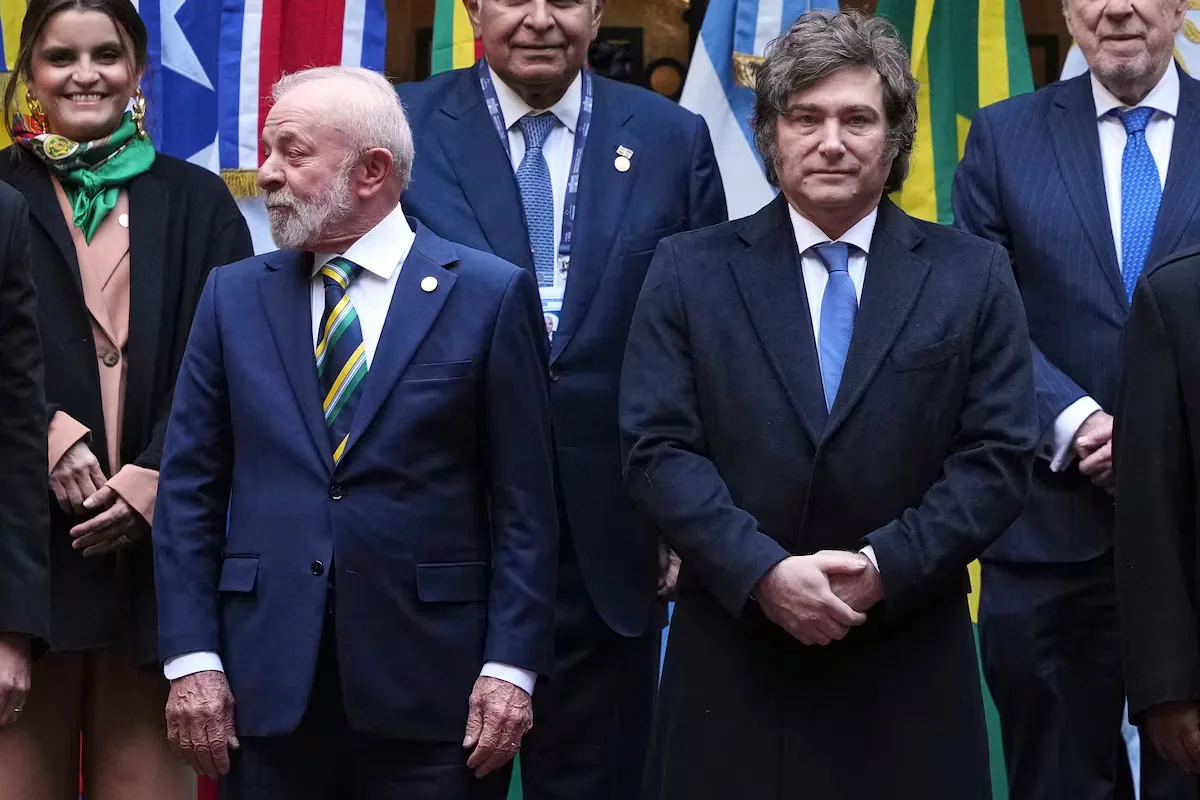
After repeated personal attacks by the Argentine president, Javier Milei, against his Brazilian counterpart, Luiz Inacio Lula da Silva, the Brazilian Government withdrew its ambassador in Buenos Aires and downgraded the bilateral relationship to the level of chargés d’affaires. Lula’s Foreign Minister, Mauro Vieira, assured this Wednesday that the decision will remain until the “repeated insults and aggressions” by Milei cease. The Argentine Executive avoided offering apologies for the outbursts of its leader — he called Lula “prisoner,” “corrupt,” and “socialist trash” — and attributed the tensions to “expressions from both sides that reveal political and ideological differences.”
Read more Ken Salazar assures “having no evidence” that the Mexican Government has links with drug trafficking
The diplomatic conflict raised between the two largest South American economies, the core of Mercosur, is the most serious since the relaunch of the bilateral relationship after the democratic restoration in the mid-1980s.
The dispute escalated following Milei’s statements against Lula 10 days ago, when he visited the city of São Paulo to support the opposition presidential candidacy of Flávio Bolsonaro. After the new insults uttered by the Argentine leader over the weekend and also this Tuesday, Brazil decided that its ambassador, Julio Bittelli, will not return to Argentina after being recalled for consultations. The decision was informed to the Argentine ambassador in Brasilia, Daniel Raimondi, who was excused from remaining in the country, since the diplomatic link will be channeled at a lower level.
“The decision to downgrade relations to the level of chargés d’affaires” will be maintained “until the conditions that caused” the measure cease, that is, “the repeated insults and aggressions against Brazil,” explained Minister Mauro Vieira this Wednesday in an interview with Radio Perfil. “There were four consecutive statements within a week in which the president of Argentina, in a very rude and aggressive way, criticized Brazil, its institutions, and President Lula in an unprecedented manner,” he assured. “We asked for explanations and said that, as long as there were no satisfactory explanations, we would keep our ambassador in Brazil.”
Foreign Minister Vieira recalled that “Brazil and Argentina have always had the best relations since 1985,” when the recovery of democracy enabled “a new type of bilateral relations, integration, collaboration, and cooperation.” The minister asserted that President Lula “is not interested in the color of the party in power in another country” and emphasized that “education and respect are fundamental; without them, there can be no dialogue, and the ideological issue is totally secondary.” Lula himself asked this Wednesday to put aside ideological differences to strengthen Mercosur: in an interview with the portal Meteoro Brasil, he did not mention Milei but highlighted that “the relationship between States is a matter of State interest.”
The Argentine Executive’s approach to the conflict focused, in contrast, on the political disagreements between both governments. “It is a unilateral decision by Brazil that we regret,” said Foreign Minister Pablo Quirno. “There have been expressions from both sides that reveal political and ideological differences. Argentina decided not to transfer them to the diplomatic sphere. Unfortunately, Brazil has every right to decide what it has decided. We regret it because we understand there is another way to preserve relations between our countries,” Quirno stated this Wednesday at a press conference.
The Argentine Government has not yet announced whether it will withdraw its ambassador in Brasilia. For now, according to local press reports, the diplomat will return to his country to take a vacation.
When asked whether Milei would issue an apology for his attacks against Lula, Quirno avoided giving a direct answer. “President Lula, his Government, has uttered insults against our president that have not been answered,” he justified, without specifying what he was referring to. “It is more a matter of substance than form; we have deep ideological differences,” he insisted. The only concrete reference to an act by the Brazilian president was that “Lula himself visited former president Cristina Kirchner in her house arrest before last year’s elections, and there was no complaint from our side about interference.” Although the foreign minister did not mention it, Milei often justifies his animosity towards Lula by the Brazilian leader’s support for the Peronist candidate in the 2023 presidential elections.
In the standoff between the governments of Milei and Lula, the geopolitical struggle that Latin America is subject to is also at stake. Milei aims to establish himself as a regional leader of an ultra-right aligned without nuances with the President of the United States, Donald Trump. “The region is changing ideological direction. We celebrate it and hope that this also happens in Brazil,” said Foreign Minister Quirno and confirmed that the Government is organizing a summit of right-wing presidents in Buenos Aires this year. Milei’s hope, with Trump behind, is to be able to invite a triumphant Bolsonaro after the Brazilian elections next October.