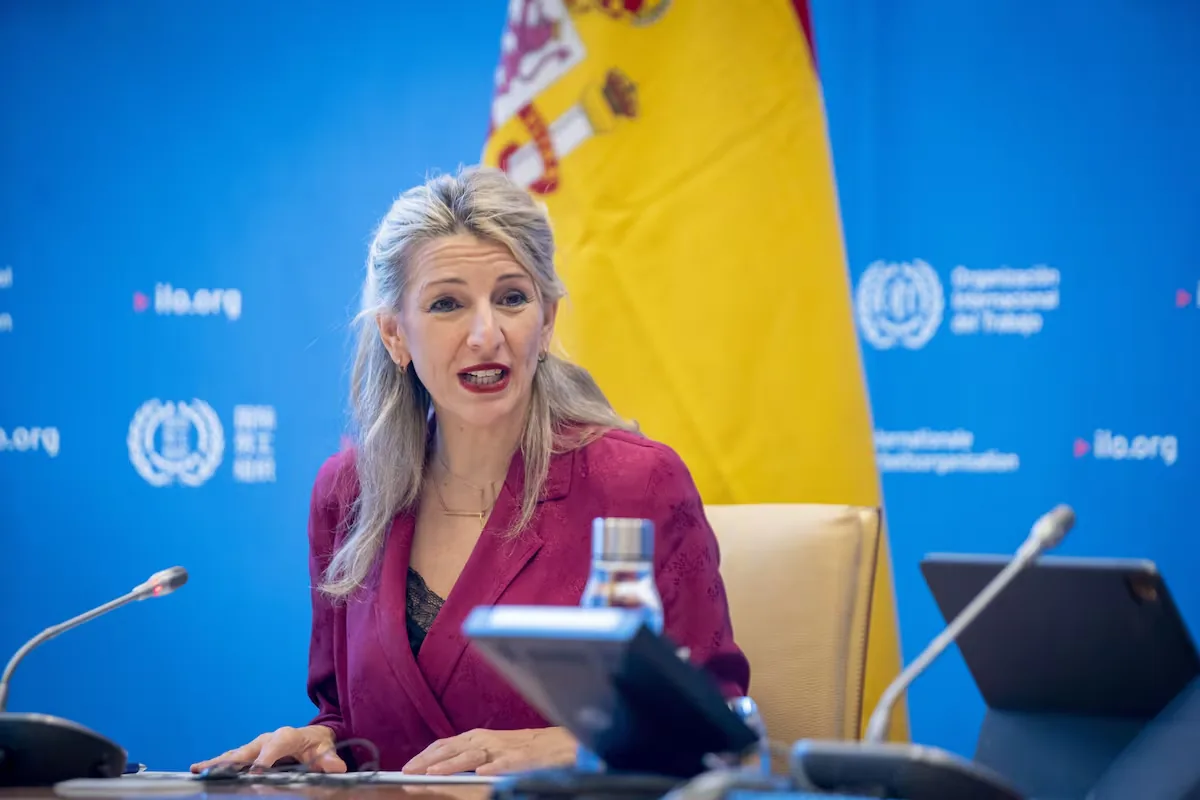
The second vice president and Minister of Labor, Yolanda Díaz, has formally presented her candidacy for the position of Director-General of the International Labour Organization (ILO), where it has already been registered alongside that of her only rival so far: the current Director-General, the African Gilbert F. Houngbo, who announced last April that he will run for re-election. This registration of her candidacy has been accompanied by an action program, which EL PAÍS has had access to, that Díaz wants to implement if elected next November.
The negotiation and approval of a decalogue of basic labor standards — universal and, therefore, applicable in all countries — is the main feature of this action program that includes other innovations, such as opening the financing of this UN agency dedicated to the world of work to new forms of public-private contributions.
According to this program, Díaz seeks to develop, through tripartite dialogue (between governments, employers, and unions) “a universal floor of labor rights.” The vice president has called this catalog the Global Charter of Labor Rights, and proposes that it take the form of the conventions usually established by this organization to regulate different aspects of working conditions and that “would allow systematizing the great principles developed by the ILO throughout its history (such as social justice and decent work) and, at the same time, incorporate the new challenges of 21st-century work.”
Alongside this initiative, the Minister of Labor, whose candidacy has been proposed by the Spanish government, explains that her leadership at the ILO will be based on three pillars. The first is directly related to her project to develop a charter with basic and universal labor rights, and consists of “strengthening, without hiding behind lack of budget, the creation of international labor standards,” which, she argues, “constitute the DNA of the ILO and its main comparative advantage in the multilateral system.” This pillar must, she adds, “concentrate the necessary resources to strengthen the compliance monitoring system.”
The second pillar refers to cooperating with the tripartite actors of social dialogue so that they design effective public policies. Thus, Díaz’s program states that the ILO “must offer practical tools so that economic growth effectively translates into social development and equity, and vice versa, to turn the ILO into a global hub of knowledge.” Finally, the third pillar will consist of carrying out development cooperation programs that are “the executive arm on the ground” of the two previous pillars (the creation of standards and the design of public policies from social dialogue).
Read more It looks like a normal lounger, but its zero gravity design completely changes the way you rest
Additionally, Díaz’s program states that “advancing the democratization of the organization is an urgent task,” revitalizing, among other things, social dialogue within the ILO itself. “Social dialogue cannot be seen as a slow and ineffective decision-making method, but quite the opposite,” she argues. To this end, she advocates improving governance through greater efficiency in the organization: “Much more can be done without increasing resources.”
Seeking funding
However, among Díaz’s plans to lead this organization is also to improve its finances. Specifically, she intends to “undertake a search for voluntary contributions.” She points to contributions from traditional donor governments, development agencies, regional investment banks, and, as a novelty, suggests exploring new forms of public-private collaboration. All this to “guarantee the financial sustainability of the organization, without undermining its independence.”
In short, Díaz reiterates that the ILO is going through a period of crisis and, therefore, “this is not a time for the status quo, but for a strategic shift for this organization, which, in the opinion of the Spanish vice president, “needs to move from managing decline to strategic leadership, with greater transformative ambition.” The one she advocates and, as recognized by the Prime Minister himself, Pedro Sánchez, has carried out from the Ministry of Labor.
Now, after the official registration of this candidacy along with her action program, the Minister of Labor, who already gave up leading her party Sumar two years ago, will continue as a member of the government awaiting the result of the decision to be made on November 16 by the ILO Governing Body. This body is composed of 56 votes among government members from 28 countries, as well as 14 trade union representatives and another 14 employer representatives. However, the person elected to lead this organization will not take office until a year later, in November 2027.
Read more Junts criticizes the poor record of the PSC Government: “Illa has sunk Catalonia”