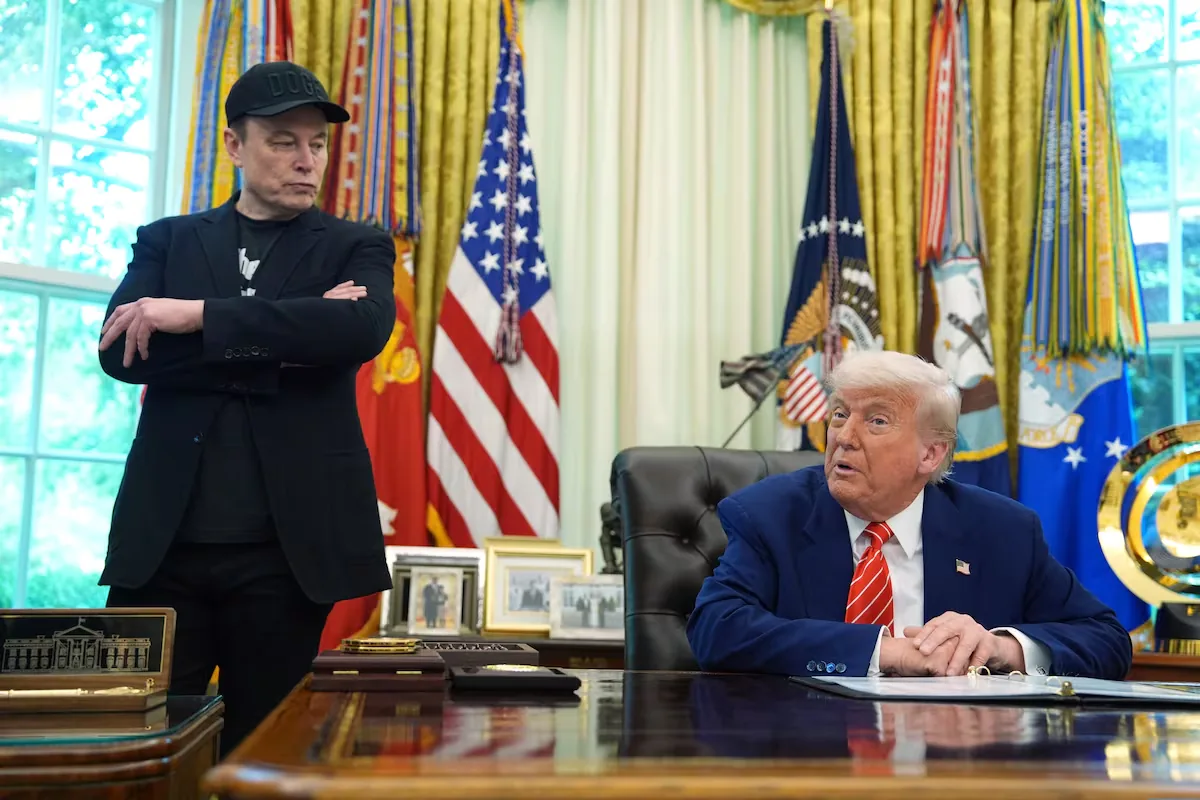
Elon Musk promised in 2025 that his so-called Department of Government Efficiency (DOGE) would cut $2 trillion from government spending and be the “most transparent organization” within the federal apparatus. It has been almost a year and a half since then, and DOGE has not come close to that figure nor has it carried out processes that allow for precise verification of the supposed results of its cuts, according to a report from the United States Government Accountability Office (GAO).
Read more United States refuses to reveal the names of those sanctioned for links to the CJNG
As of August 7, DOGE boasts on a website — its Wall of Receipts — that it has saved a total of $215 billion through layoffs and cuts to the amounts of federal government contracts, grants, and lease agreements. That saving is quite far from the $2 trillion promised by Musk and is even less because, in its calculations, DOGE included cuts that were already underway before its creation, the GAO explained in its report.
Likewise, the GAO reviewed changes to contracts, grants, and lease agreements where DOGE supposedly achieved savings totaling $110 billion but could not verify how that amount was reached.
“DOGE was not transparent regarding the methodologies used to calculate the savings. Specifically, DOGE did not use the methodology it claimed to have used to calculate most of the savings related to contracts reported as eliminated,” the GAO specified.
“Regarding grants, DOGE did not provide sufficient information to verify the method used to calculate 96% of the reported savings. Similarly, the Wall of Receipts does not include an explanation of how the savings from eliminated lease contracts were calculated,” it added. For example, the GAO found that 108 of 264 lease contracts that DOGE sought to terminate were already in the process of being eliminated when that ‘department’ was created. This means that an amount of $53.5 million that DOGE claims to have saved in that category is actually $15.3 million lower.
When evaluating other types of contracts, such as those of the Department of Defense, the GAO found that cuts to their amounts either did not occur or were exaggerated because money that possibly would never have been disbursed was counted as saved — for example, in cases where the approved ceiling for a multi-year contract was assumed as spent money — or expenses incurred in agreements terminated early were not considered.
“In our analysis of 21 contracts from the Departments of Defense and Health and Human Services, we found significant variations in the amount of savings achieved or potentially achieved by those agencies compared to what was reported on the Wall of Receipts, including cases where the source of the savings is unknown,” the GAO explained.
This was reflected in the analysis of a contract in which the health office of the Department of Defense requested technological services for more than 700 treatment facilities worldwide. It was a contract totaling $1.7 billion that DOGE claims to have eliminated. However, the GAO found that no steps were taken either to end it or to reduce its amount. “Therefore, there was no saving at all,” the GAO detailed.
The ‘government department’ named after a cryptocurrency
DOGE — an apparent nod to the cryptocurrency of the same name — was born from an idea of Musk during the 2024 presidential campaign, when he was a major donor to Donald Trump’s efforts to return to the White House. When he succeeded and assumed power again, Trump signed an executive order creating a Department of Government Efficiency that in practice was not a department as such, since Musk, the face considered the agency’s leader, did not even have to be confirmed by the Senate, as happens with heads of federal government departments.
The initiative was launched with a structure in which the name of the United States Digital Service was changed to the United States DOGE Service. Within that DOGE Service, a temporary organization was created that was to report to the president’s office and whose mandate ended on July 4 of this year, according to the executive order.
DOGE’s first measures sowed chaos in several federal agencies. It dismantled the United States Agency for International Development (USAID) despite it being established through a congressional process and warnings about the tremendous impact this would have on vulnerable populations worldwide.
Amid allegations of supposed “fraud” and “waste” for which no evidence was provided, DOGE officials also scrutinized sensitive databases such as that of the Social Security Administration (SSA). That intrusion was challenged in court, and there was a point during the lawsuit when the SSA chief questioned the sending of vital checks to nearly 70 million people in the United States.
The unreachable savings promised by Elon Musk
From the start, it was known that reducing federal government spending by $2 trillion, as Musk said, was an extremely difficult task. On one hand, one must consider how the federal budget is divided, and on the other, the weight Congress has regarding it.
The federal government budget so far in fiscal year 2026 shows that the largest share (23%) has gone to Social Security payments: $1.24 trillion that cannot be cut because it is committed money and can only be modified through legislation.
The second crucial item in the federal budget this fiscal year has been the United States debt (15%), as $827 billion has been allocated to interest payments. Failing to meet those payments would jeopardize the stability of the world’s debt markets.
What can be touched is what is known as discretionary spending. But, to achieve the $2 trillion savings Musk talked about, DOGE would have had to eliminate it completely.