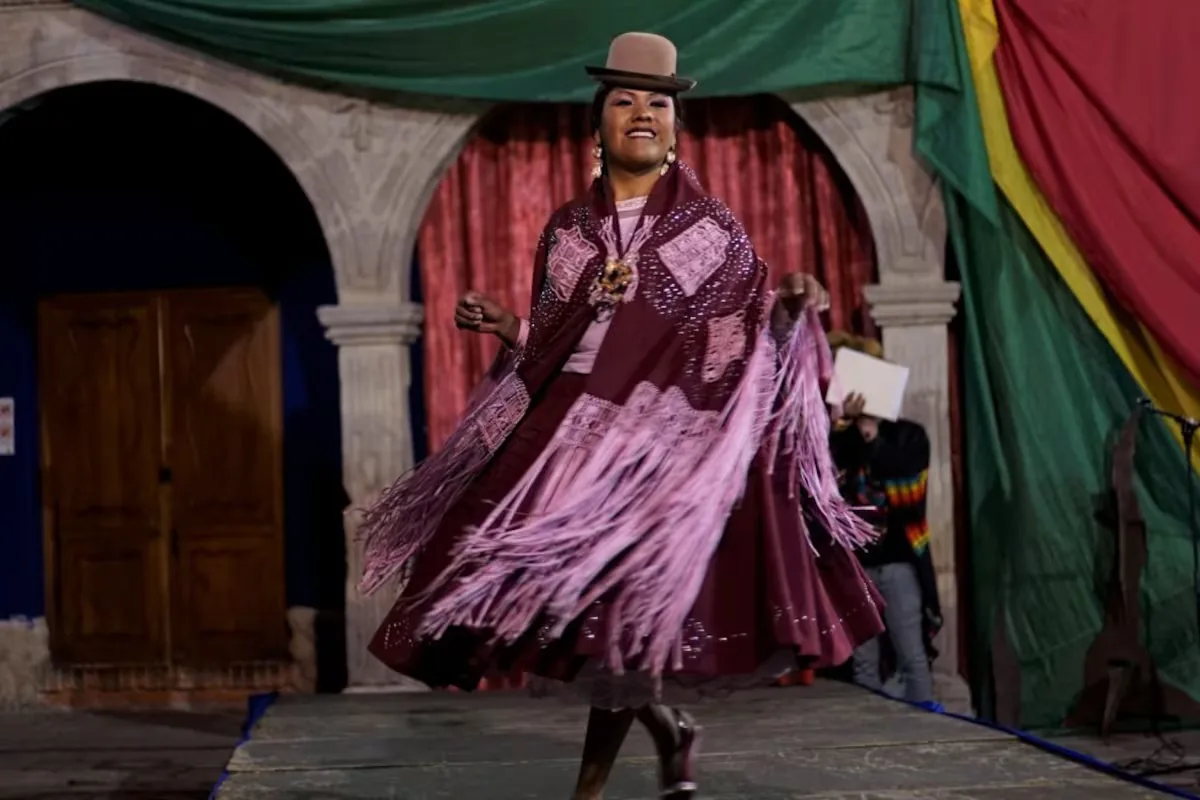
The cholitas align the sway of their colorful skirts with that of their two long and tightly braided plaits. The heel of their patent leather sandals strikes the stage floor to follow the sound of electronic keyboards, synthesizers, and drums, accompanied by their sharp and penetrating voices, so traditional of the Bolivian highlands and valleys. The pre-Hispanic and joyful melody of the huayño merges with the modern tropical rhythm in cumbia chicha, one of the greatest symbols of cultural syncretism in Bolivia. It began to be played in shanties on the outskirts of cities where migrants from the countryside arrived. Today it is a success replicated at patron saint festivals, in the halls of the luxurious buildings of the Aymara bourgeoisie — the cholets — at baptisms, nightclubs, and graduation parties.
The historian and writer from Sucre, Máximo Pacheco, compiles a lifetime of study in communities to narrate in his novel Las desolvidadas del amor how those displaced from their lands — willingly or not — find in cumbia chicha, chichera or southern cumbia a refuge from the marginalization to which the city pushes them. A communion with their own where they can express their deep sense of belonging. The book was written in 2014; thanks to the effort of friends to whom Pacheco sent the draft, the work was finally published this month by Dum Dum Editora and is presented as one of the highlights at the La Paz Book Fair, open until this Sunday.
“I have not written fiction ever since. I abandoned the craft of novelist with that book, I don’t have time and I am exhausted,” Pacheco says from his office as director of the National Archives and Libraries of Bolivia (ABNB), the largest repository of the country’s documentary memory. Academic work keeps him busy. His work at the ABNB is recognized for adding oral sources to an archive that until a few years ago only had written testimonies. From those experiences in the inter-Andean valleys, blending different people he met in fieldwork, his protagonists emerge: Margolita and Sirinamelia. Two Quechua women expelled from their communities, victims of misogyny and sexual violence, still prevalent in rural life, but who find redemption in chicha music.
Margolita was exiled from her community as a child by her own father, after he blamed her for “letting herself be abused” when she was leaving school, becoming pregnant after the assault. The Ombudsman’s Office of Bolivia recorded between 2014 and 2024, 4,800 marriages of adults with minors under 18, unions that were possible through parental consent by an exception in the Family Code. The Assembly eliminated in September, by law, any exception that allowed that type of union. Sirinamelia, the other protagonist, was born deformed because she was already her mother’s sixth child, who was over 60 years old, a victim of her own husband, who abused her when he came home drunk.
“The characters are from a place where I lived for five years, about 40 kilometers from here [Sucre], a Quechua area. I can’t give you the name of the place because they will be angry with me, I have lived with them for a long time and they don’t like to be exposed,” Pacheco half-confesses. But Margolita and Sirinamelia could be inspired by any of the successful current singers or dancers of chicha groups: Floricielo, Yarita Lizeth, or Muñequita Milly. And the fictional band they form and that gives the work its name, Las desolvidadas del amor, has a name as suggestive as the real and box office bands Virus de Amor, Clímax, or Lágrimas por Amor. Musical groups that in their lyrics express their loves, disappointments, or betrayals with a deep feeling of pain.
Read more “Don’t even approach the Sierra”: the war fractures in Sinaloa and violence intensifies in Mazatlán
Between 2020 and 2024 alone, more than 250 southern cumbia groups were registered in Bolivia, most based in the highlands and valleys, according to data from the National Intellectual Property Service (SENAPI). Many of them participated in the country’s first specialized festival, the Chicha Fest, whose first edition was held in 2022 and gathered around 30,000 people. The next day an old La Paz newspaper headlined: “Cumbia chicha goes from being discriminated against to the favorite of the masses.” Today, the Chicha Fest rotates its venue between cities in Bolivia and Peru. Maroyu or Kumbia Fusión have also helped internationalize the genre with tours in Spain, the United States, or Argentina, where they are welcomed by the Quechua and Aymara diaspora.
At one of those cross-border events, in May 2024, singer Florelisa, whose real name is Elizabet Flores, was detained for not carrying a work visa. During police investigations, it was revealed that between 2023 and 2024 the artist had more than 120 performances between Bolivia and Peru, for which she would have earned half a million dollars. A mere glimpse of the industry and scene created by the chichera, a phenomenon with a following of researchers who establish that it was born in Peru in the 1960s, as part of the migration from the highlands to Lima. A fusion (ahuaynamiento) of huayño and an Andean adaptation of Colombian cumbia that exploded in Bolivia from 1990.
The reach that Andean cumbia has had in Bolivia is measured in exclusive television channels, production companies and specialized studios, commercial circuits associated with CD sales or with huge warehouses dedicated to dancing, called chichódromos. The universe around cumbia chicha is unfolded by Pacheco in his book, which he calls an “anthropological novel in which I gather my experiences in the rural area,” featuring Andean mythology, the cruel violence of the countryside, dirty realism of society’s margins, but above all, images of foot-stomping that awaken the sounds of the highlands.
Images of cholitas moving their skirts with their hips to show their white petticoats, phosphorescent brocades, multicolored hair ribbons, and sparkles, as adornments, on the faces of the dancers and singers.
Read more Colombia begins a new era marked by God and uniforms