Johanna Mecke, a 25-year-old German student, decided to bring forward her vacation in Spain this year to avoid the summer heat. “We came the last week of May and it was perfect. We had the beach and summer temperatures, but we didn’t exceed 30 degrees,” she recounts in a phone call. She frequently travels to the country since she spent a semester in Granada, but this time she prepared the trip more carefully than in previous years. She compared prices, looked for deals, and ultimately chose to stay in an Airbnb instead of a hotel and rent a hybrid car to keep the budget in check. “If traveling were cheaper, we would do it for longer,” she sums up. Her experience reflects some of the changes beginning to be seen among European visitors and helps explain why two of the main national tourist markets, Germany and France, are losing momentum this year.
Read more No shelter from the precarization of rent: «It is affecting people of all ages»
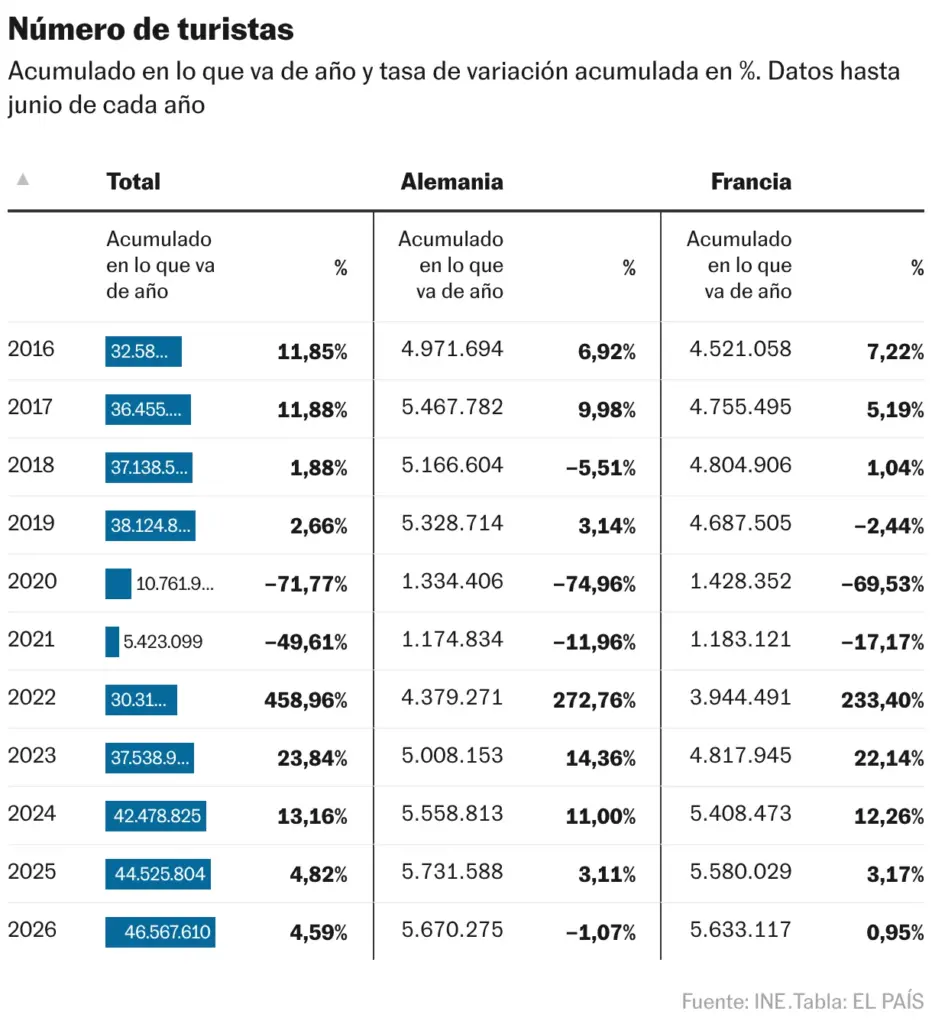
The June data published by the National Institute of Statistics (INE) show a 5.9% drop in arrivals of German tourists and a 1.7% decrease among the French compared to the same month last year. At first glance, it might seem like a temporary setback within another historic summer. However, the evolution of the year as a whole points to the opposite. In the first six months of the year, Spain received 1% fewer travelers from Germany than in the same period in 2025, while visits from France remained practically stagnant, far from the advances recorded in the years following the pandemic.
The comparison with recent years clearly reveals the change in pace. After the strong rebound in 2022 and 2023, and after both the French and Germans maintained double-digit growth in 2024 and moderate growth in 2025, both markets have clearly lost momentum. The slowdown also coincides with a moment when Spain aims to surpass the barrier of 100 million international tourists for the first time. The aggregated figures still point to an exceptional year thanks to the push from the British, Americans, and other markets, but the loss of strength of two of its main clients poses obstacles to achieving this goal.
Several factors converge behind the slowdown: the lower economic dynamism of the major European economies, the increase in the cost of vacations in Spain over recent years, and increasingly extreme weather, with heat waves forcing changes in travel habits. All this increases the risk that “this temporary setback becomes a structural issue because the average French or German tourist perceives that visiting the country is no longer worthwhile,” predicts Pablo Díaz Luque, a tourism professor at the Open University of Catalonia.
The economic setback
The economic performance of the region is the first piece of the puzzle. Both France and Germany grew barely 0.2% in the second quarter of the year, a rate insufficient to dispel household uncertainty, as seen in consumer sentiment indices. Germany continues to experience a very weak recovery after several years marked by industrial stagnation, while France also suffers a loss of momentum in private consumption. Added to this context is the escalation of tension in the Middle East, which continues to fuel doubts about the evolution of inflation and energy costs.
The climate of uncertainty has not caused Europeans to give up traveling, but it is changing the way they organize their vacations. José Serrano, a professor at the European University, believes that consumer behavior responds more to a logic of caution than to a drastic cut in leisure. “In this scenario, many families do not give up traveling, but delay booking, reduce the stay, or adjust their budget. More than a loss of Spain’s appeal, the data point to demand being more sensitive to the economic context,” he details.
This is the case of Eduardo González, a Frenchman of Latin American roots who has been vacationing in Spain for over a decade. This time he has returned to Horta de Sant Joan, a small inland town in Tarragona where he already spent part of his vacation last summer. This time he will stay there for a month with his wife, his 15-year-old daughter, and the family dog. The rental of the accommodation cost them about 10% more than a year ago, although they still consider it a good deal. “You will never get a month in France for the same price,” he says. However, this increase has conditioned the rest of the trip, since unlike past vacations, when they combined their stay in Catalonia with a few days near Bilbao and another week in the Tortosa area, this year they have decided not to travel to other parts of the country and stay the whole month in the same town.
But it’s not just the González family; sector forecasts indicate that French citizens will organize this holiday more cautiously. According to Alliance France Tourisme — an association that groups the main companies in the sector — domestic tourism is experiencing a new boost this summer. Seven out of ten French people planned to spend their vacation in their own country, a proportion higher than last year, according to a survey conducted at the end of April by the organization. The main reason for this change of course is the search for security and an adjustment in the family budget, which this year has been reduced by about 150 euros on average.
Mecke’s experience is quite similar. She and her 27-year-old partner took time to find the most economical combination for their five nights in Alicante. They paid 400 euros for accommodation, found flights from Berlin for 175 euros per person, and rented a hybrid car for 90 euros for six days, which reduced fuel expenses. “We live in Germany and everything there is increasingly expensive, so we researched a lot to find a good deal,” she explains. Although she believes many Germans still see Spain as a “cheap” destination, in her experience “there isn’t much difference,” at least in vacation terms. She cites restaurant expenses as an example, which according to her calculations were very similar to what they would have at home.
The high cost of vacation
The second major factor deterring arrivals is the price of vacations. In recent years, the extraordinary growth in demand has allowed hotels, airlines, and travel agencies to apply strong rate increases practically without affecting occupancy. But that dynamic seems to have changed this year amid so much geopolitical upheaval.
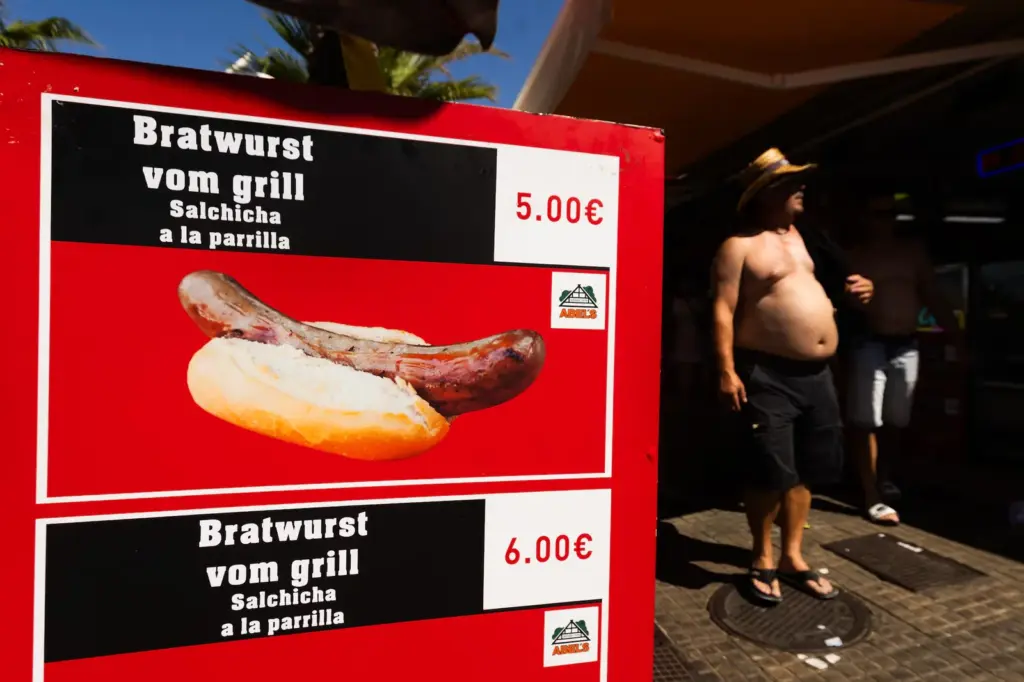
On the beachfront, the evolution of bookings reflects this decrease in tourist flow. Ricardo Yagüe González, who works at a two-star hotel located on the Playa de las Arenas in Valencia, notices fewer French visitors this summer while, among Germans, he has so far only received a group of young people, when they are usually a common profile. The gap is being filled by clients from Poland, Ukraine, and other Eastern European countries, as well as the traditional influx of Italians and Dutch. Regarding accommodation costs, he admits that his experience at the hotel is still limited to compare the evolution of rates. But he assures that his more senior colleagues — some have been there for nearly 20 years — are “shocked” by current prices.
Read more The complaint of Chantal, the young woman who survived Omar Chávez’s beatings
The firm Andersen Consulting insists that “hotel data for June do not yet show a general price drop, although there is a slight moderation in volume and occupancy.” In detail, overnight stays fell by 0.9% in June and occupancy was slightly lower than a year ago, according to the National Institute of Statistics. Despite this, hotels continued to raise their rates: the hotel price index increased by 5.6%, which also boosted revenue per room.
According to Luque, the upward trend is contributed to by “the Spanish hotel strategy of upgrading category, with a notable proliferation of four- and five-star hotels.” Serrano, for his part, considers that the problem does not lie solely in the absolute level of prices. “The effect of overcrowding is also beginning to be perceived, and when visitors perceive a lower quality-price ratio or a more congested experience, the likelihood of exploring alternatives increases,” he points out.
The result is that increasingly competitive options appear. Overcrowding acts similarly to prices. Andersen Consulting adds that “it does not necessarily eliminate interest in traveling to Spain, but it can redistribute demand towards other months, autonomous communities, secondary cities, or inland destinations.”
Adverse climate
There is a third element that increasingly weighs on travelers’ decisions: the climate. If for decades the sun was the main attraction of the Spanish Mediterranean, successive heat waves are beginning to turn that appeal into a negative factor for part of European tourism. In June this year, for example, the average daily temperature in the peninsular area was 3.2 degrees above usual, according to data from the State Meteorological Agency. And for several days, several areas of the country exceeded 40 degrees.
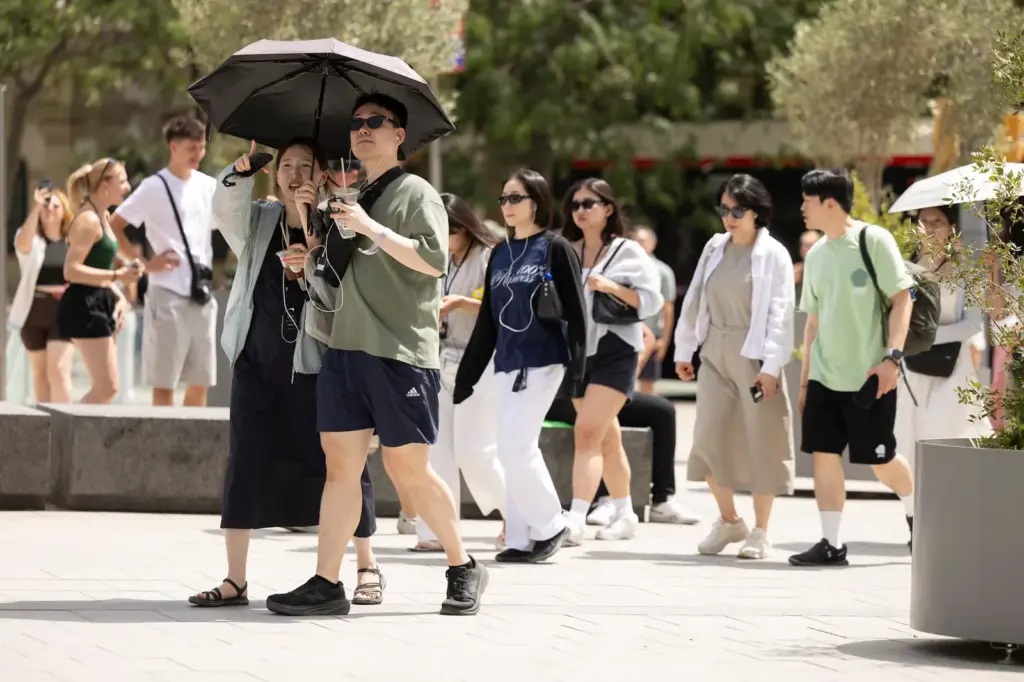
Serrano points out that this meteorological phenomenon “reduces part of the Mediterranean’s differential appeal when temperatures in central and northern Europe are equally high and, moreover, can make some segments opt for destinations with milder conditions.” In his opinion, it is clear that “climate change is already influencing the temporal and geographic distribution of tourist demand.”
His argument coincides with Mecke’s perception, who says that in her environment more and more people avoid traveling to Spain in July and August because “it’s too hot to enjoy” and prefer to concentrate vacations in spring or early autumn. “Right now there are many fires in Spain and Portugal, and maybe that’s why people tend to come more in spring or October instead of summer,” she explains.
The sector itself perceives this lower concentration of vacations between June and August. Carlos Garrido de la Cierva, president of the Tourism Board, insists that demand is beginning to be distributed more evenly throughout the year. “Medium season months are increasingly favored and high season months are maintained,” he says. This de-seasonalization, he adds, “allows for better distribution of visitor flows, relieves pressure on the most saturated destinations, and improves the profitability of many tourism businesses.”
A window of opportunity
While the French and German markets lose strength, the American market gains prominence. Between January and June, arrivals of tourists from this country have grown by almost 10%, according to INE data. “The US represents a great opportunity because it brings a visitor with a very high average expenditure and a strong interest in Spain’s cultural, gastronomic, and urban offerings. From an economic point of view, it can partially compensate for a lower arrival of European tourists, especially in terms of revenue,” Serrano details. Luque agrees with this diagnosis, stating that markets from the Middle East, Asia, or America have greater purchasing power and consume more.
However, the French and German neighbors are not easily replaceable markets. Together they contribute a quarter of all international tourists Spain receives each year — only surpassed by the United Kingdom, which contributes 20% — in addition to maintaining loyalty difficult to find in other countries. All analysts recall that European visitors have the advantage of proximity, high connectivity, and strong travel recurrence. Therefore, their loss, even if gradual, would have economic implications for the country.
That is why experts insist that diversification should not be confused with substitution. The key, in their opinion, is to strengthen Spain’s appeal to those traditional visitors while consolidating the opening to new markets. Additionally, they consider that the focus should be on tourism that generates more value and is not measured exclusively by the volume of travelers received.
Read more Imagine rebellious cities