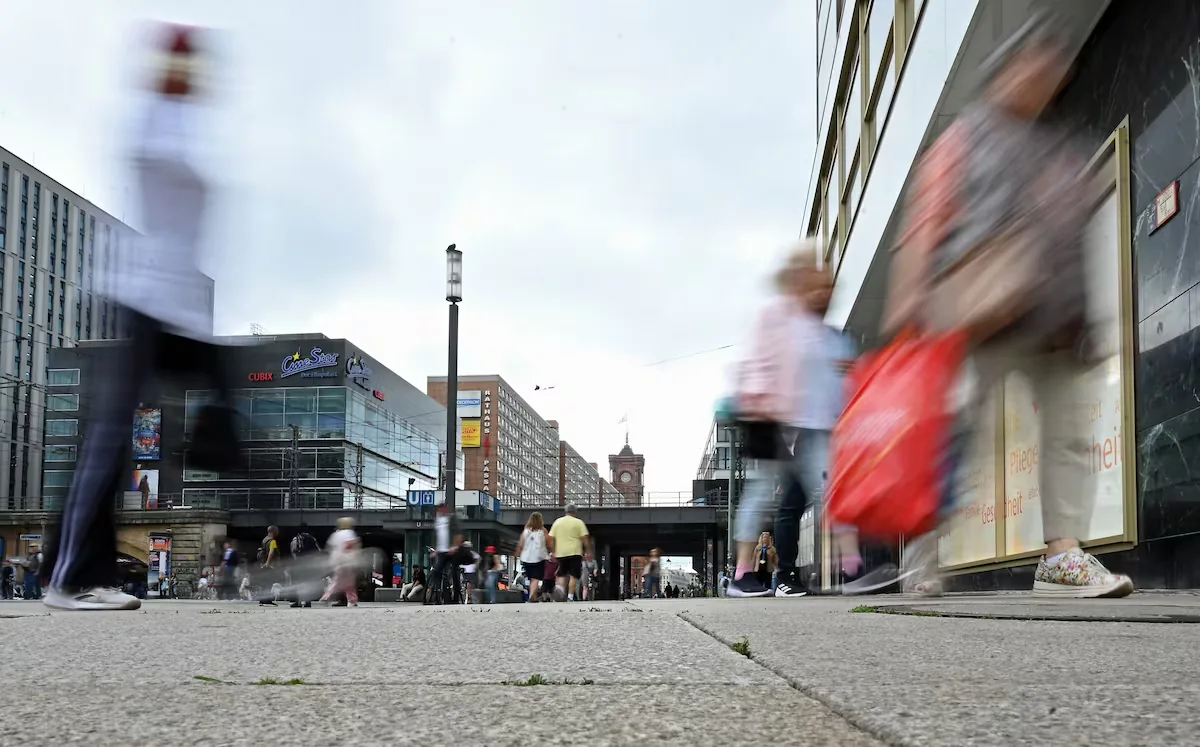
Closed stores and large commercial streets almost deserted. The image surprises tourists visiting cities like Berlin or Munich. Commercial life pauses for a day, Sunday. A day dedicated to rest in which noise is also not allowed. Now, a reform by the German government that opens the door to greater flexibility to open on Sundays rekindles the debate about a century-old tradition that is increasingly losing support and about which many voices point out that it fosters unfair competition, since online shopping is allowed on Sundays.
Read more Price hikes and extreme heat: why the numbers of French and Germans vacationing in Spain are falling
“It may seem strange to tourists that the stores are closed, but it is the same for everyone,” explains Ulf Rating, owner of Big Brobot, a small clothing and book store in the center of the popular Berlin neighborhood of Friedrichshain. “It’s something old-fashioned, from another era, but it protects me,” he admits about the fact that if it were possible to open, he or his partner would have to be in the store instead of with their families, because they cannot afford to pay anyone. “We are happy that it is not possible,” he states. In his opinion, changing this law would only benefit large chains and businesses that can afford extra staff. “It doesn’t make sense to me. That’s why I would like it to remain as it is,” he defends. Despite being in a neighborhood that attracts a lot of tourism on Sundays due to its flea markets, he does not believe that opening that day would bring him great benefit, because he would have to close another day to rest and “the big businesses would take the customers.”
Not far from there, another store that has also been in the neighborhood for years sees it differently. “My boss Pia would like to open on Sundays,” says Shannon, a sales assistant at the clothing store Prachtmädchen. She believes that for small businesses it would be good to open in an area with many passersby. “I am Australian and when I arrived in Berlin I was surprised. In my country, everyone can decide whether to open or not,” she explains. She also points out that workers would earn more and it would give students and young people the possibility to combine studies with work. Meanwhile, the popular Vollkornbäckerei Hartwich bakery on Warschauer Str., which could open on Sundays, prefers not to. “We don’t want to, even though we can,” says one of its sales assistants. “Most don’t want to work on Sunday and it’s better that way. We think it’s fine,” she adds.
After years of crisis and economic stagnation, German Chancellor Friedrich Merz is striving to push through one reform after another in a desperate attempt to stimulate growth in a country hit by US tariffs and Chinese competition. The ambitious package from the coalition between conservatives and social democrats aims for a small change that, however, has sparked a heated debate. In principle, the reform will allow some establishments (basically bakeries and pastry shops) to open for eight hours instead of the current three. Public libraries will also be allowed, although these establishments do not make sales.
This has rekindled the debate about whether Sunday rest is a beneficial tradition or an anachronism that should be eliminated as other countries have done, at least in the tourist areas of large cities. Currently, exceptions apply, among others, to stores at train stations and airports, gas stations, and pharmacies, as well as souvenir, plant, or press shops. But the proposed legal change sparks a deeper discussion about whether to open stores on Sundays or not.
The debate has taken place within Merz’s own Christian Democratic Union (CDU). MP Stefan Nacke, a member of the Bundestag’s Labor Committee, told Die Zeit: “Those who want to turn Sunday into a regular shopping day confuse modernization with permanent availability. Sunday rest protects workers, families, and social life.” Meanwhile, the CDU’s economic wing reminds that consumption is one of the most important pillars of the economy.
In 1919, Sunday rest was enshrined in the Weimar Republic’s Constitution. It established that Sundays and holidays “shall continue to be protected by law as days of labor rest and spiritual elevation.” This rule was incorporated into the current Basic Law, which was approved in 1949. But local regulations and authorizations vary. In Berlin, for example, four Sundays of opening were established this year. Also, in Berlin, Hamburg, or North Rhine-Westphalia, for example, sales can be made 24 hours a day from Monday to Saturday. Bavaria, on the other hand, is one of the most restrictive states.
Churches and social associations argue that Sunday rest offers a break from consumerism and promotes social cohesion. However, supporters of abolishing it point out that more and more people shop in online stores like Amazon or Chinese merchants, while urban centers lose appeal due to the increase in vacant premises and closures.
Read more No shelter from the precarization of rent: «It is affecting people of all ages»
One of the businesses most affected by online commerce is bookstores. “I have often thought it would be good to open the store on Sundays. We are an independent bookstore and independent businesses are under a lot of pressure in Germany, probably throughout Europe, especially because of online commerce that is available every day, even Sundays. And that harms us,” says David Mesche, one of the two owners of the small independent bookstore chain Buchbox, which has three stores in Prenzlauer Berg and one in Friedrichshain.
He would like them to at least have a special status and be able to open like libraries. “During the pandemic in Berlin we were allowed to open because politicians were aware that it is a cultural good,” he recalls. He also thinks it would be fair to pay workers more on Sundays. In the end, opening that day would also bring great benefits to cities where tourists could visit small neighborhood businesses, something that “would enhance the area and make it more interesting for tourists.”
The German Trade Association (HDE) demands that opening be allowed at least between 10 and 12 Sundays a year throughout the country. “Sunday is one of the busiest days in e-commerce, so special openings on Sundays would be an opportunity to gain ground against online commerce,” explains Steven Haarke, General Director of Labor, Education, Social Policy, and Collective Bargaining at the HDE, about an opening that, as he recalls, would be from 1:00 p.m., so it would not interfere with religious services.
“For many people it is a day of leisure, when restaurants and cultural and leisure centers are open as usual,” he points out. “Retail, on the other hand, is usually left out, although nowadays shopping is much more than a mere supply activity. For many people, shopping is part of their leisure activities and is an important boost for urban centers to be full of life.” Haarke criticizes that compared to other European countries Germany is “unnecessarily restrictive.”
In two recent independent surveys by INSA and YouGov, about half of respondents were in favor of the ban, support that has been declining over the years. This is also reflected when talking to consumers in stores. “I like it to be a quiet day with everything closed,” says Theresa while browsing clothes in a mall store. But her friend Antje sees it differently and points out that if stores opened on Sundays, people “would not flock” to buy at the supermarket the day before closing, especially when there is a holiday and stores close two days in a row.
However, the Verdi service union insists on the need for workers to rest. “Longer opening hours do not generate more business volume nor contribute to making urban centers livelier,” explains Corinna Gross, director of Verdi’s retail group. “On the contrary, they are a powerful tool in the unfair competition of large commercial groups. They cause a shift of turnover from rural areas to cities and from small and medium-sized enterprises to commercial giants. The result is increasingly desolate urban centers, with the same chains as always.” In her opinion, it is a debate that has not changed and she recalls that Verdi is part of an alliance in favor of Sunday rest formed by unions and churches that joined more than 20 years ago to defend what they consider “a social achievement.” “Sunday work in the retail sector is an attack by employers on the work-life balance of more than three million retail workers,” she denounces.
Read more The complaint of Chantal, the young woman who survived Omar Chávez’s beatings