









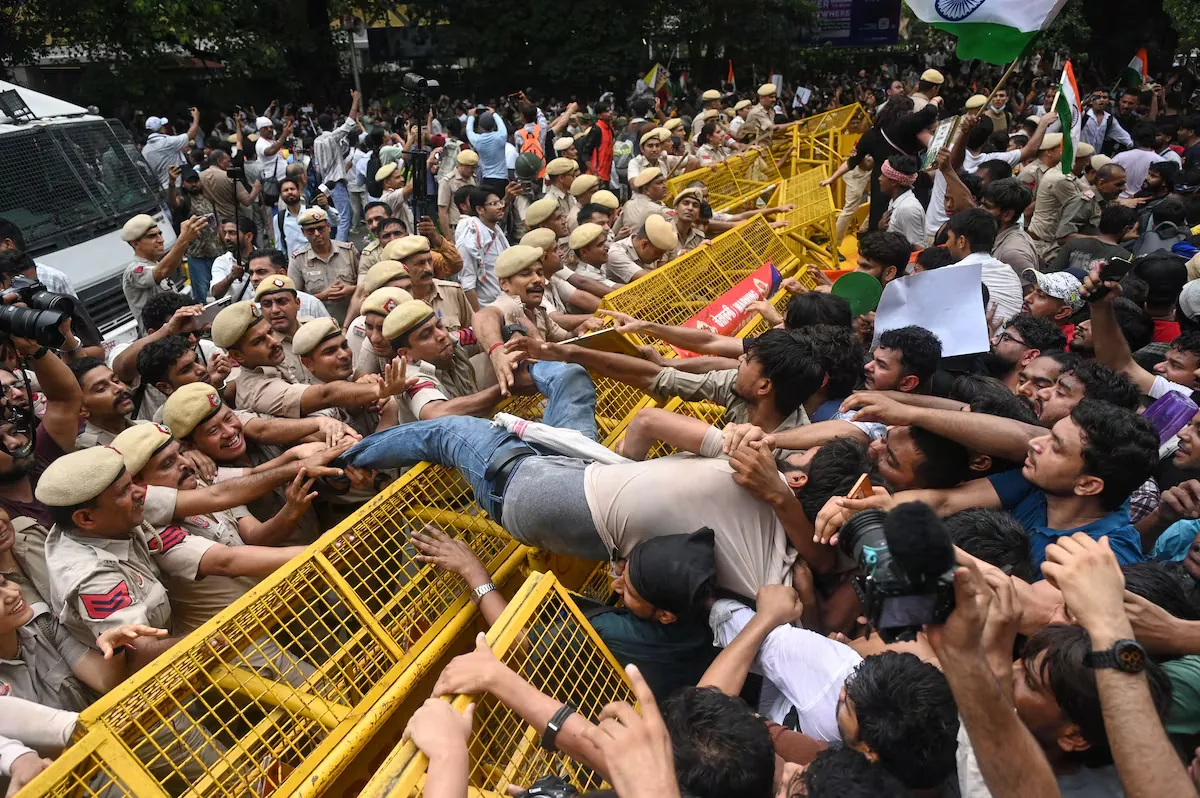
At the end of last week, tens of thousands of people entered the Spanish city of Ceuta illegally from Morocco. A few days later, on Monday this week, Prime Minister Narendra Modi’s party lost a seat in a by-election in the state of Bihar that the party had controlled for three decades. Behind two seemingly unrelated events occurring thousands of kilometers apart lies a common denominator: the unrest and agitation of Generation Z, those born between 1997 and 2012, in the Global South.
Read more In search of the good life in cities: “The city is not planned with citizen well-being in mind”
Although there are no official data, multiple journalistic testimonies have agreed that a large part of the people who entered Ceuta were young. There is no doubt that, regardless of whether there was a political calculation to spur the movement or not, the personal reason of those who moved was immense frustration with their prospects in their home society. Generation Z (or Gen Z) led a notable protest movement in Morocco in September and October of last year. In this case, it is not a protest movement, which places it in a different category, but it is a symptom of unrest with explosive political potential.
In the India episode, Modi’s party (BJP) defeat comes shortly after the extraordinary youth protest known as the cockroach movement, which has shaken the country for weeks and led to the resignation of the Education Minister, an almost unheard-of event given the track record of a prime minister who prides himself on not yielding to pressure. The protest erupted after a university entrance exam cheating scandal was revealed, triggering the anger of a generation that sees no meritocracy, no opportunities.
This week’s defeat in a traditionally safe seat adds to that lost battle and is a very strong political signal that doubles the sense of BJP’s weakness. It was about replacing a representative who left office after assuming the national presidency of the BJP and who during the campaign had described Gen Z protesters as “a virus and a band of cockroaches dedicated to destroying the country.” The move did not go well.
The protests in India and Morocco are part of an impressive sequence. Kenya, Nepal, Bangladesh, Madagascar, Indonesia, Peru… one after another, episodes of youth mobilization occur that, in several cases, have achieved notable political successes, even toppling governments, for example in Nepal or Madagascar.
Each country has its own characteristics, and the Global South is a deeply heterogeneous space. Each protest had specific ignition reasons, from outrage over a restrictive social media measure in Nepal to failure to provide basic supplies in Madagascar; from rejection of fiscal measures in Kenya to anger over the huge expenses to organize the next World Cup while precariousness abounds and opportunities are lacking in Morocco.
But it is evident that there are common denominators behind all these protests ―and behind the will to flee Morocco―.
There is a pattern of demographic boom and difficulty in adequately absorbing an increasingly educated population into labor markets; there is systemic discontent with corruption, nepotism, betrayal of the value of meritocracy, repression, and censorship; there is extensive use of social media. And there are supranational elements that exacerbate national failures: from wars that drive inflation to pandemics, from the fragmentation of the trade landscape to China’s overwhelming manufacturing power.
Thus, more than 1 billion young people aged 14 to 29 in the Global South incubate enormous frustration that is released in strong shocks that shake power structures.

“This generation does not believe in the system, understood as a state of affairs that generates predictability. They feel it does not deliver. They feel very intensely that the intergenerational solidarity commitment is broken with them. No matter how hard they try, they do not have good jobs. The political system does not meet their needs. They inherit an unsustainable planet. They are anti-system because the system has frustrated them, betrayed them with the idea of predictability,” says Antoni Gutiérrez-Rubí, political consultant and author of the book Polarization, loneliness, and algorithms (Siglo Veintiuno), which explores the characteristics of Generation Z.
This dissatisfaction with the system takes two tendentially different forms in the advanced democracies of the Global North and in the Global South. In the North, it materializes with voting at the polls for radical options or at least alternatives to the mainstream. Hence the success among young people of far-right parties ―with a strong prevalence bias among males― or the rise of figures from the left wing of the Democratic Party in the United States, strongly supported by young people.
“In the South, with weaker institutions and democratic codes, that option of breakaway voting generally does not exist and what exists is outright rupture. Often in these protests there are people who march, but also people who physically break and destroy,” points out Gutiérrez-Rubí, who believes there is a strong tendency in that generation to believe the system cannot be reformed.
An interesting feature of these protest eruptions is that they overcome classic divisive factors. Gutiérrez-Rubí notes that the traditional left-right axis conditioning does not affect them.
The protest in India also transcended categories. “We saw Muslims, Hindus, Christians, Sikhs, Buddhists, people from all castes and social classes unite, help, and protect each other,” wrote Arundhati Roy in an article also published by this newspaper.
Beatrice Grace Alouch Obado, associate professor in the area of International Relations and Sustainable Development at IE University and Schiller International University specializing in African studies, agrees in pointing out the overcoming of traditional categories. “Much of African political competition has traditionally been conditioned by ethnic identities, clientelism, partisan loyalties. And Generation Z, its language, is kind of above all that.”
Read more Open on Sunday, the taboo of businesses in Germany that the Government wants to break
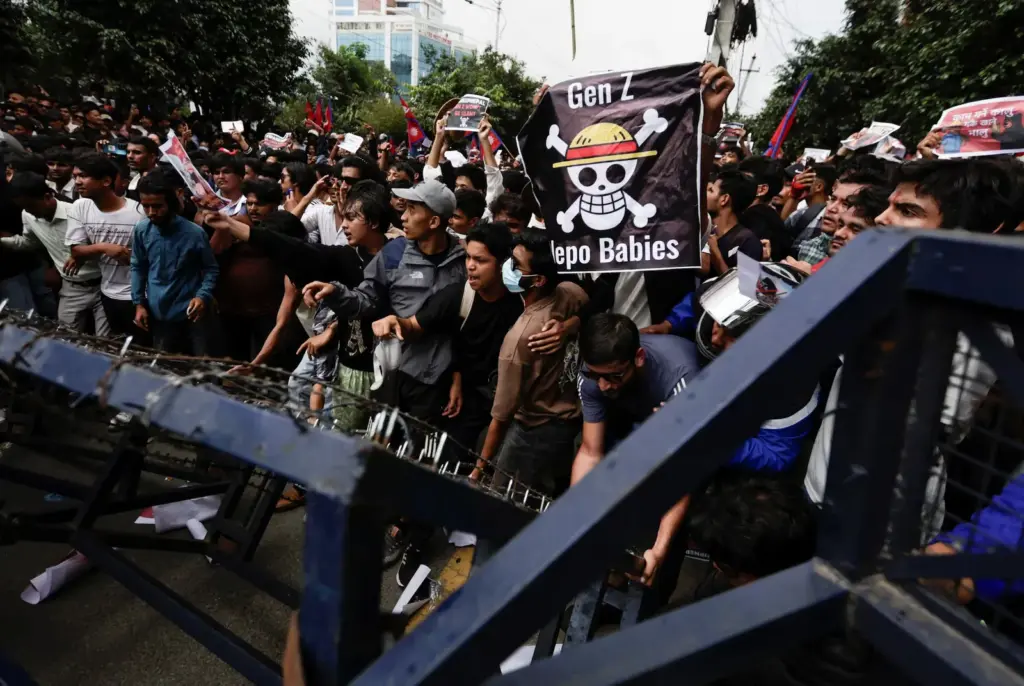
In that sense, Alouch Obado believes Gen Z is achieving results in Africa that go beyond the fall of some rulers or the withdrawal of certain measures, not only because of overcoming certain traditional divisions. “They are transforming politics, even though they do not yet hold power. First, because many African governments today know that a digitally organized generation can mobilize hundreds of thousands of people in a matter of hours. And then, because there is a modification of citizen expectations. This generation is demanding more transparency, institutional efficiency, and public accountability. Every institutional transformation begins when citizens stop accepting as normal what previously seemed inevitable.”
Despite these positive stimuli, there is also concern about symptoms of a short-circuit in engagement after protest outbursts.
“Social media mobilizes a lot, they are a catalyst. The problem is to see if these mobilizations then translate into political parties capable of making the expected changes. If new formations are created or if traditional ones adopt the approaches. That is another matter,” says Eva Borreguero, professor at the Faculty of Political Science at Complutense University of Madrid specializing in South Asia, and author of the recently published essay India. The new global power (Península).
Sometimes a consistent current of change is generated. Borreguero points to the case of Nepal, with the young mayor of Kathmandu, engineer and rapper Balen Shah, one of the protest leaders, who is now prime minister. But in Bangladesh a different trend has been recorded. “What we have seen is that traditional parties have been strengthened while the student party that organized the mobilization has had very few votes,” says Borreguero.
In that case, at least there was a party that tried. But the risk is that, for many, after the outburst of indignation, there is a return to an apolitical life. After the cathartic moment, back to the previous. Many indicators point to Gen Z as one of the loneliest generations compared to previous ones, who forge fewer physical social ties, encapsulated in the digital dimension.
“If you look closely, it is difficult in these protests to see young people all holding a long banner together, with all that implies, preparing it beforehand, carrying it, holding it together,” says Gutiérrez-Rubí. “They tend to go each with their own slogan, with their own sign. And these are protests very oriented to punishment. They go out, fight, but then tend to return to the underground world. They take control of public space, and then return to the catacombs, return, to put it simply, to being cockroaches. An immediate goal is sought, but often social bonds, subsequent political organizations capable of managing are not built. What is at stake is the idea of gradualism and the idea of reform. Both concepts, graduality and reforms, are essential for democratic development, social and economic development,” concludes the consultant.
Many factors converge in pushing in that direction of renunciation. It is reasonable to think that new technologies, while being extraordinary mobilization elements as they quickly spread news of scandals, protest calls, emotional arguments, at the same time soon exert a negative magnetic effect that distracts, isolates, and withdraws from the real world.
At the same time, the global nature of the cause of certain problems can have a demoralizing effect, inducing resignation as it is beyond the capacity for local and even national change.
Robert A. Manning, distinguished researcher at the Stimson Center, has addressed these issues in a text published by the institution of which he is a member. In a telephone conversation, he reflects on some of them.
“We are in an interregnum between the old order and what will follow. In this phase, there are financial trends that are problematic for certain countries. AI sucks all kinds of investments and we are witnessing a flow of capital that goes more towards advanced countries than developing ones. Meanwhile, about twenty African countries are near bankruptcy due to unsustainable debt, and climate change financing is also problematic,” says Manning, who held several positions in the past at the US National Intelligence Council.

To this must be added the abrupt cut of USAID and inflationary escalations that raise the price of basic products.
But there are other trends that directly affect development models. Manning points to the impressive Chinese manufacturing fabric, an almost unbeatable industrial sector, and also to the tariff offensives of the Donald Trump Administration, with the consequent fragmentation of markets, as elements that hinder much of the Global South’s path toward prosperous and stable models.
These are titanic problems before which it is easy to lose motivation. But the protest record of Gen Z in the last two years, with the spectacular falls of government officials, is already a very strong seismic movement in the Global South.
The Ceuta episode is completely different in its characteristics, since a geopolitical calculation is of utmost relevance here and, instead of subjects of a claim, here the young people have been objects and victims of a dark maneuver. But, even affirming those differences and not knowing the truth about the organization of the episode, it contributes to showing that Gen Z’s unrest has enormous destabilizing potential. In their home societies ―the Moroccan regime will undoubtedly be taking note of the shameful meaning, for it, of that desperate and massive stampede― but also beyond, as evidenced by the tremors that still shake Spanish society.
Read more Price hikes and extreme heat: why the numbers of French and Germans vacationing in Spain are falling