Gabriel Rufián flashed his classic mischievous smile from the top of the Congress speakers’ tribune, praised Pedro Sánchez for his stance on the war unleashed by the United States and Israel against Iran, and crowned him with a little mischief:
It must be recognized that he has had vision … and also luck. His luck is legendary.
To the ERC spokesperson’s remark, the president responded with another ironic smile, while slightly shaking his head:
-Mr. Rufián says I have luck… Well, I don’t know… The pandemic, the volcano, the flash floods, the war in Ukraine, the war in Gaza, in Lebanon, in Iran…
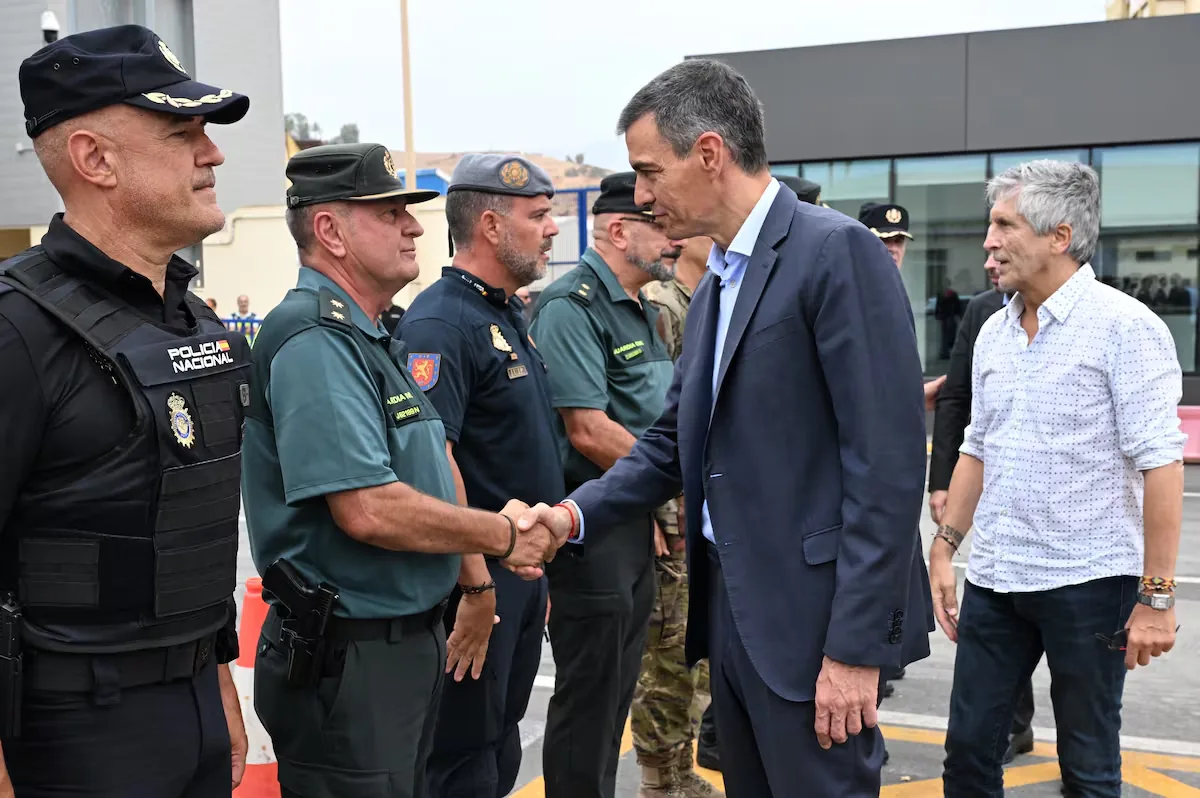
It happened on March 25, and in the litany Sánchez left out the great blackout from almost a year earlier and the Adamuz accident two months before, with a final toll of 46 dead. Forgetting aside, four months after that parliamentary exchange between Sánchez and Rufián, the president could add two more emergencies, in this case linked: the largest forest fire in Spain’s history and the sudden arrival in a few hours of more than 70,000 migrants who crossed the Ceuta border with Morocco as if it were paper thin.
Besides the baraka to which Rufián alluded – or expressed in another way – Sánchez has been accompanied by the legend summarized in the title of that kind of memoir, Manual de Resistencia. It was published in 2019 and recalled the political obstacles the socialist leader had overcome to reach La Moncloa. Simple pinches compared to what he has had to endure since then.
“What will be the next emergency?” they ask in the Government. The latest have come in pairs. No one can attest better than Fernando Grande-Marlaska. The Interior Minister was in Ávila on Thursday, July 30, following the extinction tasks of the mega-fire that has surpassed all known records in Spain, and the next day he had to rush to Ceuta, facing the greatest migration crisis remembered. “Distressed,” describes another member of the Executive who spoke with him that day.
The first coalition government in central power in Spain since the Second Republic debuted at the Council of Ministers on January 14, 2020. Just two months later, on March 14, it was forced to decree the confinement of the population due to a pandemic unlike any the planet had suffered in the last century. Since then, a top-level emergency – one that could be labeled “historic” – has followed every year, with only a truce between 2022 and 2024, a period in which the July 2023 elections were held that allowed Sánchez to defy forecasts and renew his government despite the PP surpassing him in votes.
Before this July that ended amid runaway flames and a human exodus whose images amazed the entire planet, the main milestones had been: eruption of the La Palma volcano (September 19, 2021), Russian invasion of Ukraine (February 24, 2022), Valencia flash flood (October 29, 2024), unprecedented blackout across the territory (April 28, 2025), Adamuz accident (January 18, 2026), and war against Iran (February 28, 2026). That grim inventory could be increased with the terrible wave of fires last year, which already then reached levels of destruction never recorded until this July far exceeded them. And leaving aside other crises of different kinds, perhaps more politically devastating for the Government: judicial investigations and corruption cases that have taken down some of Sánchez’s most trusted men.
Surely this Government and those to come will have to get used to a trend that seems a product of the times and the state of the world. “The improbable is politically increasingly decisive because what was once improbable is now less and less so,” says Daniel Innerarity, Professor of Political Philosophy at the University of the Basque Country and the European Institute of Florence. Traditional politics struggles to face this panorama, Innerarity points out: “We have political systems with few incentives for governments to prepare for improbable things that require effort, attention, and resources, and that do not have electoral gratification. But the Valencia flash flood or now Ceuta show that politicians have realized these were things that happened rarely before and now happen more. And if you are caught unprepared, they can finish you off.”
The political readings of each of these crises have been another battle between those two Spains opposed around the figure of Sánchez. His supporters use the list of events to praise the Government’s response and enlarge the myth of the great resistor. His detractors have recovered it these days for the opposite: attributing them to the alleged incompetence of the Executive and painting the image of a chaotic country or even a “failed state,” a slogan that the most extreme right-wing proclaim at every episode.
During the pandemic, the Government devised an instrument, the ERTEs, which has served as a guide to try to mitigate the effects of subsequent crises and emphasize its motto that this Executive “leaves no one behind.” Right now it has just adapted that pattern to companies and workers whose activity has been affected by the fires in Madrid and Ávila. And the Ministry of Labor is also studying ways to compensate businesses that have had to close for a few days in Ceuta.
“The PP opposition has been to wait for some of these crises to blow up the Government and save it the work of presenting a feasible and attractive alternative,” analyzes Innerarity. But, with polling data in hand, and at least so far, none of these episodes seems to have caused great wear. Unlike when corruption scandals like those of José Luis Ábalos and Santos Cerdán broke out, the 40dB. barometer for EL PAÍS and SER did not show electoral cost for the PSOE after each of those crises. After the Valencia flash flood it even experienced a slight rebound. And despite all the political noise with the pandemic, at the end of 2020 the pollster GAD3 kept Sánchez’s party at the same percentage as in the elections a year earlier.
Belén Barreiro, director of 40dB., emphasizes that PSOE’s losses are concentrated among its centrist voters for other reasons, corruption and mainly concessions to the independence movement. Those leaks are compensated by expanding space to its left, at the expense of weakening its allies. “After the summers, with the fires, there is even greater ecological awareness detected and that favors the left,” she highlights. Another matter is the Ceuta crisis, likely to have greater consequences. Following the regularization process, the polling institute already detected that immigration is a sensitive issue among the working class and “divisive and complex for the left.”