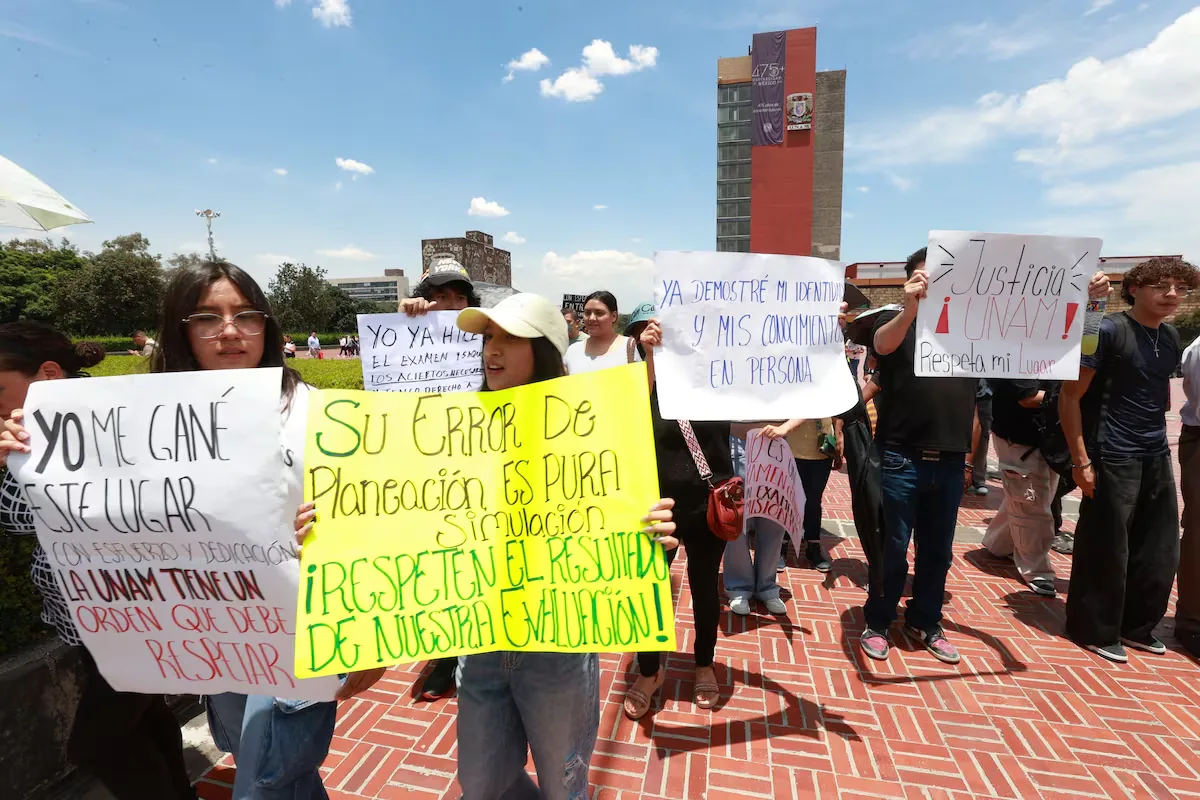
The National Autonomous University of Mexico (UNAM) is going through its lowest moments, with hundreds of questions about its control mechanisms following the fiasco of the latest admission exams. The jump to the online and distance mode, which produced results so excellent that they seemed implausible, has forced a close examination of the process in search of massive cheating. The facets of this unprecedented crisis, however, continue to multiply as days go by, and alongside the discussion about the limits of technology, a much deeper debate about the higher education system in Mexico has emerged. Minister Lenia Batres criticized UNAM’s selective mechanism as neoliberal, and the president, Claudia Sheinbaum, offered to open the doors of the Rosario Castellanos University to those rejected by the study center, an alternative that flooded social networks with mockery but also with questions about the real options for Mexican students. “This episode is relevant for the institution, but even more so because it exposes the problem of educational opportunities throughout the system. It illustrates vocational preferences and space limitations,” summarizes Alejandro Canales, an expert in educational policies at UNAM.
Read more The orchestra of biodiversity that only sounds in the dark
The selection process called into question summoned 158,000 applicants for a total of 22,000 places, meaning only one in seven will manage to access the classrooms of Mexico’s great public university. That fierce competition, besides explaining, at least partially, the incentives to seek external help, illustrates the great concentration of demand in a handful of institutions led by UNAM, followed by the National Polytechnic Institute (IPN) and some state universities. “The issue in Mexico City is not about opportunities, it is about young people’s preferences for certain types of institutions and certain types of careers,” Canales assesses.
“A student who finishes high school has a relatively wide range of options. The problem is that most students are not convinced by many of those options. They do not see them as legitimate options that will guarantee their insertion into the labor market,” argues Emilio Blanco, a specialist from Colmex, in this regard. “This generates a very marked symbolic hierarchy of prestige in favor of UNAM and IPN,” he considers. It is a vicious circle where prestige feeds demand and market expectations and vice versa. The result is that, regardless of whether the imbalance in educational quality is real or exaggerated — it is difficult to know, as there are no evaluation systems to measure the accumulated learning level — it has real effects on labor market insertion possibilities.
That fierce fight for a few options considered attractive by students coexists with a bigger problem within the system: territorial and income inequality, which directly affects access to university classrooms. While in Mexico City the higher education coverage rate during the 2024-2025 cycle was 136.2% (of which 33.8% corresponds to people from other states), in states such as Chiapas, Oaxaca, and Guerrero the rate does not reach 25%. A similar picture occurs when the population is divided according to income. “Of young people in the first decile, that is, those with the most unfavorable conditions, only 4.4% are in higher education,” exemplifies the UNAM professional. That brutal inequality dilutes among the national average, 45.1%: the government wants to raise it to 55% by 2030.
It is in this scenario that initiatives such as the Benito Juárez Universities for Well-being and the National Rosario Castellanos University arise, the latter presented by the Mexican leader as an alternative for those rejected. Both were created in 2019 under the influence of Morena executives: the first, under Andrés Manuel López Obrador’s six-year term, and the second, with Sheinbaum at the helm, first as an institute of higher studies of Mexico City and later nationalized in 2024. Neither has admission exams, although the access methods differ — Rosario Castellanos requires a prior preparation course — and both seek to alleviate access barriers for lower social strata.
Read more Mass trials without guarantees in El Salvador: “Judges are afraid, they are condemning everyone”
The problem, experts point out, is twofold. On one hand, says Emilio Blanco, “in Mexican culture, where entering university is still seen as a passage marked by merit, the lax entry mechanisms like those of Rosario Castellanos make many people not see it as a real university.” “A process of stigmatization and discrediting is produced that ends up defeating the initial objective name of inclusion,” the expert elaborates, concluding: “What you end up achieving is an exclusive inclusion or a precarious inclusion because your degree has no social recognition.”
The other problem, adds Canales, is that neither sufficient nor appropriate investment has been made to turn them into truly attractive and quality options for students seeking alternatives to the elite circuit. “The improvisation of the Benito Juárez Universities was something that the majority of young people noticed. That is, facilities that were not properly suitable for learning, a faculty that was not the right one…,” the expert lists.
All this results in a lack of resources aimed at building alternatives that have the same quality as existing options, the only real way to correct the demand imbalance and offer equally competitive training to enter the labor market. After the 2019 constitutional reform and the creation of the new General Higher Education Law, the creation of a specific federal fund was contemplated to ensure free education at the highest level. However, to date, no funds have been allocated to it. “How can free education or the expansion of educational opportunities be guaranteed if there are no resources?” asks Canales. “What recent governments have done, not only those of the Fourth Transformation, is to try to expand opportunities in the cheapest way possible: investing little, giving small degrees, micro-certification of knowledge… That kind of strategy is doomed to fail,” Blanco adds: “It only strengthens the hierarchical slope that places UNAM as the only or one of the few desirable destinations.”
Sheinbaum faced a first controversy upon arriving at the National Palace for reducing the budget allocated to the National University in her first budgets. She later rectified and attributed it to a “mistake” by the Treasury, which had not considered the inflation increase. It was corrected in the final project. Nevertheless, the National Association of Universities and Higher Education Institutions (ANUIES) estimates the accumulated budget deficit since 2018 at 50.4 billion pesos, of which 42.6 billion correspond only to state public universities. The pressure to increase the number of places at UNAM and other centers has not stopped growing each year, but resources do not increase at the speed required to expand educational offerings. Much less to generate real alternatives that alleviate the desperation to enter the classrooms of the great reference university in the region.
Read more Castro-style capitalism: Havana promises economic changes without giving up political control