









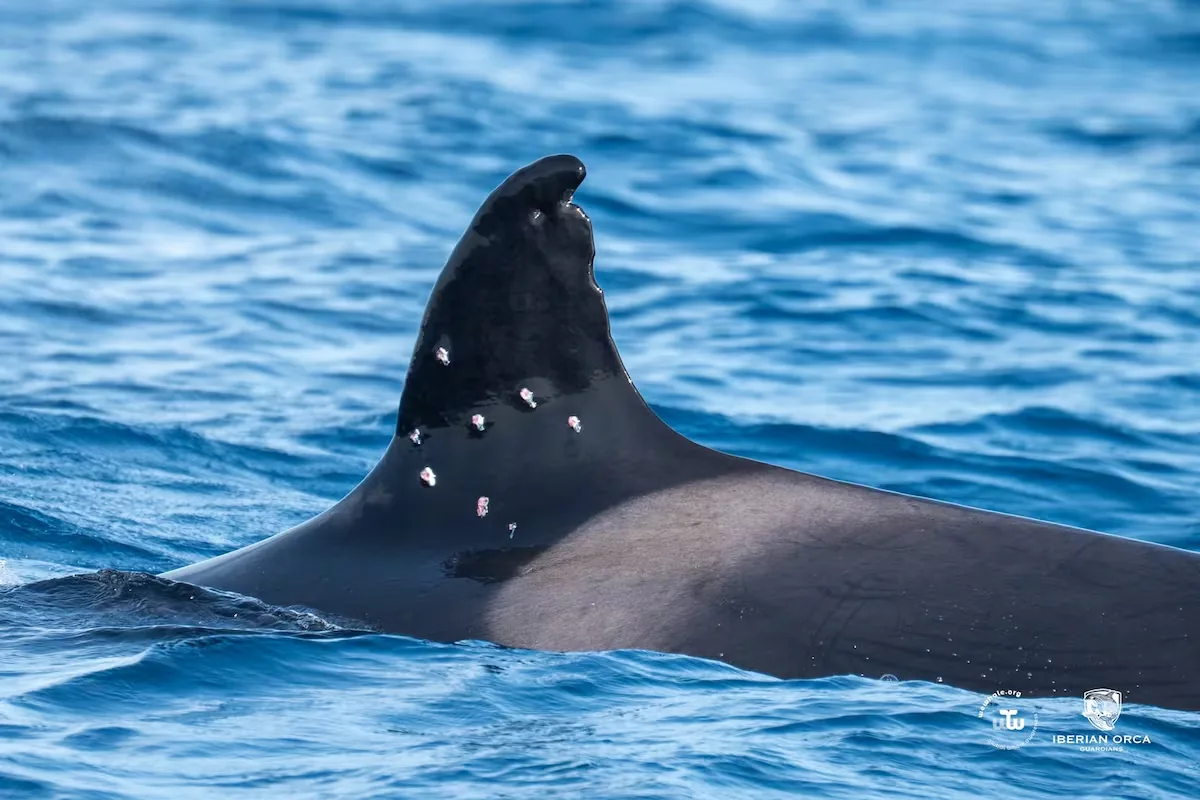
On August 10, a team of scientists spotted Toñi, the oldest matriarch of the Iberian orca population and guardian of decades of wisdom that she passes on to her group, swimming with two companions through the Strait of Gibraltar. She had not been seen there for two years. It was at that moment that they detected marks on her dorsal fin consistent with shotgun pellet shots. Once analyzed, there is no doubt that she received 10 impacts and that some remain lodged in her fin, posing a risk of infection. Toñi, also known as The Grandmother, is not just any orca: she is 60 years old and is also the great-grandmother, grandmother, and mother of the ones known as gladis, the individuals involved since May 2022 in controversial encounters with boats.
She herself joined those contacts with boats a year ago, without scientists knowing why she started doing so at that time. The gladis approach sailboats and interact with the hulls and rudders, which has caused some boats to end up sinking. Experts consider this behavior more of a game than an intention to cause harm, but it has generated a conflict between humans and orcas that adds to the existing tensions with fishermen over competition for tuna. The Iberian orca population is classified as critically endangered by the International Union for Conservation of Nature (IUCN) and as vulnerable in the Spanish Catalogue of Threatened Species.
The Ministry for the Ecological Transition became aware of what happened this Tuesday and has opened an investigation to clarify the facts. They have contacted Portuguese authorities, as initial information suggests the shots may have occurred in their territory, although this has not yet been confirmed, sources from the department indicate.
“She has always had a strong immune system and has been very well, so we trust she can get through this despite her age,” explains Ignacio Peinó González, the researcher who discovered Toñi’s injuries while sailing on a Turmares boat, a company that, in addition to whale watching, develops scientific programs. Toñi travels with two other orcas, Pingu and Scarlet.
When they detected them, they had just arrived from Galicia after traveling along the Portuguese coast, where they had been spotted in Faro. At that time, Toñi showed no wounds, so researchers consider the possibility that the shots were fired somewhere between Faro and the Strait of Gibraltar. What surprised Peinó and his team is that she was not traveling with her entire group of 18 individuals. In total, the Iberian orca population, which is declining, numbers about 32 individuals, according to the latest count.
Read more Nina Lykke: “Children in Norway are in charge in a crazy way. Authority is very much denigrated”
Janek Andre, president of the association We Whale/Iberian Orca Guardians, has been monitoring Toñi since he received information about her injuries. He was with her and two companions for two to three hours this Tuesday and Wednesday. “They were hunting and swimming and she seemed to be quite well,” explains Andre. They know Toñi perfectly, who even approaches their boat when she sees them, “because they are able to recognize her.” “She touches the hull, but always gently, and that is a sign that she is in good physical condition,” Andre describes. But this time, she only did it once and did not stay with them for long, which may imply she is not in such good condition.
“These are not anonymous animals, we know them individually, also their families. Seeing The Grandmother like this is devastating,” laments Andre. Behind the shootings may be the conflict between orcas and boats, but “regardless of the opinion each person may have, shooting at these animals can never be an acceptable response,” the researcher states. “These orcas need protection, not retaliation,” he says.
Another problem is that the shots could provoke a reaction in the orca. “She carries in her mind decades of information, including when they die because of humans or are shot… And the rest will imitate what she does,” explains Alberto López, marine biologist and spokesperson for the group Orca Atlántica, another organization that monitors these intelligent marine mammals. The orcas come south following the bluefin tuna, which enter by the thousands in spring and summer to spawn in the Mediterranean. Their strategy is to corner them in Conil, Barbate, Zahara, and Tarifa, where the tunas also fill the fishermen’s almadrabas.
The latest data provided by the Ministry for the Ecological Transition indicate that the number of interactions between boats and orcas generally decreased during the summer of 2025. On the coasts of Cantabria and Galicia, there was a slight increase, while in Cádiz and the Strait of Gibraltar they continue to decline. The ministry recommends avoiding navigation in high-risk areas and planning routes as close to the coast as possible whenever feasible.