“I have two minutes left on the phone. I don’t know if I will be alive tomorrow. If we talk again, I will be very grateful.” These are the last words of a conversation with EL PAÍS with Dawit Tesfay, a pseudonym for security reasons of a 24-year-old Ethiopian who has been waiting in the Saudi Jamis Mushait prison for eight months for the execution of his sentence: death by beheading. Tesfay was sentenced for a drug-related crime after a trial that lasted only a few minutes and in which he had no lawyer or interpreter, according to his account and documented by human rights organizations in dozens of similar cases.
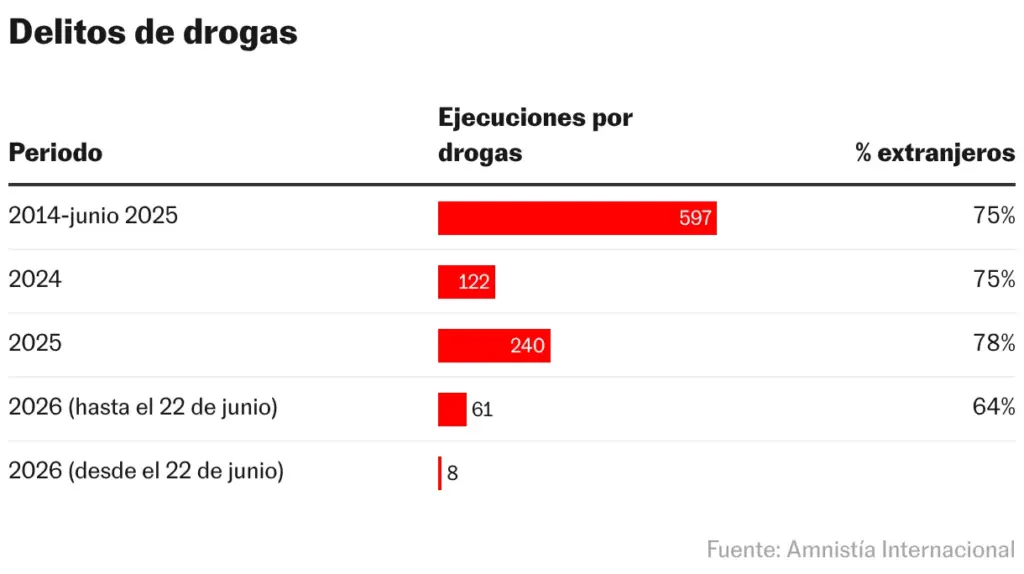
Amnesty International recorded 96 executions in Saudi Arabia between January 1 and June 22, 2026, of which 61 were for drug-related crimes. Of the latter, 39 were foreigners. Meanwhile, between January and August 2026, Human Rights Watch (HRW) documented that at least 20 Ethiopian citizens had been executed for drug trafficking (the last three on July 31) and that at least another 76 of this nationality are at imminent risk of execution. Every time Tesfay says goodbye, neither he nor anyone else knows if communication will be reestablished. The young man also does not know when his turn to die will come. He says there were 68 death row inmates in his ward when he arrived. Now there are 55 left.
The Gulf monarchy defends in official statements announcing executions that these occur after sentences have passed through various stages of judicial review, but organizations such as HRW and AI have found a pattern of serious irregularities: extremely brief procedures, sometimes reduced to a single hearing, absence of lawyers and interpreters, and in some cases, documents in Arabic that the accused could not understand.
The families of these young men, human rights organizations, and the regional authorities of Tigray, the northern Ethiopian region from which most come, demand their release and repatriation home, or at least that they be given a fair trial. Haish Subagadis, former director of the Tigray Youth Affairs Office, lists the requests made by families and regional authorities: “We request legal advice, fair trials, respect for procedural guarantees, and respect for migrants’ rights. In addition, we ask for repatriation, freedom, and case reviews, one by one,” he demands by phone.
The words of Adam Berhe, another condemned man with whom EL PAÍS has communicated over the past two weeks, reveal the terror experienced behind the walls of Jamis Mushait. “They come suddenly, call someone out, and take them away to be beheaded,” says this 34-year-old Tigrinya man, also under a fictitious name. He has been waiting for his execution for more than three years. “Just last week, eight people were beheaded in this prison. We live in terror,” he says.
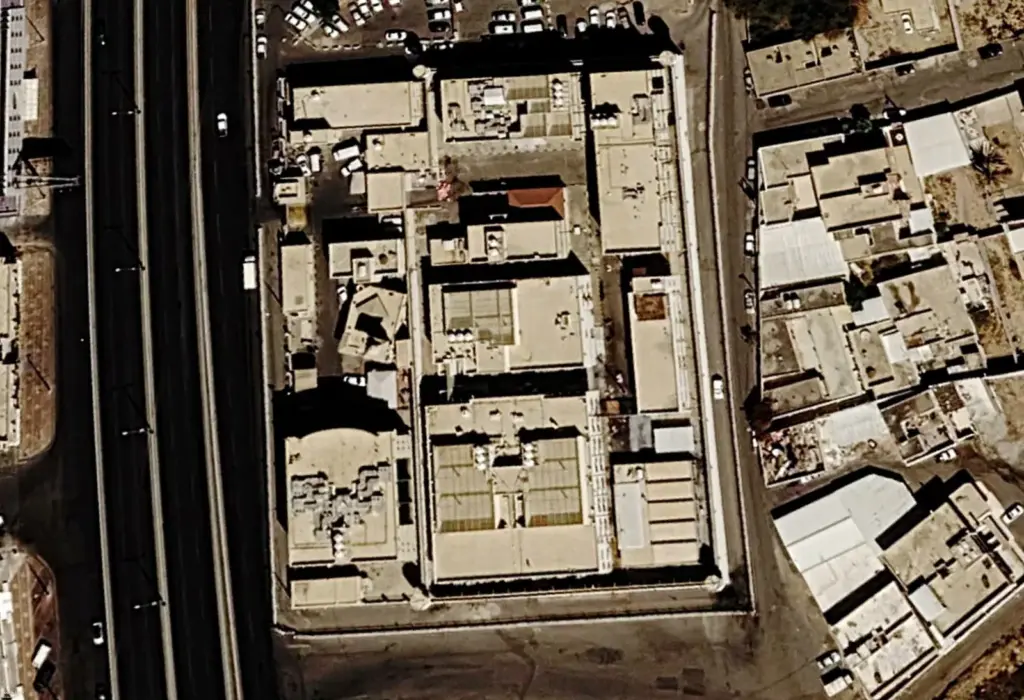
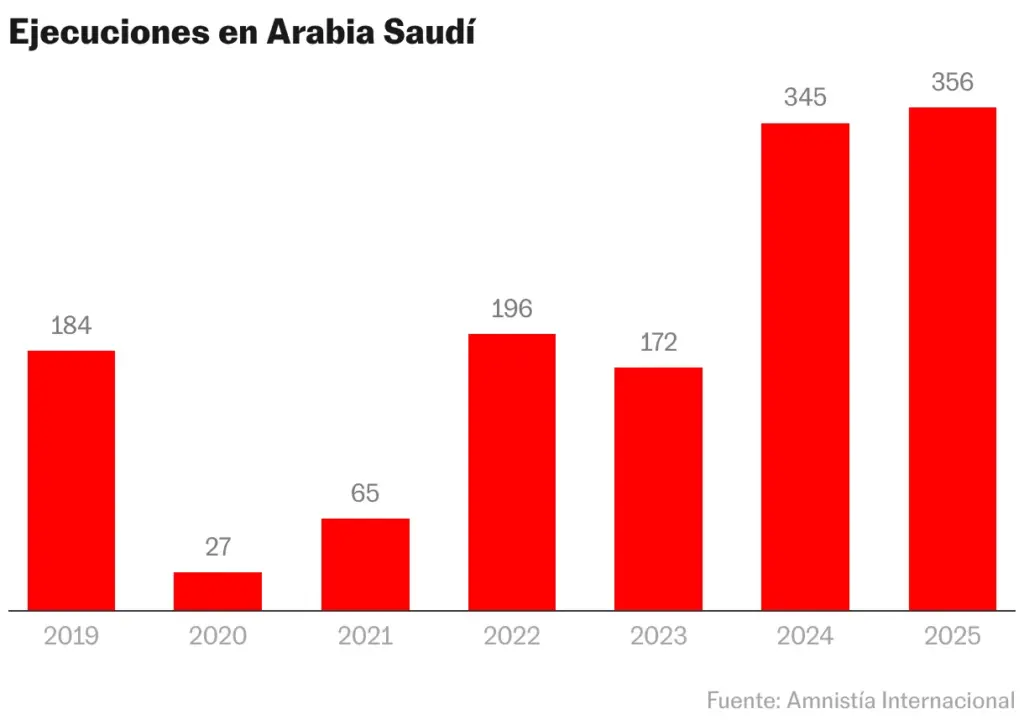
Both Berhe and Tesfay were convicted of transporting hashish, a substance prohibited in Saudi Arabia. The kingdom maintained a de facto suspension of executions for drug-related crimes for years but resumed them in 2022 following a policy of toughening against this type of criminal offense, and has gained momentum in applying the death penalty to reach record numbers. In 2025, it executed at least 356 people, according to HRW, the highest number recorded in a single year since modern records exist. The previous year had already broken the record, with 345.
Berhe admits he knew what he was transporting and accepted to do so because he was in an extreme need situation, but insists he did not think the consequences would be so severe. “And now I am sentenced to death,” he laments. Tesfay, on the other hand, claims he did not know what he was carrying. He had arrived in the Gulf monarchy a few months earlier and was working caring for livestock when he was offered another job where he could earn more money. “Only when we were arrested did I hear the word hashish for the first time. I didn’t know that was what I was carrying,” he repeats several times.
They come suddenly, call someone out, and take them away to be beheaded”Adam Berhe, sentenced to death in Saudi Arabia
Saudi Arabia’s anti-drug policy has had a particularly strong effect among Ethiopians. Dana Ahmed, Amnesty International researcher for the Middle East, points out in a phone interview that in the last two years her organization has observed a drastic increase in the number of these nationals sentenced to death and executed. “Our records show that at least 36 Ethiopians were executed in 2025. This year, 20; all for smuggling hashish.”
However, Ahmed dismisses the existence of specific persecution against them. “In general, foreign citizens are disproportionately affected by Saudi Arabia’s use of the death penalty, especially for drug-related crimes.” According to her data, between 2015 and 2025 almost 70% of executions for drug trafficking involved foreigners.
No lawyer or trial
Joey Shea, senior researcher at HRW in Saudi Arabia, says judicial processes are riddled with irregularities. Very little information about them is released, but documented cases show a recurring pattern. “Some defendants appeared in only three court hearings lasting just a few minutes, held even by videoconference. None had legal assistance,” she explains.
Many of the accused also did not speak Arabic. According to Shea, numerous prisoners were forced to sign documents written in a language they did not understand and that could contain confessions. Later, to file appeals, they had to write letters in Arabic and deliver them to prison officials themselves to be forwarded to judges, with no way to verify if they were actually sent.
Tesfay confirms that his trial lasted “two minutes” and that he had no interpreter or legal representative. “At that time, I didn’t even know what a lawyer was,” he says. Also that he was forced to sign documents written in Arabic that he did not understand. “There is no scenario in which it can be said that these men received a fair trial,” Shea concludes.
Amnesty International has collected reports of torture and other ill-treatment. “In some cases, people told the judge they had been tortured and coerced into confessing; however, this was not taken into account in the final sentence and they were sentenced to death anyway,” Ahmed denounces. She adds that, even under Saudi law, a confession obtained under coercion should be withdrawn.
Read more The keys to the trial for the murder of Tupac Shakur, 30 years after his death
Escaping the war
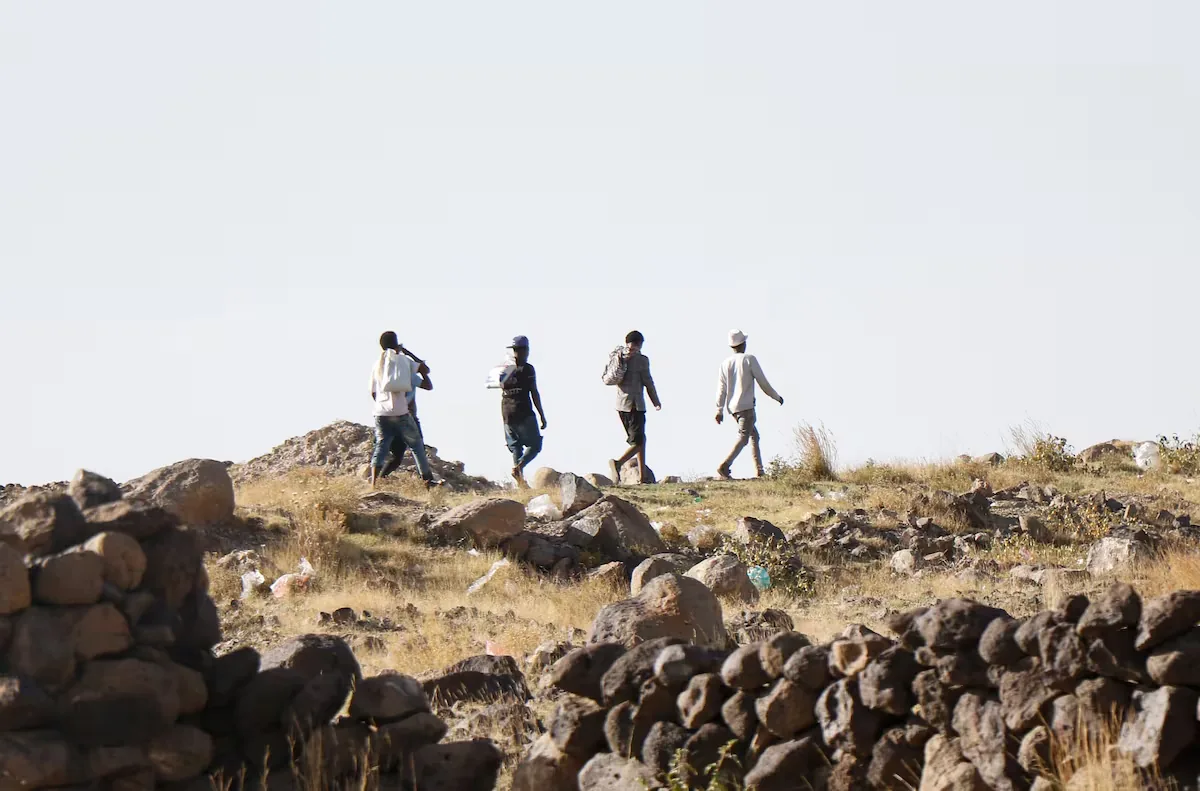
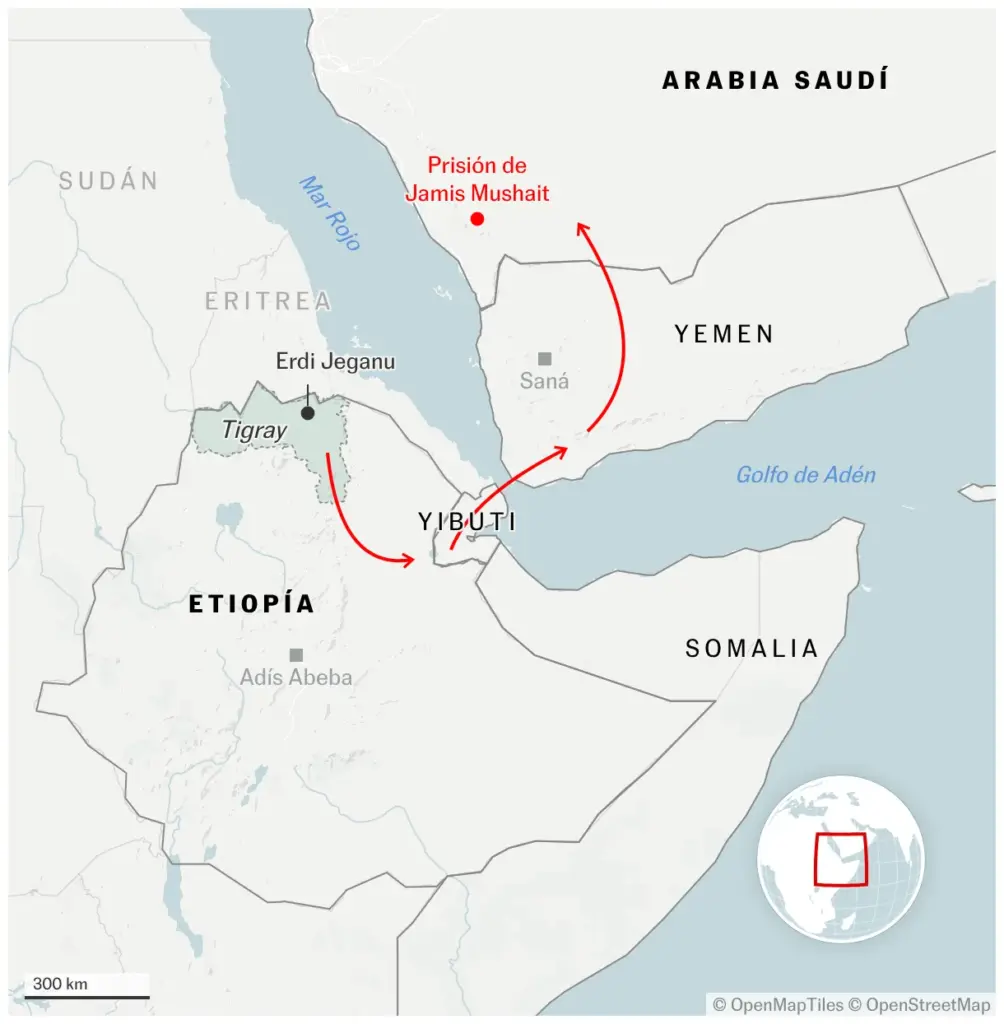
Like Berhe and Tesfay, many of the men filling the death row corridor of Jamis Mushait come from Tigray, in northern Ethiopia, and arrived in Saudi Arabia through Yemen after crossing the Gulf of Aden. They were fleeing the war fought by Ethiopian federal government forces supported by Eritrean troops and the Tigray People’s Liberation Front (TPLF) separatists between 2020 and 2022.
According to Shea, they are especially vulnerable men who, after months or years trapped in Yemen without work, food, or resources, end up being recruited by drug trafficking networks. “They are offered a job without explaining what it involves. They are simply told: ‘Take this package to this place and I will pay you,’ or ‘I will give you food,’” she explains.
In one documented case, Shea adds, the migrant did not even know he had crossed the Saudi border: he thought he was still walking inside Yemen. “They are used to do the most dangerous part of the job, but they are not informed of the role they play within those broader networks,” the researcher denounces. “In several cases, people were deceived, extorted, and forced to transport materials to Saudi Arabia without knowing what they were carrying,” Ahmed agrees.
Berhe did know what he was transporting but decided to take the risk because, he says, he was desperate in Yemen. Married and father of a child, when he left he was the main breadwinner of his family. “The war destroyed my life. I could no longer support my home,” he says in his brief contacts. The brutality of the conflict from which Berhe fled was evident in episodes such as that of Erdi Jeganu, Berhe’s village. There, an Associated Press investigation reported in 2022 the death of 63 civilians at the hands of Eritrean soldiers, including 10 children.
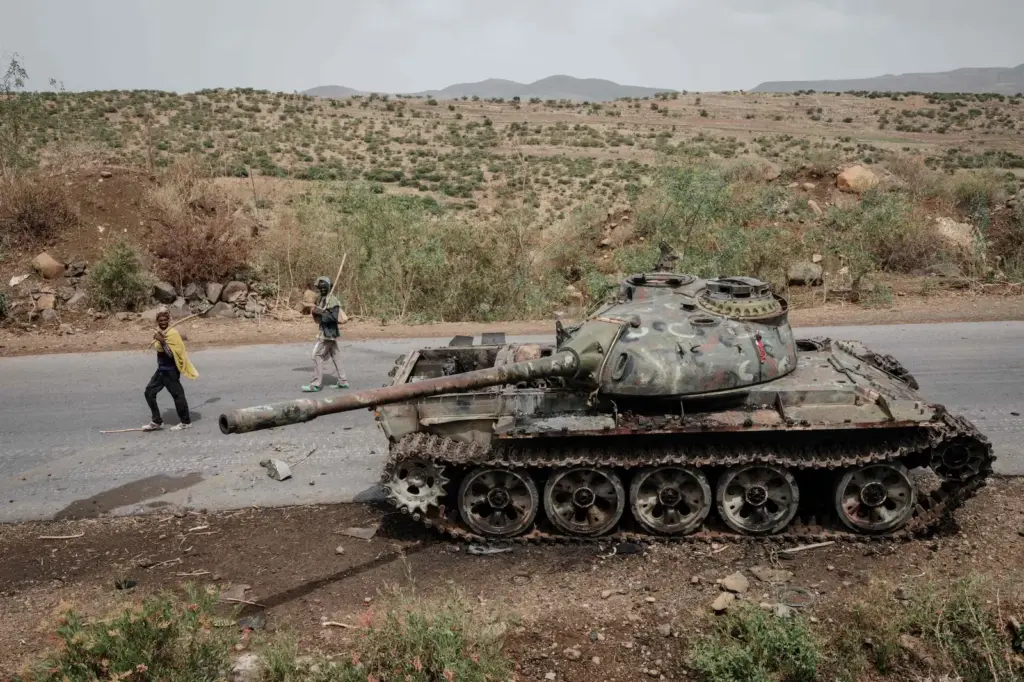
Berhe’s intention was to reach Saudi Arabia, but he encountered enormous difficulties. “When people reached the border, they were shot and killed,” he recalls. In fact, HRW already documented in 2023 that Saudi border guards had killed hundreds of Ethiopians trying to cross from Yemen and pointed out that these attacks could constitute crimes against humanity if they responded to a state policy.
Tesfay also left Tigray in 2020, during the first months of the war. “I was in 11th grade when I left school. We had no one to help us, so I was forced to emigrate.” His father, Tesfay Gebreyesus, waits for him at home. He is 60 years old, has had an illness for two decades that prevents him from working as before, and says his son left to do what he could no longer do: support his family, although he tried to convince him to stay. “If my son has committed any crime, I am willing to compensate the Saudi government, even if I have to beg on the street,” he tells EL PAÍS by phone from his home in the Gulomikada district, in eastern Tigray.
A plea to save life
The concern has also reached international bodies. The African Commission on Human and Peoples’ Rights, an organ of the African Union, expressed on July 22 its “deep concern” and requested that sentences be reviewed, pointing out complaints about lack of lawyers, interpreters, and consular assistance. Meanwhile, the United Nations Working Group on Arbitrary Detention has considered that death sentences and executions for drug-related crimes in Saudi Arabia are incompatible with international law and has urged the kingdom to reinstate the moratorium for these types of crimes.
The Ethiopian Ministry of Foreign Affairs says it maintains permanent contacts with Saudi Arabia and highlights in a press release on July 13 that 1,971 Ethiopian citizens have benefited from royal pardons and that the government has begun facilitating their repatriation. This newspaper contacted the Ethiopian Ministry of Foreign Affairs to obtain their version, without receiving a response. Nor did it receive one from the Saudi Ministry of Foreign Affairs or the Saudi Human Rights Commission (HRC).
Organizations such as HRW, AI, or Reprieve, among others, have called on Ethiopian and Saudi authorities to guarantee the fundamental rights of citizens sentenced to death. They also call on the international community to speak out against executions and on Saudi Arabia for an immediate moratorium on death sentences for drug-related crimes.
HRW also laments the lack of international pressure. “I think it is a very difficult story to place on the agenda,” Shea says. “Saudi Arabia is a strategic partner for many Western countries and this does not seem like a politically comfortable moment to criticize its human rights record.”
In Jamis Mushait prison, waiting has become a routine. “We pray; I spend most of the time sleeping. There is not much to do here,” Tesfay says. “The life we lead here is extremely hard. We live in very difficult conditions. The only message I want to convey is that you don’t lose hope for our lives,” the young man pleads. It is a plea both men repeat in every contact with this newspaper. “Life here is very hard, but I have hope thanks to those outside trying to help us,” insists the twenty-something.
Berhe’s words are for governments and citizens, whom he asks to pressure the Saudi regime to save his life and that of his prison mates. “We are very scared. Please try to help us as soon as possible. If there is any way to find a solution, whether through a government or private institution, file a complaint on our behalf. Help us, rescue us, and get us out of this suffering and this very difficult situation,” he pleaded on August 9, in one of his last communications.